THE DEAD LANDS
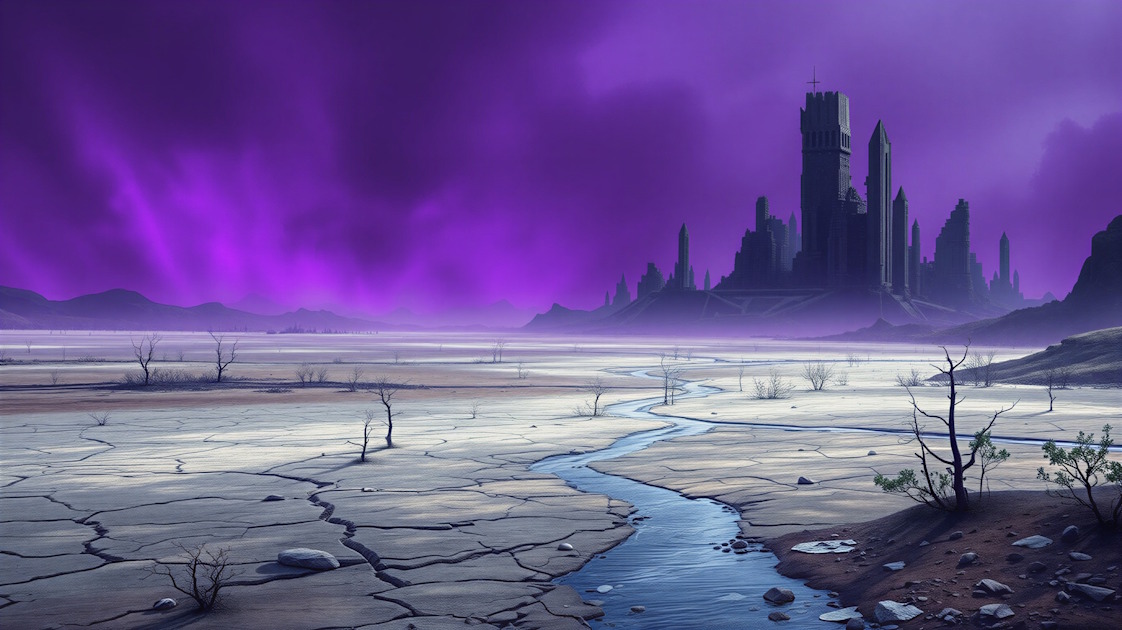
In the north of Panthora, beyond the watchful walls of Aethros, lies a region that serves as a permanent reminder of the consequences of knowledge pursued without restraint. The Dead Lands—a blighted expanse of ash-colored earth, poisoned waterways, and air that carries a persistent metallic chill having nothing to do with temperature—is the scar left by the Great Cleansing that ended the Necromancer Wars nearly two and a half centuries ago. What was once fertile Panthoran countryside, dotted with prosperous settlements and anchored by the thriving city of Navarre, is now a dead zone where necromantic corruption has seeped so deeply into the soil that no living plant takes root, no natural creature draws breath, and the boundary between life and death has been permanently disturbed in ways that even Panthora’s most advanced scholars do not fully understand.
The origins of the Dead Lands are inseparable from Navarre's story and the scholars who destroyed it. During the late Age of Change, the brilliant eslar researchers Ill Sigith and Jux Jeorn—founders of what became known as the Masadi Order—turned their study of necromantic magic from theoretical inquiry into monstrous application. Operating from Navarre, Panthora’s second great city, they raised an army of intelligent, organized undead from the city’s own population and launched a war of conquest against the rest of the eslar kingdom. The Necromancer Wars raged for eight years before the Council of Minds sanctioned a desperate response: the Great Cleansing, a massive magical working that consumed nearly half of Isia’s accumulated magical artifacts and required the willing sacrifice of the master alchemist Keth’mor to power its terrible energies. The spell shattered the Masadi Order’s undead armies and broke the necromancers’ hold on the region. But it could not undo the corruption that had taken root in the land itself. The earth that had absorbed years of concentrated necromantic energy was transformed at a fundamental level, and the territory that had sustained Navarre and its surrounding settlements became the Dead Lands—a wound in the living world that has refused to heal.
The Dead Lands extend outward from the ruins of Navarre in every direction, covering an area whose precise boundaries shift with a slow, creeping persistence that the Guardians of the Dead at Aethros monitor with ceaseless vigilance. The border between corrupted and habitable territory is not a clean line but a gradual transition—a twilight zone where living plants grow stunted and sickly, their leaves darkened and their roots unable to draw proper nourishment from soil subtly poisoned by proximity to the corruption beyond. Further in, even these diminished signs of life disappear entirely. The ground takes on the color and texture of ash, dry and granular, regardless of rainfall. Water that touches the soil runs off in dark rivulets, carrying trace contamination downstream, requiring constant monitoring by Aethros to ensure that tainted runoff does not reach Panthora’s living waterways. The air within the Dead Lands carries a quality that visitors describe not as a smell exactly but as a sensation—a faint pressure against the senses, a wrongness that the body registers before the mind can articulate what is amiss.
At the heart of the Dead Lands stands Navarre itself—the City of the Dead, as the eslar call it. The crystal towers of Panthora’s once-magnificent second city still rise above the blighted plain, but their surfaces have darkened to a bruised purple-black that no longer catches light but seems instead to absorb it. Undead remnants walk the streets, their movements possessing a terrible deliberateness—figures going about routines whose purposes may have been forgotten centuries ago or that serve designs no living mind can fathom. Whether these remnants possess any true intelligence or are merely echoes of the living people they once were remains a question that Aethros’s scholars have debated for generations. One thing is certain: Navarre has never been entirely still. Something persists within its walls, sustained by the same necromantic energies that poisoned the ground beneath it.
The Dead Lands are not ruled in any conventional sense, though not for want of trying. Since the destruction of the Masadi Order, the corrupted zone has periodically attracted necromancers, liches, and other undead entities who seek to exploit the region’s saturated necromantic energies to establish their own dominion. The concentration of death magic within the Dead Lands acts as a beacon to those who practice the dark arts, offering a ready-made source of power that would take decades to cultivate elsewhere. These would-be lords have ranged from minor practitioners drawn by ambition beyond their capability to genuinely dangerous figures whose command of necromantic forces posed credible threats to the wider region. Each has followed a similar pattern: arrival, consolidation of whatever undead forces the Dead Lands provide, an initial period of expansion or fortification, and then destruction at the hands of the Guardians of the Dead operating from Aethros.
The Guardians take their mandate to prevent any necromantic power from re-establishing itself within the Dead Lands with absolute seriousness. Their deep reconnaissance teams maintain constant surveillance of the corrupted zone, monitoring for the telltale signs of organized activity that indicate a new claimant has arrived—unusual concentrations of undead movement, the construction or repair of fortifications within Navarre, disruptions to the ambient necromantic energy patterns that suggest someone is actively drawing upon the region’s power. When such signs are detected, Aethros responds with the decisive force needed to eliminate the threat before it can grow beyond the capacity of a single operation to contain it. The Guardian’s record in this regard is unblemished. No necromantic force has been permitted to consolidate within the Dead Lands long enough to threaten Panthora since the original Masadi Order was broken, and the Council of Minds intends to maintain that record indefinitely.
The Dead Lands' environment presents challenges that go beyond the military. Prolonged exposure to the region’s necromantic saturation affects living beings in ways that are cumulative and insidious. The condition the eslar call shadow-weariness—a spiritual exhaustion born of proximity to concentrated death magic—can afflict even the hardiest Guardians after extended operations within the corrupted zone, requiring withdrawal to Aethros or Isia for recovery that may take weeks or months. Physical effects are more immediate: unprotected living tissue begins to degrade after hours of exposure, and even the phase-resistant materials developed by Aethros’s researchers provide protection measured in days, not indefinitely. These limitations constrain the depth and duration of Guardian operations within the Dead Lands, creating windows of reduced surveillance that the more cunning would-be rulers have occasionally attempted to exploit.
The phenomena observed within the Dead Lands have fueled both scholarly research and popular dread across Panthoran society. Sounds carry strangely in the corrupted zone—fragments of what might be speech or music drifting from Navarre’s direction at unpredictable intervals, distorted beyond recognition but clearly originating from some deliberate source. Lights appear in the city’s towers at irregular hours, flickering in patterns that some researchers believe may constitute a form of communication, though with whom or what remains unknown. Most disturbing are the occasional sightings of organized groups moving with clear purpose along the old trade roads leading out from Navarre—columns of figures that march toward the border before halting at some invisible boundary and returning to the city. These movements do not correlate with the arrivals of new would-be rulers and appear to follow a rhythm of their own, suggesting that whatever animates the Dead Lands operates according to patterns independent of any external necromantic influence.
The ecological impact of the Dead Lands extends beyond the corrupted zone’s own borders. The gradual outward creep of corruption, measured in inches per year yet relentless over centuries, has forced periodic adjustments to Aethros’s defensive perimeter and consumed territory that was once productive Panthoran farmland. The tainted waterways draining from the corrupted zone require purification systems that demand continuous resources and expertise to maintain. Wildlife in the borderlands behaves abnormally—animals avoid the transition zone with an instinctive revulsion, while insects and other invertebrates that venture too close undergo visible changes that the scholars of Aethros document with clinical precision and deepening unease. The cumulative effect is of a wound that does not bleed but slowly spreads, its edges advancing with a patience that mirrors the immortal nature of the forces that created it.
For the eslar, the Dead Lands represent something more than a geographic hazard. They are a moral landmark—the physical embodiment of a lesson that Panthoran culture has inscribed into its deepest foundations. Every eslar child learns the story of how the brilliance of Ill Sigith and Jux Jeorn, unchecked by the ethical constraints that the rest of their society has since made inviolable, produced a catastrophe whose consequences persist centuries after the individuals responsible were destroyed. The Principles of Ethical Inquiry that govern all Panthoran research were written in direct response to the Dead Lands’ creation. The Demonstration of Merit that every citizen must complete includes an extensive examination of the moral failures that allowed the Masadi Order to flourish. The annual memorial ceremonies during the Festival of Knowledge include the recitation of every known name of Navarre’s original population—a ritual that takes hours and serves as a reminder that the undead figures still moving through the city’s darkened streets were once living people with families, futures, and the right to a death that was not stolen from them.
The question of what to do about the Dead Lands has occupied the Council of Minds for centuries without producing a satisfactory answer. A second Great Cleansing is theoretically possible but would require resources modern Panthora can ill afford, and it might not succeed against corruption that has had centuries to entrench itself in the very bedrock. Reclamation through gradual purification has been attempted on small scales at the border but has proven effective only in the shallowest zones of corruption, with the deeper taint resisting every technique that eslar science and sorcery have devised. Containment—the current strategy, maintained through the permanent garrison at Aethros and the vigilance of the Guardians of the Dead—has preserved Panthora from immediate harm but does nothing to reverse the damage already done. For now, the eslar watch, study, and remember, trusting that the knowledge they accumulate will eventually reveal a solution that their predecessors could not find. The Dead Lands wait with a patience that does not belong to the living, keeping whatever secrets they have gathered in the long centuries since the last true light of Navarre went dark.