The Green Mother
Origins & Nature
The Green Mother is the second of the three great presences revered by the dryads of Uhl, standing beneath the Great Oak and above Sylvana the Eternal in the ancient hierarchy of forces that governs fey existence. She is the source of Earth Power—the fundamental energy that flows through soil and stone and root, binding the living world to the ground from which it springs. Where the Great Oak is consciousness, and Sylvana is the turning of the cycle, the Green Mother is the raw creative force that makes both possible. Without her, there would be no Earth Power. Without Earth Power, there would be no dryads, no fey magic, and no life in the deep places of the world where sunlight never reaches.
Like the Great Oak and Sylvana, the Green Mother predates the Old Gods by an immeasurable span. She belongs to an order of existence that was already ancient when the first divine being stirred into awareness. The Old Gods shaped civilizations, waged wars, and eventually fell. The Green Mother was here before any of that, and she remains long after. She exists outside the framework of mortal theology entirely—not as a rival to the gods but as something so fundamentally different that comparison loses meaning. The gods concerned themselves with the affairs of mortals. The Green Mother concerns herself with the earth, and the earth concerns itself with everything.
She is real, as Sylvana is real, but her reality operates on a different scale. Sylvana walks among the trees as a radiant dryad, intimate and present, close enough to touch. The Green Mother is vaster and more remote—an elemental force that achieved consciousness, or perhaps a consciousness so ancient that it became indistinguishable from the element it inhabits. She has a will, a personality, and mannerisms that are distinctly her own, but these qualities exist at such magnitude that mortal minds can perceive only fragments of them, the way a person standing in a valley perceives only the nearest slope of a mountain range that stretches beyond the horizon.
Earth Power
Earth Power is the lifeblood of fey magic and the essential ingredient in the creation of every dryad who has ever emerged from an oak. It flows through the world like an underground river, invisible to most but felt by those who know how to listen—a slow, immense current of energy that nourishes the roots of the oldest trees, sustains the enchantments that protect dryad groves, and infuses certain places with a vitality that defies ordinary explanation. It is the reason that some forests feel more alive than others, the reason that certain soils produce growth of impossible vigor, the reason that the deepest and most ancient woods carry an atmosphere of power that even the least sensitive traveler can detect.
The Green Mother is the source of this power. Not its custodian, not its greatest practitioner, but its origin. Earth Power flows from her the way light flows from a flame—not by conscious effort or deliberate distribution but as a natural consequence of her existence. She does not choose where Earth Power goes any more than a spring chooses which channel the water follows. The power radiates from her and saturates the world, pooling in some places more than others depending on the character of the soil, the depth of the roots, and the age of the forest above. Where Earth Power concentrates, the conditions for fey life become possible. Where it is thin or absent, the forest is merely a forest—beautiful, perhaps, but lacking the deeper pulse that transforms ordinary woodland into something enchanted.
Dryads interact with Earth Power constantly, drawing on it to sustain their magic, to heal, to communicate through the root networks that connect their trees, and to maintain the protective wards that guard their groves. But their relationship with Earth Power is like a fish's relationship with the ocean—they swim in it, they breathe it, they depend on it utterly, yet they can no more comprehend its full extent than a single fish can comprehend the sea. The deepest wells of Earth Power remain beyond dryad reach, tapped only by the Green Mother herself for purposes that no mortal or fey mind has ever fully grasped.
The corruption of Earth Power represents one of the gravest threats to dryad existence. When soil is poisoned, when dark magic taints the ground, when the residue of divine conflict seeps into the earth, the flow of Earth Power is disrupted or twisted. Groves that lose their connection to clean Earth Power wither and die, their dryads weakening alongside their trees as the sustaining current is cut off. The Fall of the Old Gods caused widespread disruption of this kind, and some regions of Uhl have never recovered—places where Earth Power was so thoroughly corrupted that the ground itself became hostile to fey life. Dryads regard these blighted places with a grief that borders on physical pain, for they represent wounds inflicted not merely on the land but on the Green Mother herself.
The Act of Creation
The birth of a dryad is the most sacred mystery in fey existence—the moment when Earth Power combines with the life of a maturing oak to produce something entirely new. The process is natural rather than deliberate, unfolding according to conditions that even the most learned dryad elders understand only in broad terms. Not every oak produces a dryad. Not every forest with sufficient Earth Power gives rise to fey life. The combination of factors that must converge—the age and health of the tree, the richness of Earth Power in the surrounding soil, the depth and reach of the root system, and other unknown variables—makes each emergence a genuine miracle, unpredictable and unrepeatable.
The Green Mother does not choose which oaks will bear dryads. She does not bend over each maturing tree and breathe life into it, selecting some for the gift and passing over others. The process flows from her existence as naturally as growth flows from fertile soil—an inevitable consequence of what she is rather than a conscious act of will. And yet the dryads do not experience this impersonality as coldness or indifference. To them, the fact that their creation arises from the Green Mother's very nature rather than from a deliberate decision makes it more profound, not less. They were not chosen. They were inevitable—the natural result of Earth Power doing what Earth Power does when the conditions are right.
This understanding shapes the way dryads regard their own existence. They do not see themselves as created beings in the way a sculptor's statue is, shaped by an external intelligence according to a preconceived design. They are emergences—expressions of a force that is always present, always flowing, always seeking the conditions under which new life can appear. The Green Mother made them possible, but she did not make them. The distinction is subtle but essential to dryad self-understanding, and it colors their relationship with the Green Mother in ways that sharply separate it from the worship mortal races direct toward their gods.
When a new dryad emerges from her oak, the grove celebrates not only the arrival of a new sister but the continued vitality of the Earth Power that sustains them all. Each emergence is proof that the Green Mother endures, that her power still flows, and that the deep connection between earth and tree remains unbroken. In an age when so much has been lost—when the Old Gods have fallen, when corruption threatens the ancient forests, when mortal civilization presses ever closer to the wild places—every new dryad is a quiet declaration that the oldest force in the world has not yet been extinguished.
Worship & Invocation
If dryad reverence for Sylvana can be described as honor through awareness, their relationship with the Green Mother is something deeper and more instinctive—closer to the way a living body relates to its own heartbeat. The Green Mother is not worshipped so much as she is acknowledged, constantly and without ceremony, in every act that draws upon Earth Power. Every time a dryad blends with her oak, every time she communicates through the root network, every time she shapes an enchanted acorn or strengthens a grove's protective wards, she is engaging with the Green Mother's essence. Formal invocation would be redundant. The connection is already there, woven into the fabric of dryad existence.
That said, certain moments call for conscious recognition of what is otherwise felt but unspoken. The Spring Emergence ceremonies, which celebrate the renewal of life and the arrival of new dryads, carry the strongest association with the Green Mother. During these gatherings, the eldest dryad of the grove speaks words of gratitude directed not upward, as mortal prayers are directed, but downward—toward the earth, toward the roots, toward the source. These acknowledgments are simple and unadorned, free of the elaborate ritual that characterizes mortal religion. A typical invocation might be nothing more than a statement of recognition: that the earth gives, that the power flows, that the mother endures.
Dryads who feel the Green Mother's presence most acutely tend to be those with the deepest bond to their own trees—elder dryads who have spent centuries blended with their oaks, their consciousness so intertwined with the root network that they can feel the pulse of Earth Power moving through the ground the way a sailor feels the tide. For these dryads, the Green Mother is not a distant abstraction but an immediate reality, a presence felt in the marrow of their trees and the deep soil beneath them. They do not claim to understand her. But they know she is there, the way one knows the ground is solid without needing to test it.
The Green Mother's name is also spoken during times of crisis, particularly when a grove faces corruption or blight that threatens its connection to the earth. In these moments, the invocation is less an act of worship than an act of orientation—a reminder to the grove of what they are fighting to preserve. The Green Mother does not answer prayers. She does not intervene on behalf of those who call her name. But the act of speaking it aloud reconnects the dryads to the fundamental truth of their existence: that they are children of the earth, sustained by a power older than gods, and that as long as that power endures, hope is never entirely lost.
Legends & Parables
The Shaping of Valdremor
The oldest surviving dryad legend about the Green Mother concerns the forest called Valdremor, a name that translates roughly as "the first deep place." According to the story, Valdremor existed before any other forest in the world, growing in an age when the earth was young and bare and the only living things were stone and water and the raw, undirected energy that slept beneath the surface. The Green Mother, stirring into awareness for the first time, looked upon the barren world and felt within herself an impulse that had no precedent—not a thought, not a plan, but something more elemental. A need.
She pressed herself into the earth. Not downward, as a seed is pressed into soil, but outward—spreading through the rock and clay and sand until her essence saturated the ground for leagues in every direction. Where her power gathered, the stone softened. Where it pooled, the soil grew rich and dark. And from that soil, fed by the first true flow of Earth Power, the first trees rose—not oaks, not yet, but vast and nameless things whose roots reached so deep they touched the bones of the world. Valdremor grew in a single age of the earth, its canopy so dense that the ground beneath it never saw direct sunlight, its root systems so extensive that they drank from underground rivers no mortal has ever found.
Whether Valdremor still exists is unknown. Some dryad traditions hold that it endures somewhere beyond the edges of all known maps, hidden behind mountains or beneath the sea, a primeval forest where Earth Power flows in concentrations that would overwhelm any ordinary fey who wandered beneath its canopy. Others believe Valdremor was destroyed long ago, perhaps during the cataclysm that ended the Age of the Old Gods, its ancient trees reduced to stone and memory. The dryads who tell the story do not insist on either interpretation. What matters is not whether Valdremor survives but what its creation reveals: that the Green Mother's first act was not one of will or design but of need—an irresistible compulsion to fill the empty world with life.
The Roots Beneath the War
During the conflicts that preceded the Fall of the Old Gods, when divine armies clashed across the surface of the world, and mortal civilizations burned in the crossfire, a grove of dryads in a forest whose name has been lost found themselves caught between two advancing forces. The earth shook with the impact of powers no mortal creature could withstand. Trees that had stood for a thousand years were uprooted in an instant. Fire rained from the sky, and the soil itself split open as the fury of warring gods tore the landscape apart.
The dryads of this grove could not flee—bound to their oaks, they had no choice but to endure. They retreated into their trees, blending as deeply as they could, and there, in the shared consciousness of the root network, they felt something they had never felt before. Deep beneath the carnage, far below the reach of divine fire and the trembling of shattered stone, the earth was calm. Not merely undisturbed but actively calm, as though something immense and patient held the deep ground steady while the surface world destroyed itself. The roots of their oaks, reaching down past the violence, touched that stillness and drew from it a strength that no amount of surface destruction could diminish.
The grove survived. When the wars ended, and the gods lay broken, the dryads emerged from their trees to find the world around them reduced to ash and ruin. But their oaks still stood, scorched and battered but alive, their roots anchored in soil that the Green Mother had held firm through the worst catastrophe the world had ever known. The dryads understood then that the Green Mother's power did not operate on the surface, where mortal and divine affairs played out their transient dramas. Her domain was deeper than any war could reach, older than any god could remember, and more enduring than any force that had ever tried to break it. The story is told as a reminder that no matter how terrible the destruction above, the earth beneath remains, and the Green Mother within it.
The Silent Grove
There is a tale told quietly among elder dryads, usually during the Winter Contemplation when the groves are at their most reflective, about the only recorded instance of the Green Mother manifesting in physical form. The story places the event deep in the Age of Resilience, during the decades of chaos that followed the Fall, when entire forests were dying from corruption that seeped up through poisoned groundwater and tainted soil.
A grove whose dryads had watched their sisters perish one by one over the course of years found itself reduced to three—an elder named Korindel and two younger dryads who had emerged only decades before the Fall. The corruption was closing in, and Korindel knew that their oaks would be next. She had exhausted every technique she knew. The wards were failing. The soil was turning black beneath their roots. She gathered the two young dryads and told them to prepare for their final blending.
That night, the forest went silent. Not the ordinary silence of a winter evening but a total absence of sound—no wind, no rustling, no distant call of owl or fox. Even the creaking of their own oaks ceased. Into that silence came a presence so vast that all three dryads dropped to the ground, not in worship but because their legs would no longer hold them. The earth beneath their hands was warm, almost hot, and it pulsed with a rhythm that Korindel recognized as Earth Power—but concentrated to a degree she had never imagined possible.
She looked up and saw the Green Mother.
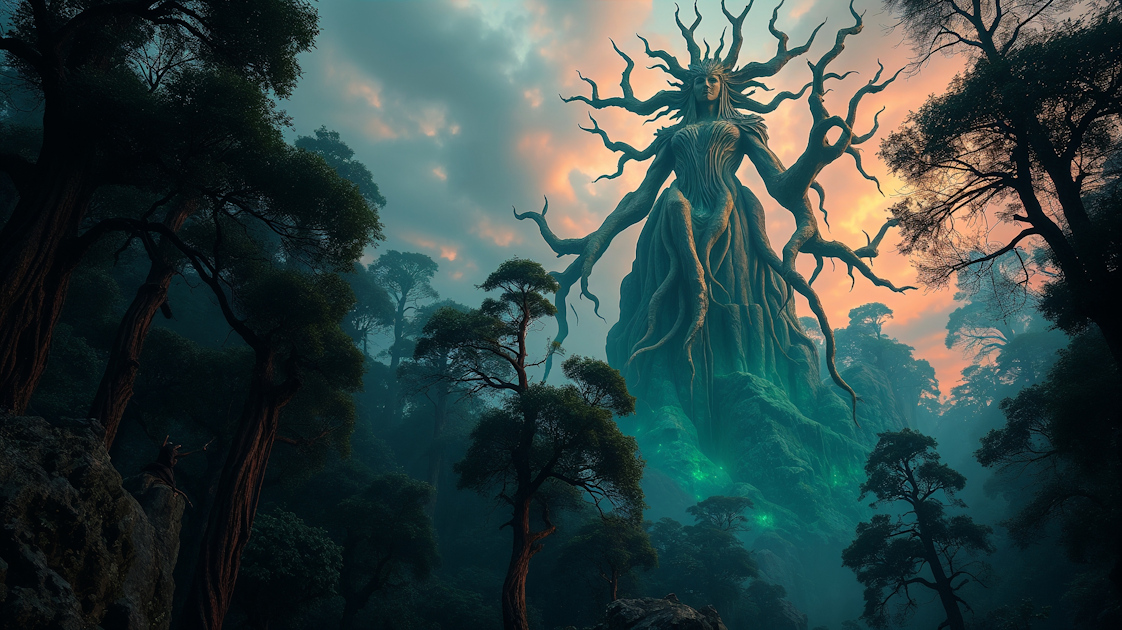
What Korindel saw is described differently depending on which grove tells the story, but certain details remain consistent across all versions. The Green Mother was enormous—taller than the oldest oaks, her form composed of living earth and tangled roots and flowering vines that bloomed and withered in ceaseless succession across her body. She was distinctly female in shape, but her features were not fixed. They shifted like the surface of a deep pool disturbed by something moving far below—recognizable one moment, elemental the next. Her eyes, when they could be seen, held a depth that made the dryads feel as though they were looking not at a face but into the earth itself, down through layers of soil and stone and time to something that had no bottom.
The Green Mother did not speak. She did not gesture or acknowledge the three dryads in any way they could interpret. She stood in the center of their dying grove for what might have been minutes or hours—time lost its meaning in her presence—and then she pressed one hand flat against the corrupted ground. The earth heaved. The dryads felt the corruption that had been killing their grove drawn downward, pulled away from the roots of their oaks and dragged deep into the earth where, presumably, it could do no further harm. Clean Earth Power surged upward to replace it, flooding the soil with a vitality so intense that the dryads' oaks put forth new growth in the dead of winter.
When the dryads regained the strength to lift their heads, the Green Mother was gone. The forest sounds had returned. The soil beneath their hands was cool and dark and rich. Their grove would survive. Korindel lived for four more centuries and never spoke of the experience without pausing first, as though the memory required a moment of preparation before it could be approached. When pressed to describe what the Green Mother had looked like, she would say only that she had seen the earth stand up, and that it had been the most beautiful and terrifying thing she would ever witness.
The Unknowable Mother
The Green Mother occupies a space in dryad understanding that is fundamentally different from Sylvana's. Where Sylvana can be encountered, spoken to, and to some degree comprehended, the Green Mother exists at a scale that resists comprehension entirely. She is not hidden. She is not deliberately obscure. She is simply too vast, too elemental, and too deeply woven into the fabric of the world for any single mind—mortal or fey—to contain more than a sliver of what she is. Knowing the Green Mother is like knowing the ocean by standing on its shore. The experience is real, the glimpse is genuine, but the fullness of the thing remains forever beyond reach.
Dryads accept this with a grace that other races might find difficult. They do not construct elaborate mythologies to explain the Green Mother's nature, nor do they argue over competing interpretations of her will. They understand that she has a personality, a character, a way of being that is distinctly her own—the story of the Silent Grove reveals purpose and compassion in her actions, even if the dryads who witnessed them could not fully parse the intelligence behind them. But they also understand that perceiving fragments of her character is not the same as understanding her, and they do not mistake the one for the other.
This acceptance shapes dryad philosophy in ways that extend far beyond their relationship with the Green Mother. The willingness to live with mystery, to draw meaning from what is felt rather than what is known, runs through every aspect of dryad culture—their approach to magic, their tolerance of ambiguity in prophecy and omen, their refusal to reduce the natural world to a set of principles that can be fully cataloged and controlled. The Green Mother did not teach them this. She did not need to. Her very existence—immense, essential, and ultimately beyond the reach of understanding—is the lesson.
What the dryads know is this: the earth gives life. The power flows. Beneath every forest, beneath every grove, beneath the roots of every oak to which a dryad is bound, the Green Mother endures. She was here before the gods, before the kingdoms, before the first tree broke through the surface of a barren world and reached toward the sun. She will be here after everything built upon her has crumbled and returned to soil. She is the ground beneath all things, and she is enough.