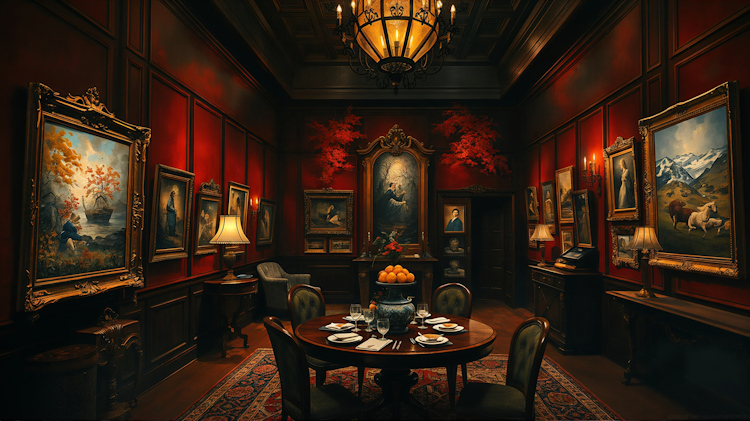
The Red Tea Room is one of those places that most people in Alchester have never heard of, which is precisely how its patrons prefer it. Tucked away on a quiet street, the establishment operates with the serene confidence of a venue that has never needed to court attention because the right people have always known where to find it. By day, it serves as a tearoom — a place of unhurried conversation, fine blends, and the kind of genteel silence that allows a person to hear themselves think, a luxury in a city that rarely stops talking. By evening, its character shifts. The tables are cleared, the lighting softened, and the Red Tea Room becomes something rarer: a gallery where Alchester's artists display their work for audiences small enough to be called intimate and discerning enough to be called exclusive.
The interior favors shadowed ambiance over brightness, its rooms lit by sources that create warmth without exposure — the kind of lighting that flatters artwork and forgives the viewer. Paintings line the walls during exhibits, their frames catching what glow the room provides while the spaces between them recede into soft darkness. The décor is restrained. Nothing competes with whatever is on display. Waiters circulate with trays of brandy snifters, moving between guests with the practiced invisibility of staff who understand that their role is to be present without being noticed. The guest lists for evening events are curated, and the woman who manages the door has been known to exercise her judgment with a firmness that money alone cannot always overcome — though, as with most things in Alchester, a sufficiently handsome bribe from a sufficiently well-dressed gentleman has been known to open doors that the guest list would otherwise keep closed.
The Red Tea Room has earned its reputation as a venue for artists whose work merits serious attention. The gatherings it hosts are not the crowded spectacles of public galleries but small, carefully composed evenings where a painter might show a dozen canvases to an audience of twenty — collectors, patrons, fellow artists, and the occasional matron who attends because being seen at such events confirms a social standing she considers essential to maintain. Conversations here are conducted in measured tones, and opinions about the work are offered with the kind of calibrated precision that reveals as much about the speaker as about the art. It is a place where reputations are quietly built, where the right word from the right patron can transform an unknown artist's career, and where the simple act of being invited says something about your place in Alchester's cultural hierarchy.
The tearoom's daytime character is no less considered, if more relaxed. Regular patrons occupy familiar chairs with the settled ease of people who have been coming here long enough to claim them by habit rather than reservation. The tea is excellent — sourced through connections the proprietor does not discuss — and the pastries are supplied by a baker whose name is shared only with those who politely ask and are deemed worthy of the answer. Conversation drifts between tables at a volume that respects the room's atmosphere, and the staff refills cups with a timing that suggests an almost supernatural awareness of when a guest's attention has shifted from their companion to their empty cup.
What makes the Red Tea Room remarkable is not its exclusivity, its tea, or even the quality of the art displayed within its walls, but the experience it cultivates. Something about the space — its lighting, its proportions, the way sound settles within its rooms — creates an atmosphere where beauty is not merely observed but felt. Patrons have described leaving an evening exhibit with the lingering sense that the world outside looks slightly different from what it did when they entered, as if the art had adjusted something behind their eyes. Whether this effect owes itself to the skill of the artists who show here, the particular qualities of the room itself, or something less easily explained is a question the Red Tea Room's regulars have debated over tea and brandy for years without reaching consensus. Most have stopped trying. The experience, they have concluded, is its own answer.
The Red Tea Room asks little of its visitors beyond an appreciation for quiet and an openness to seeing familiar things in unfamiliar ways. It is not the grandest venue in Alchester, nor the most famous, nor the most influential. It is simply a place where art and tea are served with equal care, where the lighting is always kind, and where the door opens for those who belong — and occasionally, for those who arrive with enough charm and coin to convince the woman at the entrance that they might.