The Silver Gentlemen's Club occupies a columned building on Ashmore Street with the quiet confidence of an institution that has never needed to explain itself. No sign advertises its presence. No window displays invite passersby to look inside. The entrance is polished stone and heavy oak, attended by staff who recognize members before they reach the door and assess strangers with a courtesy so practiced it takes a moment to realize you've been evaluated, categorized, and, if found wanting, dismissed — all before the first pleasantry leaves their lips. Membership is not purchased. It is earned, cultivated over years of proving oneself worthy of the company kept within. Men have offered fortunes for a place at these tables. Most have been declined.
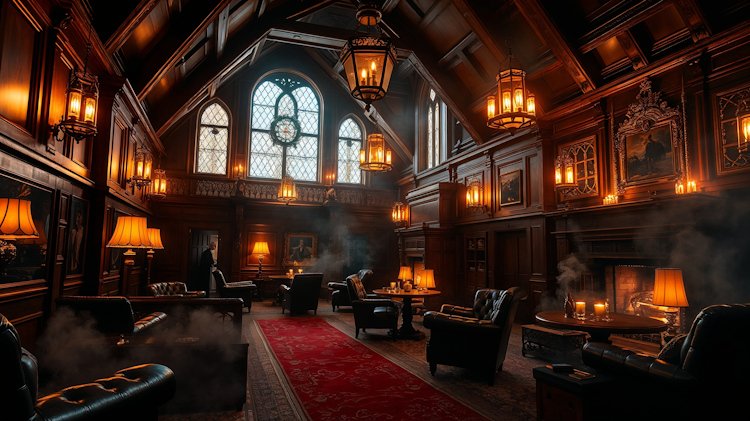
Inside, the club unfolds as a series of rooms, each a carefully curated stage for a different variety of influence. The foyer gives way to the card room, where men hunch over hands of crowns and kings while fortunes change ownership beneath a haze of cigar smoke with all the drama of a battlefield and none of the noise. Beyond lies the dining room, where silver clinks against porcelain and the luncheon crowd conducts the quieter business of alliance-building over courses that arrive with the precision of a military operation. The main lounge occupies the club's heart — a vaulted room of dark wood paneling and deep leather chairs arranged in clusters that encourage the kind of private conversation no one outside the circle will ever hear. Tall windows overlook the street, and near the fireplace, where the afternoon light pools in amber warmth, the men who matter most in Alchester gather to shape the city's fortunes over glasses of Seacean red.
The smoking lounge fills the eastern wing, its heavy velvet drapes filtering daylight into a perpetual twilight where cigars glow like fireflies, and the air hangs thick with the mingled scents of expensive tobacco and quiet ambition. Small mahogany tables anchor leather chairs into intimate arrangements, and a grand piano stands in the corner, played on occasion by hired musicians whose talent is exceeded only by their discretion. It is here, in the soft collision of smoke and whispered confidence, that the club's true commerce takes place — not the trading of goods or the signing of contracts, but the exchange of information, the forging of alliances, and the careful, bloodless destruction of rivals who never see the blow coming.
The staff is as much a part of the club's architecture as the wood paneling. Morris, the thin steward who has manned the entrance for longer than most members can remember, greets each arrival with a practiced nod and a drink preference recalled without asking. Servers appear at elbows with glasses on silver trays, anticipating needs before they are expressed. The kitchen produces meals that satisfy without drawing attention to themselves, and the wine cellar stocks vintages that would make a connoisseur weep — though weeping, like all displays of excessive emotion, is discouraged within these walls. The staff sees everything, hears everything, and repeats nothing. Their silence is not bought. It is bred — the product of years of service in an environment where a careless word can end a career, a reputation, or, on occasion, a life.
The men who hold membership in the Silver Gentlemen's Club represent the upper strata of Alchester's commercial and political elite. Merchants whose trade networks span the Four Fiefdoms share leather chairs with landholders whose properties stretch across multiple principalities. Banking partners whose signatures move capital by the tens of thousands sit within arm's reach of airship magnates whose fleets connect distant cities. Lords whose committee seats grant them influence over policy rub shoulders with self-made men whose fortunes were built through methods that polite conversation renders into terms like "aggressive acquisition" and "creative enterprise." Old money mingles with new ambition, and both understand the unspoken compact that governs everything within these walls: what happens at the club stays at the club, and the smile across the table may belong to the man who is, at this very moment, engineering your downfall.
The Silver Gentlemen's Club makes no pretense of democracy or public service. It exists for its members, by its members, and the decisions made within its rooms ripple outward through Alchester's markets, guilds, and governing institutions with a force that no elected body can match. Trade routes open and close based on conversations held over afternoon brandy. Reputations are built and dismantled between the first course and dessert. And somewhere in the lounge, a man whose smile is his most dangerous weapon raises a glass of exceptional wine and steers the conversation toward a subject that will, by evening's end, give him precisely the advantage he came here to acquire. The club asks only that its members conduct their affairs with discretion, maintain the appearance of civility, and settle their accounts — financial and otherwise — without inconveniencing the staff. Beyond that, gentlemen may do as gentlemen please. The walls have heard worse, and the walls do not talk.