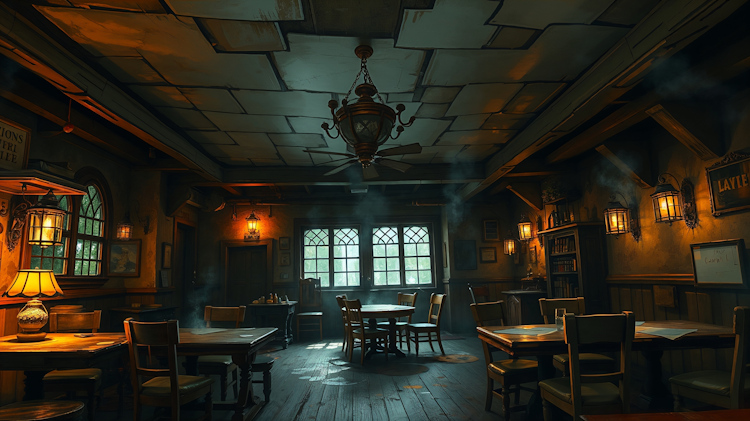
The Singing Sword has been pouring drinks in Shantytown for longer than anyone can remember, which in a town where most people try to forget as much as possible says something. The tavern occupies the ground floor of a sagging two-story building on the main street, its open door leaking conversation and lamplight into the darkness outside like a wound that won't close. The structure leans slightly to one side, as if it grew tired of standing straight decades ago and decided to settle into a more comfortable position. Nobody has bothered to correct the tilt, and at this point, regulars would probably find the place unsettling if it were level.
The proprietor is a man named Haddon Grubb, a barrel-chested former soldier who lost his sword arm in a border skirmish nobody remembers and replaced his military career with the only other profession that rewards a loud voice and a willingness to deal with difficult people. Haddon pours drinks with his remaining hand with such practiced ease that newcomers sometimes don't notice the empty sleeve pinned to his shoulder until their second or third visit. He compensates for the missing arm with a knee he has perfected for launching overserved patrons through the front door and onto the cobblestones outside — a maneuver he performs with such regularity that the regulars have stopped looking up when it happens. Haddon talks constantly. To his customers, to his mugs, to the walls, and, on slow nights, to the mounted sword above the bar that gives the tavern its name. The blade hasn't sung in living memory, if it ever did, but Haddon insists it hummed once during a storm some years back, and he has never let the story die. Nobody believes him. Nobody tells him so.
The tavern's interior is exactly what a person would expect from the only drinking establishment in a town that can barely afford one. Mismatched tables and chairs crowd a floor whose boards have been worn smooth by generations of boots. The ceiling hangs low enough that tall men duck by instinct, and the beams are dark with decades of smoke from the fireplace that provides the room's only reliable heat. The air smells of cheap ale, woodsmoke, and the damp earthiness that permeates everything in Shantytown, a scent so ingrained in the walls that no amount of scrubbing — not that anyone has tried — could remove it. Candles and a handful of oil lamps provide light that flatters no one and illuminates just enough to find your drink without spilling it. The ale is watery. The food, when available, is whatever Haddon managed to acquire that day and cooked in the only manner he knows, which is badly. Nobody comes to the Singing Sword for the cuisine.
What the Sword offers instead is warmth and noise — two commodities in short supply in a town where the nights are cold and the silence between them carries the weight of too many unanswered prayers. On a good evening, the tavern fills with the clink of mugs, the stomp of boots on old wood, and the kind of laughter that sounds more like defiance than joy. On quieter nights, when the merriment turns subdued and even Haddon runs out of things to say to his sword, the Singing Sword becomes something closer to a vigil — a room full of people who have nowhere else to go, drinking because stopping means thinking, and thinking in Shantytown leads nowhere good.
The tavern serves as the town's only reliable gathering point, which means it functions as message board, gossip exchange, hiring hall, and confessional all at once. Strangers who pass through Shantytown inevitably end up at the Sword, because there is simply nowhere else, and the regulars have learned to read newcomers with the quiet efficiency of people whose survival depends on knowing the difference between a harmless traveler and something worse. Haddon watches everyone who walks through his door with an attentiveness that belies his rambling conversation, and the staff — a handful of locals who work for drink as much as coin — keep their eyes open and their mouths shut when it matters. Information passes through the Singing Sword the way water passes through a sieve: everything comes in, most of it drains out, but traces remain for those who know where to look.
Below the tavern, accessed by a short flight of moss-slick stairs off the alley that runs along one side of the building, a handful of makeshift apartments occupy the basement level. These are not rooms that Haddon advertises or even acknowledges unless pressed. They are spaces that exist because people need them — dark, cramped, cold, heated only by whatever meager coals the occupants can manage, with cracked windows that admit more draft than light. The sounds of the tavern above filter through the floorboards: boots stomping, mugs clinking, Haddon's voice carrying on about the sword or the weather or whatever has caught his attention. For those who shelter below, the noise is either a comfort or a torment, depending on how far the distance feels between their lives and the simple act of sitting in a warm room with a drink in hand and nothing to fear.
The Singing Sword will never be celebrated. No traveler has ever recommended it, no ballad has been written about its ale, and the sword above the bar has almost certainly never sung. But the tavern endures in a town where endurance is the only virtue that matters, its door open and its lamps lit against another long night at the edge of the world. Haddon Grubb will pour your drink, tell you a story you didn't ask for, and throw you out when you've had enough. In Shantytown, that passes for hospitality, and it is more than most have any right to expect.