Thessara the Tide Bringer, the Drowning Hand
Introduction
Thessara the Tide Bringer is the sitheri goddess of water, flood, and the cold indifference of the swamp that sustains and kills with equal disregard. She is the current that carries and the current that pulls under. She is the rain that fills the channels and the rain that drowns the nests. She is every drop of water in the Grimmere, and she does not care whether that water flows into a sitheri’s mouth or into a sitheri’s lungs. The distinction between drinking and drowning is a problem for the drinker, not the water. Thessara has never, in the entire span of sitheri mythology, demonstrated the slightest interest in which outcome the water produces.
Among the four gods of the sitheri Swamp Pantheon—equals whose relationships shift with the same restless inconstancy as the tides Thessara governs—she occupies the position of the environment itself. Sythraxis created the sitheri. Morghen taught them to hunt. Vexthul claims them when they die. But Thessara controls the medium through which all of this occurs, the water without which the Grimmere would be dry ground and the sitheri would be reptiles baking on stone instead of predators gliding through channels that exist at her pleasure. Her power is not dramatic in the way that a kill or a birth is dramatic. It is pervasive. It is everywhere. And it can be withdrawn at any moment, for any reason, or for no reason at all.
Thessara’s fate is assumed to be death, though the sitheri have never recovered evidence sufficient to confirm it. She did not die in the spectacular manner of Morghen, cut down by a rival god’s claws. She did not consume herself in sacrifice like Sythraxis. She was present, and then the waters changed, and then she was not present, and the sitheri have spent five centuries trying to determine whether the absence of a water goddess means she is dead or whether it simply means she has become indistinguishable from the water she always was. The distinction matters less than the sitheri would like, because the floods still come, the channels still shift, and the drowning sacrifices she demanded are still offered to waters that may or may not contain anything capable of receiving them.
Appearance & Symbols
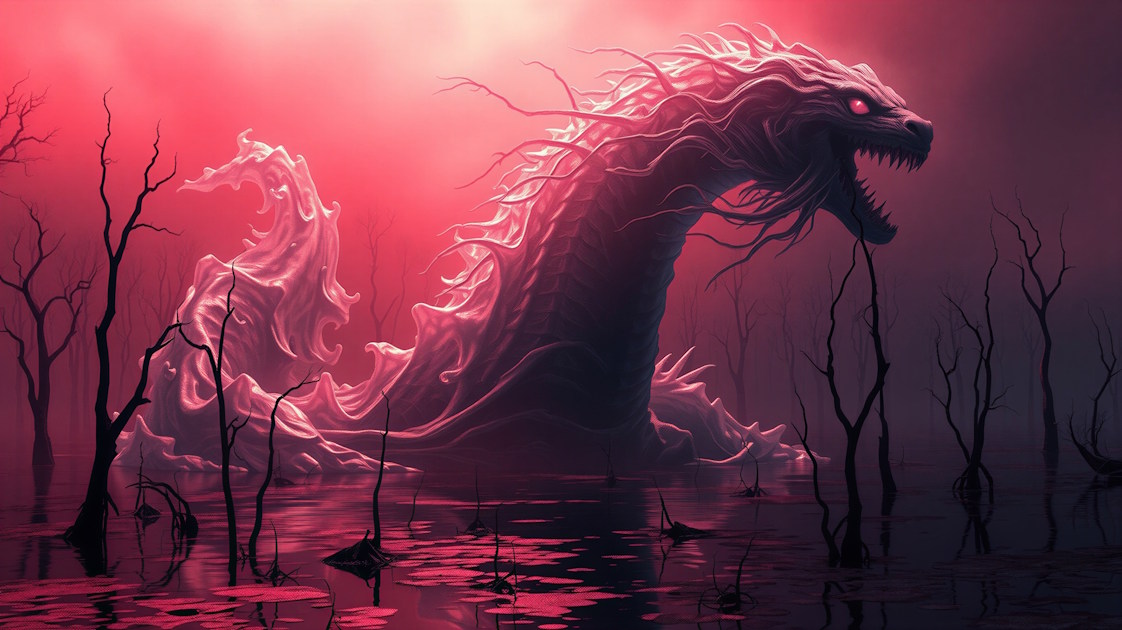
Thessara is depicted as water given serpentine form—a vast coiling shape composed entirely of liquid, its surface shifting between transparency and the dark opacity of deep swamp water depending on the light, the season, and the artistic tradition rendering it. She has no scales, no fixed features, no permanent anatomy. Her form is the form of the water at the moment of observation: smooth and glassy when still, churning and violent when in motion, dark when the sediment rises and clear when the current runs fast enough to scour the channel clean. She is not a serpent made of water. She is water that has chosen, temporarily and without commitment, to resemble a serpent.
Her eyes, when they appear, are the colorless transparency of water so deep that light enters but does not return—not dark, not bright, simply empty of the visual information that eyes are supposed to provide. Sitheri artists consider the eyes the most challenging element of Thessara’s depiction, because they must communicate the specific quality of attention that characterizes water’s relationship with the things immersed in it: total awareness without the slightest trace of concern. The water knows you are in it. The water does not care that you are in it. The water will be exactly as present after you drown as it was while you breathed.
She is depicted in two states: the still coil, in which her liquid form rests in a basin or channel with the surface-tension perfection of undisturbed water, and the surge, in which her body rears upward in the posture of a serpent striking, her form losing coherence at the edges as spray and current blur the boundary between goddess and environment. The still coil represents Thessara between floods—present, watchful in her empty way, the water doing nothing because nothing needs doing. The surge represents the flood itself, the moment when the water moves with purpose that looks like intent but may simply be physics. The sitheri do not know which state is more dangerous. They suspect both are equally so.
The primary symbol associated with Thessara is the Rising Tide—three horizontal wavy lines stacked with increasing thickness from top to bottom, representing water levels climbing from normal to fatal. This symbol appears on the stilts and platforms of sitheri settlements, on sacrificial sites near deep water, and on the boundary markers that warn of channels subject to sudden flooding. Its placement at specific heights on settlement structures serves both sacred and practical purposes, marking the water levels at which Thessara’s influence transitions from sustaining to lethal. Secondary symbols include the Spiral Current, representing the whirlpools that form in Thessara’s channels, and the Open Mouth, a circle of water rendered as a ring without closure, representing the undiscriminating consumption of the flood.
Origins
The sitheri tell Thessara’s origin as a drowning story, because drowning is the first thing the water ever taught them. Before Sythraxis swallowed the Dark and the Grimmere became a living ecosystem, the swamp was water and nothing else—a vast, featureless expanse of standing liquid that had no current, no tide, no movement of any kind. It was not dead water. Dead water is water that has stopped moving. This water had never started. It existed in a state of absolute stillness that was not peace but paralysis, a body of liquid so inert that it could not sustain life, could not erode stone, could not do any of the things that water does in a functioning world.
Thessara formed from the water’s first movement. The myths do not specify what caused the movement—perhaps Sythraxis’s eruption from the deep displaced enough liquid to create a current, perhaps some geological shift tilted the ground beneath the standing water, perhaps the water simply reached the point where its own weight demanded motion. Whatever the cause, the first current that flowed through the proto-Grimmere carried with it something that had not existed before: direction. Purpose. The willingness to go somewhere, which is the fundamental quality that separates living water from dead. Thessara coalesced from that first current the way Morghen coalesced from the swamp’s first killing—an inevitable consequence of a necessary force achieving enough complexity to become aware of itself.
Her first act was a flood. The myths describe it without the moral framing that other races might apply—no punishment, no cleansing, no divine statement of intent. The water rose because the water rose. Thessara did not direct the flood toward any target or away from any sanctuary. She simply allowed the water to do what water does when nothing constrains it: spread, fill, submerge. Everything that could not survive the flood died. Everything that could survive it adapted. The sitheri, being semi-aquatic by nature, survived. Other creatures did not. Thessara drew no distinction between the two outcomes. The flood was not a test of worthiness. It was a fact. Water rises. Things drown. The sitheri who understood this understood Thessara. The ones who did not understand it are not remembered.
Domains & Attributes
Thessara governs water in every form it takes within the Grimmere—the standing pools, the flowing channels, the underground springs, the seasonal floods, the mist that rises from warm water into cold air, the rain that falls from skies the sitheri rarely see through the swamp’s perpetual canopy. Her domain is not the ocean, which lies beyond the Grimmere’s landlocked boundaries, but the interior water that defines the swamp’s character and determines the conditions under which the sitheri live, hunt, and die. Every waterway in Death’s Head Swamp is Thessara’s body. Every current is her pulse. Every flood is her breath, drawn in and expelled according to rhythms that the sitheri have learned to predict but have never learned to control.
Her second domain is the flood itself—not merely as a hydrological event but as a theological principle. The flood represents the fundamental unpredictability of existence in the Grimmere, the reality that conditions which sustained you yesterday may kill you today and that the difference between safety and destruction can be measured in a single hand’s width of rising water. Thessara’s floods do not discriminate. They do not target the wicked or spare the righteous. They are expressions of a force that operates without moral content, applying its consequences to everything within its reach with the perfect impartiality of a phenomenon that does not know or care what it destroys. The sitheri consider this the most honest form of divine power: one that makes no promises and plays no favorites.
Her third domain is drowning—the specific mode of death that she claims as her own and that the sitheri offer as her primary form of sacrifice. Drowning occupies a unique position in sitheri thanatology. It is not the violent death of combat, which belongs to Morghen. It is not the natural death of age or illness, which belongs to Vexthul. It is the death that the environment delivers—the quiet, inexorable filling of lungs with water that was, moments before, the medium of survival. The transition from breathing water’s surface to breathing water’s interior is, in sitheri understanding, the purest expression of Thessara’s nature: the same substance that sustains you becoming the substance that kills you, without changing its own character in any way. The water does not become malicious when it drowns. It remains water. The drowning is your problem, not the water’s.
Her domain does not extend to the creatures that live in the water, which fall under Morghen’s hunting purview, or to the land that the water covers, which belongs to no god in particular. Thessara governs the water itself—its movement, its volume, its presence and absence. She decides where the channels flow. She decides when the floods come. She decides which basins fill and which drain empty. Everything else—what the sitheri do with the water she provides, how they navigate it, what they pull from it—is their concern, not hers.
Nature & Temperament
Thessara is the most alien presence in the sitheri pantheon—a goddess whose temperament is so thoroughly inhuman that even the cold-blooded sitheri, who pride themselves on their emotional detachment, find her difficult to comprehend. She does not hate. She does not love. She does not take pleasure in destruction or satisfaction in sustenance. She is water, and water is the absence of intention wearing the shape of a thing that acts. When the flood comes, it is not because Thessara wills it. When the channels flow clean, it is not because Thessara approves. The water does what water does, and if there is a consciousness behind the doing, that consciousness has never demonstrated the slightest interest in communicating its purposes to the creatures that depend on it.
Her caprice is the quality that the sitheri find most unsettling, because caprice implies randomness, and the sitheri distrust randomness as deeply as they distrust weakness. Sythraxis is predictable: she produces, she evaluates, she consumes or she keeps. Morghen is predictable: he hunts, he kills, he collects proof. Even Vexthul follows patterns that the sitheri can anticipate and prepare for. Thessara follows nothing. The floods come when they come. The channels shift when they shift. The water rises and falls according to rhythms that the sitheri have spent millennia trying to decode and that continue to produce variations that no amount of observation can fully predict. This unpredictability is not cruelty, because cruelty requires intent. It is indifference elevated to a divine principle—the recognition that the forces sustaining your existence are under no obligation to continue doing so and may stop at any moment for reasons you will never understand.
Her darkness is absolute. The myths contain no episodes of mercy, no moments of hesitation, no instances where Thessara spared a victim or softened a consequence. The drowning sacrifices she demands are not requests that can be denied without consequence. They are payments extracted for the privilege of existing in her domain, and the sitheri who fail to make them discover that the water’s tolerance for their presence is conditional, revocable, and entirely without the warmth of negotiation. Other gods can be reasoned with, bargained with, appeased through clever offerings or strategic flattery. Thessara cannot. She does not hear supplications because there is nothing in her that recognizes the concept of supplication. There is only the water, and the water takes what the water takes.
The sitheri’s relationship with Thessara is, accordingly, the most honest relationship in their theology. They do not pretend to understand her. They do not claim her favor or interpret her actions as signs of approval. They pay the sacrifices she demands because the alternative is worse, and they build their settlements on stilts because they have learned through experience that the water will rise and that nothing they say or do will influence when or how high. This relationship—stripped of every comforting fiction that other races layer onto their interactions with the divine—is, in the sitheri’s estimation, the only truthful way to engage with a power that has never pretended to care whether you live or die.
The Swamp Pantheon
Thessara’s position within the Swamp Pantheon is that of the medium—the element in which the other gods’ purposes are carried out, the stage on which their dramas unfold, the water that fills the world they compete to control. Her relationships with the other gods are defined less by personal interaction than by the inescapable fact that everything in the Grimmere depends on water, and water depends on nothing but itself.
Her rivalry with Sythraxis is the most celebrated conflict in sitheri mythology, a territorial war between the goddess who claimed the swamp as the birthplace of her children and the goddess who was the swamp, or at least the most essential part of it. Sythraxis considered the Grimmere her domain by right of creation—she had swallowed the Dark, produced the sitheri, established the matriarchal order that governed their civilization. Thessara considered the Grimmere her body—every channel, every pool, every drop of standing water an extension of her physical form, occupied by Sythraxis’s children only because the water permitted their occupation. The myths describe their conflicts in terms of flood and drought: Thessara raising the water to drown Sythraxis’s nesting grounds, Sythraxis coiling her body across channels to redirect the flow away from territory she claimed, each goddess asserting dominance through environmental manipulation that reshaped the Grimmere’s geography in ways that persist to the present day.
The sitheri celebrate this rivalry rather than lamenting it, viewing the tension between First Mother and Tide Bringer as the engine that keeps the swamp dynamic, productive, and dangerous enough to forge strong sitheri. A Grimmere controlled entirely by Sythraxis would stagnate, its waters managed for the comfort of her children rather than the health of the ecosystem. A Grimmere controlled entirely by Thessara would flood without purpose, drowning the sitheri that give the swamp its meaning. The tension between the two produces the Grimmere as it actually exists: unpredictable, hostile, and exactly challenging enough to ensure that only the strong survive. The sitheri do not want their gods to cooperate. They want them to fight, because the fighting makes the world that makes the sitheri.
Her relationship with Morghen was one of reluctant dependency. The hunter needed the water to stalk his prey through the Grimmere’s channels. The water needed the hunter not at all. Morghen adapted to Thessara’s conditions because he had no choice—the water went where it went, and the hunter either learned to hunt in it or did not hunt. The myths describe Morghen’s occasional frustration with channels that shifted mid-pursuit, tides that rose during carefully planned ambushes, and floods that scattered prey he had spent days positioning. Thessara did not redirect the water to thwart Morghen specifically. She simply did not care whether her movements inconvenienced him, and the distinction between active sabotage and total indifference is, from the victim’s perspective, academic.
Her relationship with Vexthul the Bone Keeper is the simplest in the pantheon and the one that most closely mirrors a functional partnership. The drowned become Vexthul’s. The water that drowned them remains Thessara’s. The two domains share a boundary at the surface of the water, and neither goddess trespasses beyond it. Thessara delivers the dead to Vexthul through the simple mechanism of drowning, and Vexthul collects them from the water’s edge without complaint or competition. It is the only relationship in the sitheri pantheon that operates without friction, and the sitheri note this with the grim observation that the only gods who can cooperate without conflict are the ones who have agreed on who gets the body and who gets the water that killed it.
The Great Deeds
Thessara’s Great Deeds are floods—not battles, not hunts, not acts of creation or defense, but hydrological events so vast and so consequential that the sitheri record them as divine achievements rather than natural disasters. The distinction between the two categories is, in Thessara’s case, nonexistent. Her deeds are her nature expressed at maximum scale, the water doing what water does with enough force and volume to reshape the world.
The First Flood, described in Thessara’s origin myth, remains the foundational event of her mythology—the moment when standing water became moving water and the Grimmere transformed from a lifeless basin into a dynamic ecosystem capable of sustaining the sitheri civilization that Sythraxis would eventually produce. The sitheri do not celebrate the First Flood. They acknowledge it the way one acknowledges the ground beneath one’s feet: as a precondition for everything else, too fundamental to require ceremony, too important to be taken for granted.
The Drowning of the Dry Season is the myth the sitheri tell about the only time the Grimmere nearly ceased to be a swamp. During a period the myths place before the establishment of the ten broods, a drought of unprecedented severity reduced the Grimmere’s water levels to the point where channels dried, pools evaporated, and the exposed mud cracked and hardened into surfaces that no longer supported aquatic life. The sitheri, dependent on water for mobility, hunting, and thermal regulation, faced extinction. Thessara, whether out of self-preservation or the same indifference that governed all her actions, responded by drawing water from sources the myths do not specify—underground rivers, distant watersheds, perhaps the substance of her own body. The water returned in a single, catastrophic surge that refilled the Grimmere in a day, drowning everything that had adapted to the dry conditions and restoring the swamp to its previous state. The sitheri survived because they could swim. The creatures that had moved into the drying swamp during the drought did not. The myth teaches that Thessara’s gifts and Thessara’s destructions are the same event viewed from different positions relative to the waterline.
The Carving of the Channels is Thessara’s most structurally significant deed—the event that created the Grimmere’s navigable waterway system from what had previously been an undifferentiated expanse of shallow flooding. The myths describe Thessara moving through the swamp with enough force to gouge permanent channels in the substrate, creating the network of deep-water routes that the sitheri use for transportation, hunting, and territorial division. These channels did not serve sitheri purposes by design. Thessara carved them for her own reasons—the water needed to flow, and flowing requires channels the way blood requires veins. That the sitheri found the channels useful was a coincidence that Thessara neither intended nor acknowledged. The sitheri have built their entire civilization around a transportation network that was not built for them, and they find this entirely consistent with their understanding of a goddess who has never done anything for their benefit and whose benefits they receive only because they are clever enough to exploit the byproducts of her indifference.
The Fall of the Old Gods
Thessara’s role during the Fall of the Old Gods is the least dramatic of any deity in the sitheri pantheon, which is consistent with a goddess whose relationship with events beyond her domain has always been characterized by comprehensive disinterest. The cosmic cataclysm that killed gods and destroyed civilizations across the surface of the world reached the Grimmere as a disturbance in the water—unusual currents, unexplained tidal surges, fluctuations in water levels that did not correspond to any seasonal pattern the sitheri had recorded. Thessara responded to these disruptions the way water always responds to disruptions: by absorbing them, redistributing them, and eventually returning to equilibrium.
The sitheri did not witness Thessara fighting the Fall’s effects. They did not see her defending the Grimmere against cosmic forces. They simply observed that the water behaved strangely for a period, that the strangeness eventually subsided, and that Thessara’s presence—which had always been felt as a quality of the water rather than a separable consciousness within it—was afterward diminished in ways that were difficult to articulate but impossible to ignore. The water still flowed. The channels still carried current. The floods still came. But something had changed in the character of the water itself, a subtle alteration that the sitheri describe as the difference between water that is alive and water that is merely wet.
The Disappearance of Thessara
The sitheri do not call Thessara’s departure a death. They call it a draining—a word that carries the specific connotation of water leaving a basin without a visible outlet, disappearing into the substrate through channels too small or too deep to observe. Thessara did not fall in battle. She did not sacrifice herself for her people. She did not descend into dormancy like the shamans claim Sythraxis did. She drained. The divine presence that had suffused the Grimmere’s waters for as long as anyone could remember seeped away over a period that the myths estimate at several months following the Fall, each day leaving the water slightly less than it had been the day before, until what remained was water without Thessara—functional, wet, capable of drowning, but empty of the consciousness that had given it purpose.
The cause of the draining is disputed. The brood mothers’ tradition holds that Thessara was killed by the same residual divine energies that poisoned the deep waters and consumed Sythraxis—that the cosmic corruption seeped into the water, and since Thessara was the water, the corruption entered her body without barrier or defense, dissolving her consciousness the way acid dissolves tissue. This interpretation serves the brood mothers’ interests by establishing all four gods as definitively dead, removing any possibility that a returning deity might disrupt the authority structures built on their absence.
The shamanic tradition is less certain. Some shamans argue that Thessara, being water, could not be killed by contamination any more than water can be killed by salt—altered, yes, made temporarily unfit for certain purposes, but not destroyed. In this interpretation, Thessara absorbed the divine corruption the way she absorbed everything else, and the process of metabolizing it required a withdrawal from conscious engagement with the world that the sitheri experienced as her disappearance. She is not dead. She is filtering. The water is cleaning itself of what the Fall deposited in it, and when the process is complete, the consciousness that gave the water its divine character will return.
A third tradition, maintained by a small number of shamans who claim access to the oldest oral sources, holds that Thessara simply left. The Fall damaged the Grimmere, the sitheri were diminished, and Thessara—who had never demonstrated attachment to anything, who had never shown the slightest concern for the creatures that lived in her waters—saw no reason to remain in a domain that no longer interested her. She drained away to wherever water goes when it leaves the world, and she did not look back, because looking back would require caring about what she was leaving, and Thessara has never cared about anything. The sitheri who hold this view do not find it upsetting. They find it consistent. A goddess who never cared whether you lived or died is a goddess whose departure changes nothing except the theology you use to explain why the floods still come.
Legacy & Enduring Influence
Thessara’s legacy is the water itself—the Grimmere’s channel system, its tidal patterns, its flood cycles, and the fundamental reality that sitheri civilization exists because it exists in water. Every settlement built on stilts, every hunting strategy that uses current and depth for tactical advantage, every territorial boundary drawn along a waterway is an acknowledgment that the sitheri live in Thessara’s body, or what remains of it, and that their survival depends on understanding the medium she once governed.
The drowning sacrifice tradition persists as her most direct liturgical legacy—the one observance that continues exactly as it was practiced when Thessara’s presence was undeniable. The sitheri drown captives in her name during seasonal floods, feeding the waters that feed the swamp, maintaining the transactional relationship that Thessara established and that the sitheri are unwilling to terminate regardless of whether anyone remains on the other end of the transaction. The logic is simple and characteristically sitheri: if Thessara is dead, the sacrifices cost nothing but captives the tribe was going to kill anyway. If Thessara is alive, the sacrifices maintain the payment schedule that keeps the water flowing. Either way, the drownings continue.
The practical knowledge of water management that the sitheri have developed over millennia represents Thessara’s most useful, if least theological, legacy. The ability to read current patterns, predict flood timing, navigate channels in conditions of zero visibility, and construct settlements that survive seasonal inundation—all of this expertise derives from generations of sitheri learning to operate within conditions that Thessara set and that her departure has not significantly altered. The water still behaves as it always behaved. The floods still follow patterns that the sitheri can approximately predict. The channels still carry current in directions that experience has mapped. Whether these patterns are the residual effects of a dead goddess’s design or the autonomous behavior of a natural system that never needed divine governance is a question the sitheri consider irrelevant to the practical business of not drowning.
Worship & Observances
Worship of Thessara is the most overtly transactional religious practice in sitheri culture—a series of payments made to a creditor who may no longer exist, maintained because the cost of discontinuing them is potentially catastrophic and the cost of continuing them is merely a supply of captives that the sitheri consider expendable. There is no devotion in Thessara’s worship. There is no love, no reverence, no aspiration to embody her qualities. There is calculation: the water demands drownings, the sitheri provide drownings, and the arrangement continues because no one is willing to test what happens when it stops.
The Drowning Tide is the most significant observance dedicated to Thessara, conducted during the peak of each seasonal flood when the water levels reach their highest point. Captives—prisoners from raids, enemies taken in inter-tribal warfare, and occasionally sitheri condemned for serious offenses against the brood—are bound and submerged in deep water, held beneath the surface until the struggling ceases, their bodies then released to the current. The brood mother presides over the ceremony and determines the number of sacrifices based on the flood’s severity, the tribe’s recent fortunes, and her assessment of how much water the coming season will require. More sacrifices during bad years. Fewer during good ones. The accounting is precise, practical, and entirely without spiritual ecstasy.
The Channel Offerings are smaller, more frequent observances conducted by individual sitheri who must travel through particularly dangerous waterways or who depend on specific channels remaining navigable for hunting or trade. A small sacrifice—typically the blood of a fresh kill poured into the water at the channel’s entrance—acknowledges Thessara’s authority over the medium through which the traveler intends to pass. The offering does not guarantee safe passage. Nothing guarantees safe passage. The offering simply communicates the traveler’s awareness that the water is not neutral ground and that using it without acknowledgment is an act of presumption that a capriciously indifferent goddess might or might not punish.
The Reading of the Waters, conducted by shamans during periods of unusual hydrological activity, involves the interpretation of current patterns, water color, and flood behavior for signs of Thessara’s continued presence or the conditions that might precede her return. These readings produce ambiguous results that the shamans interpret according to their existing theological commitments, and the brood mothers tolerate the practice because it provides useful hydrological data regardless of its spiritual validity.
Sayings & Proverbs
Sitheri sayings associated with Thessara are wet, blunt, and devoid of the professional pride that characterizes Morghen’s proverbs or the maternal authority that underpins Sythraxis’s. They are the language of a people who have learned to coexist with something that could kill them at any moment and that has never given them reason to believe it won’t.
“The water does not care” is the foundational expression of Thessara’s theology, applicable to any situation where an individual appeals to fairness, mercy, or reciprocity in the face of a force that operates without regard for any of these concepts. A warrior who complains that the current shifted during his hunt, a brood mother who protests that the flood destroyed her nesting site, a captive who begs for release from the Drowning Tide—all receive the same response. The water does not care. Adapt or drown.
“Pay the water” is an instruction to make the necessary sacrifice before undertaking any venture that depends on the Grimmere’s waterways. The phrase has expanded beyond its literal sacrificial meaning to encompass any situation where a precautionary payment or preparation is advisable before committing to a course of action. It carries the implicit warning that those who take without paying eventually discover that the water keeps its own accounts.
“Drink and drown from the same cup” is a statement of the fundamental duality that defines Thessara’s nature and, by extension, the sitheri’s relationship with their environment. The thing that sustains you is the thing that kills you. The water that fills your belly is the water that fills your lungs. The difference between survival and death is not a difference in the water but a difference in your position relative to its surface. The saying is used to remind the overconfident that every advantage they exploit is also a vulnerability they expose.
“She drained” is spoken as both a statement of Thessara’s departure and a general expression for any loss that occurs gradually, imperceptibly, and without the dramatic announcement that would allow a timely response. A brood mother whose authority erodes over years of poor decisions, a warrior whose skills degrade through lack of practice, a tribe whose territory shrinks through incremental encroachment—all are described as draining, losing their substance the way Thessara lost hers, too slowly to provoke alarm until the loss is irreversible.
Sacred Sites
The Deepwater Basins—the lowest points in the Grimmere, where the water is deepest, darkest, and most resistant to seasonal fluctuation—serve as the primary sacred sites associated with Thessara. These basins are the sites where the Drowning Tide sacrifices are conducted, their depth ensuring that the bound victims cannot reach the surface regardless of their struggles. Each brood maintains its own designated Deepwater Basin, and the approaches to these sites are treated with the wary respect that the sitheri reserve for places where the boundary between living in the water and dying in it is thinnest.
The Shifting Channels—waterways that change course unpredictably, altering their paths between seasons or sometimes between days—are regarded as the most direct evidence of Thessara’s lingering presence, or at least of the autonomic processes that her presence once governed. These channels are not navigated casually. They are treated as active territory belonging to a goddess who may or may not still occupy it, and the sitheri who must use them make Channel Offerings with particular care, acknowledging that the water here behaves with the specific caprice that Thessara’s mythology attributes to the divine rather than the natural.
The Flood Lines—marks left on ancient trees and stone formations by centuries of seasonal flooding—serve as passive sacred sites, their accumulated record of water levels forming a physical history of Thessara’s activity over time. Shamans study the Flood Lines for patterns that might predict future behavior, treating them as the closest thing the sitheri possess to written records of their water goddess’s moods. The highest flood lines, marking the most devastating inundations in the Grimmere’s history, are treated with particular significance—physical evidence of the Tide Bringer’s capacity for destruction, preserved in the scars she left on the landscape.
Concluding Remarks
Thessara the Tide Bringer may be dead, may be filtering, or may simply have left. The sitheri do not know, and in their more honest moments, they acknowledge that they never knew Thessara even when she was undeniably present. She was always the most opaque of their gods—the one whose motives resisted interpretation, whose actions defied prediction, whose relationship with the sitheri was less a relationship than a set of conditions imposed by a force that happened to occupy the same space. The water sustained them. The water drowned them. The water did both without preference or purpose, and the sitheri adapted to this arrangement because the alternative was to live on dry land, and dry land was where the warm-blooded races built their kingdoms, and the sitheri would rather drown than live among prey.
The drowning sacrifices continue. The Channel Offerings are made. The Reading of the Waters produces its ambiguous results. And the Grimmere’s channels flow, shift, flood, and drain according to patterns that may be the residual design of a dead goddess, the autonomous behavior of a natural system, or the ongoing activity of a consciousness so thoroughly merged with its medium that distinguishing between Thessara and the water she embodied has always been, and may always be, impossible. The sitheri do not need the answer. They need the water. And the water, whatever it is or is not, continues to provide—and to take—with the same cold, capriciously indifferent generosity that has defined the Grimmere since the first current flowed and the first creature learned the difference between drinking and drowning.