Thyrkos the Guardian, Warden of the Threshold
Introduction
Thyrkos the Guardian is the krill god of protection, vigilance, and the defense of sacred spaces. He is the shadow that does not move, the eyes that do not close, the silence at the border where the forest ends and the threat begins. Among the four krill gods of the Forest Pantheon—equals in standing, each governing a different facet of existence—Thyrkos occupies the position that is least celebrated and most essential. The krill do not tell stories about Thyrkos with the feral pride they bring to Nimala’s myths, nor with the quiet reverence they accord Velania’s wisdom. They speak of Thyrkos the way they speak of the branches beneath their feet: he is there, he holds, and if he were not there, everything above him would fall.
Thyrkos is dead. The krill do not soften this. Unlike Nimala, whose fate remains gloriously uncertain, and unlike the Great Tree, whose roots still pulse with the life force of the forest, Thyrkos fell during the cataclysm that ended the Age of the Old Gods, and his death was as certain and as final as the god himself would have demanded. His sacred sites emptied of their power. His presence ceased to be felt in the places where sentinels stood watch. The forest continued, but the particular quality of watchfulness that Thyrkos had woven into its borders—the feeling that something ancient and alert stood between the Merrow Woods and everything that meant it harm—was gone.
What remains is his legacy: a culture of vigilance so deeply embedded in krill society that every sentry who takes a post, every warrior who watches a trail, every parent who listens to the night sounds outside a sleeping village is participating in a tradition that Thyrkos established and that his death could not erase. The guardian is gone. The guarding continues. The krill consider this the most fitting monument a god of protection could receive—not a shrine or a prayer but a people who never stop watching.
Appearance & Symbols
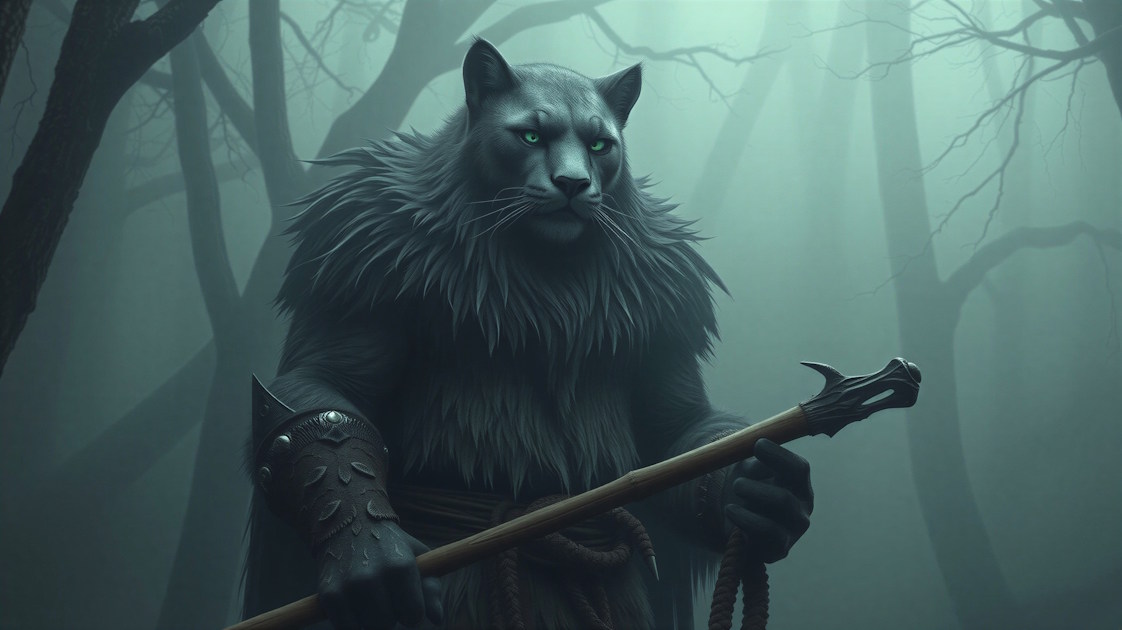
Thyrkos is depicted as the largest of the krill gods—not taller in the elongated way of human statuary but broader, heavier, built like a stone wall given feline form. Where Nimala is all lean speed and directed force, Thyrkos is mass and solidity, a body designed not to move quickly but to occupy space so completely that nothing can move him from it. His musculature is rendered in the dense, compact proportions of a creature that has traded agility for immovability, every line of his body communicating the same message: I am here, and I am not leaving.
His fur, in krill artistic tradition, is the color of old bark—deep brown layered with grey, the mottled pattern of a predator designed for concealment in shadow and stillness rather than speed. His markings are heavier and more defined than Nimala’s, arranged in patterns that suggest the rough texture of tree bark or weathered stone, reinforcing the visual impression of a being more rooted than mobile. His eyes are the deep green of forest shade, steady and unblinking, carrying the focused calm of a creature that has watched a single point for so long that it has forgotten what distraction feels like.
He is always depicted in a stance of readiness—weight settled, shoulders squared, head level, eyes forward. Never attacking. Never retreating. Never at rest in the way that implies lowered awareness. Krill artists capture him in the specific tension of the sentinel who has been watching for so long that vigilance has become indistinguishable from existence itself. His posture communicates no emotion—not anger, not fear, not boredom—only the absolute, impersonal attention of a boundary that does not care what approaches it but will respond to whatever does.
His weapon is a heavy staff of dark wood, broader at the base than at the crown, carved from a branch of one of the forest’s most ancient trees. The myths call it Roothold, and it functions less as a weapon than as a statement of position—planted in the ground, it marks the line that cannot be crossed. In some depictions, Thyrkos carries no weapon at all, his empty hands and set jaw sufficient to convey the threat his presence poses. The krill consider the weaponless depictions more authentic, arguing that a true guardian does not need a weapon to be dangerous—his willingness to hold ground is the weapon.
The primary symbol associated with Thyrkos is the Unblinking Eye—a single open eye rendered in green pigment, carved into stone or wood at the entrances to defended spaces throughout krill territory. This symbol serves both as a warning to potential intruders and as a mark of consecration, declaring that the space beyond the threshold is watched and will be defended. Secondary symbols include the Crossed Roots, representing the intertwined foundations that anchor the forest against storms and assaults, and the Standing Stone, a vertical line bisected by a horizontal bar, representing the sentry at the threshold.
Origins
The krill tell Thyrkos’s origin as a border story, because the krill understand borders the way they understand breathing—as something so fundamental it barely requires thought until the moment it fails. In the earliest days of the forest, when the trees were still learning how to grow, and the canopy had not yet closed against the sky, nothing separated the inside from the outside. The forest bled into the grassland, the grassland bled into the forest, and the things that lived in each wandered freely between them. There were no territories. There were no boundaries. There was no such thing as trespass because there was nothing to trespass against.
This was, by krill reckoning, a state of profound wrongness. A world without boundaries is a world without meaning, because if nothing is defended, then nothing has value. The forest understood this in the slow, wordless way that forests understand things, and its understanding called something into being—not from the Great Tree, whose concern was life rather than its defense, and not from the earth or the sky, but from the border itself. Thyrkos emerged from the place where the forest met what was not forest, shaped from the tension between inside and outside, belonging and intrusion, safety and threat. He was the line drawn in the dirt. He was the growl that says no further.
His first act, unlike Nimala’s explosive run through the canopy, was to stand still. The myths describe him taking a position at the forest’s edge and simply remaining there, motionless, watching the open ground beyond with eyes that did not blink and a patience that did not waver. He stood for so long that moss grew on his shoulders and birds nested in the crook of his arm, and still he did not move, because nothing had yet attempted to cross the line he had drawn with his presence. When something finally did—the myths do not specify what, only that it came from outside with intent to take—Thyrkos moved once, struck once, and returned to his position. The thing that had tried to cross did not try again. The border was established.
The krill saw him and understood what he was before they had a name for him. They were already territorial creatures, already inclined to mark spaces and defend them, but their territories were loose, negotiable, subject to the shifting pressures of predation and scarcity. Thyrkos showed them that a boundary could be absolute—not a suggestion but a fact, maintained not through aggression but through the unwavering commitment to hold a position regardless of what was approached. The krill absorbed this lesson into the foundations of their culture, and it has never left.
Domains & Attributes
Thyrkos governs protection as the krill understand it—not the passive sheltering of the weak but the active, deliberate maintenance of boundaries that separate what matters from what threatens it. His domain encompasses the physical defense of territory, the protection of tribal members from external threats, and the broader philosophical commitment to preserving the integrity of spaces, traditions, and relationships against encroachment. In the krill worldview, to protect something is to declare its value through the willingness to stand between it and harm, and Thyrkos is the divine expression of that declaration.
Vigilance forms the core of his second domain. The krill distinguish between watching and seeing, between the passive reception of sensory information and the active, disciplined attention that identifies threats before they become dangerous. Thyrkos represents the latter—the sentinel’s awareness that operates continuously, evaluating every sound, movement, and absence of movement for its potential significance. This is not paranoia; it is the professional competence of a people whose survival depends on knowing which approaches their borders before they arrive. A krill who watches without comprehension is merely awake. A krill who watches with Thyrkos’s awareness is a guardian.
His third domain is the sanctity of place—the principle that certain spaces possess an inherent significance that demands defense beyond their practical value. Sacred groves, ancestral trees, the sites where the shi-ja ritual is conducted, the heart of each tribal territory where elders gather, and children sleep—these places are not merely useful. They are meaningful, and their meaning requires protection as surely as their physical structures require maintenance. Thyrkos did not create these sacred spaces, but he established the principle that they must be defended, and the krill have maintained that principle with lethal seriousness ever since.
His domain explicitly excludes aggression. Thyrkos does not attack. He does not invade. He does not cross boundaries to impose his will on others’ territory. His violence is entirely reactive—the response of a boundary when something attempts to breach it. This distinction matters deeply to the krill, who maintain a sharp theological line between the guardian’s defensive violence and the hunter’s predatory violence. Both are necessary. Both are honored. But they are not the same thing, and confusing them dishonors both Thyrkos and Nimala.
Nature & Temperament
Thyrkos is the quietest god in the krill pantheon, which in a culture that values action over speech is itself a form of eloquence. He does not speak in the myths unless speech is required to fulfill his function, and when he does speak, his words carry the weight of what has been considered for a very long time before being released into the world. He does not argue. He does not persuade. He states, and the statement carries the finality of a closed door. Krill describe his voice as the sound a tree makes when it settles deeper into its roots—low, slow, and impossible to ignore.
His stoicism is not coldness. The myths are careful to distinguish between Thyrkos’s reserve and the emotional absence that might be mistaken for it. He feels deeply but expresses nothing, channeling every emotion into the single, unwavering purpose that defines him: hold the line. Joy, grief, anger, love—all exist within Thyrkos, but none reaches his surface because his surface is the boundary, and the boundary must show nothing that can be read as weakness or invitation. A wall that flinches is not a wall. A guardian who broadcasts his emotional state provides information to whatever is testing his defenses. Thyrkos gives nothing away.
His patience exceeds even the forest’s. The myths describe Thyrkos maintaining watch over a single approach for an entire age, motionless through seasons of rain and drought and storm, because the threat he anticipated had not yet materialized and he was unwilling to assume it never would. Other gods questioned this vigil. Nimala, characteristically, told him he was wasting time he could spend hunting. Thyrkos did not respond. The threat arrived three centuries later, and Thyrkos was exactly where he needed to be when it did. The krill tell this story when young sentries grow restless at their posts, and it never fails to settle them.
His relationship with fear is the aspect of Thyrkos’s character that the krill find most instructive. Thyrkos is not fearless. The myths explicitly state that he understands fear, respects it, and considers it a useful tool—the guardian’s early warning system, the instinct that says something is wrong before the mind can articulate what. What Thyrkos does with fear is the lesson: he acknowledges it, assigns it its proper weight, and then sets it aside so that it informs his vigilance without compromising his resolve. Fear that paralyzes is a failure of discipline. Fear that sharpens attention is a gift. The krill teach this distinction to every warrior and sentry, attributing it directly to Thyrkos’s example.
The Forest Pantheon
Thyrkos’s position within the Forest Pantheon is defined by the tension between his philosophy and Nimala’s—a productive friction that the krill consider essential to their survival. Where Nimala hunts, Thyrkos holds. Where Nimala pursues threats into their territory, Thyrkos waits for them to approach his. Both are valid responses to danger, and the krill have spent millennia debating which is superior without reaching a conclusion, which is precisely the outcome both gods would have preferred.
The disagreement between Thyrkos and Nimala is not personal. The myths contain no episodes of genuine hostility between them, only a persistent, fundamental difference of opinion about the best way to protect the krill people. Nimala argues through action—striking first, eliminating threats before they reach the border. Thyrkos argues through endurance—maintaining defenses so formidable that threats choose to go elsewhere. The krill recognize that both strategies have succeeded and failed under different circumstances, and they maintain warrior traditions that honor each approach without subordinating one to the other. The sinji embody Nimala’s philosophy. The tribal sentinels embody Thyrkos’s. The tribe needs both.
His relationship with Velania the Wise is the warmest connection in the pantheon, though warmth is a relative term when applied to a god of Thyrkos’s temperament. Velania’s wisdom provides the intelligence that makes Thyrkos’s vigilance effective—the knowledge of what to watch for, the understanding of patterns that distinguish a genuine threat from a false alarm. The myths describe Thyrkos seeking Velania’s counsel before establishing new defensive positions, respecting her insight into the natural patterns that govern movement through and around the forest. In return, Thyrkos ensured that Velania’s sacred groves and places of contemplation remained undisturbed, his protection giving her the safety she needed to pursue the deep observation that produced her wisdom. Theirs was a partnership of mutual necessity conducted in mutual silence, each god contributing what the other lacked without requiring acknowledgment or gratitude.
Thyrkos’s relationship with the Great Tree is one of direct service. The Great Tree sustains the forest. Thyrkos defends the forest. The connection requires no elaboration and no negotiation—the guardian serves the thing that gives life to everything he protects. The krill see in this relationship a model for their own obligations to the Merrow Woods: they are creatures of the forest, sustained by it, and their first duty is to ensure its survival against whatever threatens it from beyond its borders.
The Great Deeds
Thyrkos’s Great Deeds are not hunts. They are stands—episodes in which the guardian held a position against forces that should have overwhelmed him, demonstrating through endurance what Nimala demonstrates through speed. The krill tell these stories with the flat, factual tone of sentries reporting what happened on their watch, stripped of the dramatic embellishment that characterizes Nimala’s myths. Thyrkos would not have wanted it otherwise.
The Stand at the Thornwall is the oldest and most frequently told of Thyrkos’s deeds. In the earliest days of krill settlement, a blight swept through the eastern Merrow Woods, killing trees and poisoning soil in a creeping tide that moved slowly enough to seem harmless and quickly enough to be unstoppable. The blight was not a creature that could be hunted; it was a condition, a wrongness in the earth that spread through root systems and waterways with patient inevitability. Nimala circled it, looking for something to kill. Velania studied it, looking for a pattern to exploit. Thyrkos walked to the blight’s advancing edge and stood in its path.
For forty days he stood at the boundary between healthy forest and dying ground, his presence alone holding the blight at bay. The myths do not explain how a physical being could stop an ecological catastrophe through sheer force of will, and the krill do not ask. What matters is the result: the blight advanced everywhere except where Thyrkos stood, curving around his position like water around a stone, creating a bulge in its front that bought Velania the time she needed to understand the blight’s pattern and devise a means of countering it. When the crisis passed, Thyrkos stepped aside, and the ground where he had stood bore a ring of thorns that grew overnight into an impenetrable hedge—the Thornwall, which still exists in the eastern Merrow Woods, marking the furthest extent of the ancient blight and serving as a living monument to the guardian’s vigil.
The Holding of the Low Branches recounts how Thyrkos defended the krill people during a time when predators from outside the forest—creatures driven from their own territories by unknown pressures—invaded the Merrow Woods in such numbers that they overwhelmed the tribal warriors. The predators hunted from the ground, targeting krill who descended from the canopy to forage, drink, or travel between groves where the branches did not connect. Thyrkos positioned himself at the lowest accessible branches of the central forest, the transition zone between canopy safety and ground-level danger, and held the boundary for an entire season. Every predator that attempted to climb met the guardian. None succeeded. The krill above him went about their lives in safety, and when the invading predators eventually exhausted themselves against his immovable defense, they withdrew from the Merrow Woods entirely. The phrase “the low branches are held” entered krill vocabulary as an assurance that the most vulnerable access points are defended.
The Silence at the Hollow is Thyrkos’s most enigmatic deed—a story in which the guardian’s victory required not physical endurance but the suppression of every instinct that defined him. Something took up residence in a hollow at the heart of a sacred grove, something that fed on attention itself, growing stronger each time a living being turned its awareness toward it. The more the krill watched it, the more powerful it became. Warriors who investigated disappeared. Nimala, whose predatory focus was the most intense attention in the forest, could not approach without feeding the thing she meant to destroy. Thyrkos understood what was required. He went to the hollow and did the hardest thing a guardian has ever done: he stopped watching. He closed his eyes, stilled his awareness, and denied the creature the attention it consumed. He sat in the presence of an active threat and refused to acknowledge it. For how long, the myths do not say. But when Thyrkos opened his eyes, the hollow was empty. The thing had starved. The grove was safe. The krill who tell this story recognize in it a truth about Thyrkos that his other deeds obscure: the greatest act of protection is sometimes the willingness to set aside the very instincts that make you a guardian.
The Fall of the Old Gods
When the Old Gods tore themselves apart in the catastrophe that ended their age, the destruction poured across the world without discrimination, consuming divine and mortal alike. The Merrow Woods, sheltered by its density and its distance from the centers of divine conflict, weathered the initial shocks better than the surface kingdoms, but the cataclysm was too vast and too fundamental to be stopped by geography alone. The divine energies that had held the world in balance for millennia were unraveling, and the forest was not exempt from the consequences.
The krill account of the Fall focuses on what happened at the borders. The destruction did not enter the Merrow Woods as a single overwhelming force but as a series of incursions—waves of displaced energy, fragmented divine power, and the physical aftermath of cosmic violence that reached the forest’s edges in successive pulses, each one stronger than the last. Thyrkos felt them coming. He had always felt threats approaching; it was the fundamental expression of his nature. But these were threats on a scale that no sentinel had ever faced, forces that could unmake the boundary between forest and not-forest as easily as a boot crushes a twig.
Nimala ran. She circled the forest at speeds that shattered the air, creating barriers of broken wind that deflected the worst of the destruction. Velania retreated to the deepest groves, pouring her wisdom into the living network of roots and branches that connected the forest’s trees, strengthening their resilience against forces no natural organism was designed to withstand. And Thyrkos went to the borders—not one border but all of them, moving from threshold to threshold with an urgency that his myths had never shown before, reinforcing each defensive position against the waves of destruction that were now arriving in rapid succession.
The krill tell of trees at the forest’s edge bursting into flame without being touched by fire, of the ground splitting along fault lines that had been stable for millennia, of the sky itself seeming to crack and bleed light in colors that had no names. Through all of this, the sentinels who had inherited Thyrkos’s traditions held their posts, watching and reporting what they saw even as the world they were watching came apart around them. These mortal guardians were Thyrkos’s final legacy in real time, their discipline a reflection of the god who had taught them that the post is held until the threat passes or the sentry falls.
The Death of Thyrkos
The northern border of the Merrow Woods bore the worst of the Fall’s impact. Here, where the forest thinned against the foothills that rose toward the Ugull Mountains, the krill territory was most exposed to the destructive energies cascading across the open landscape. The trees in this region were younger, shorter, less densely packed—the border at its weakest, the place where a determined force could breach the forest’s defenses and reach the populated heartland beyond.
The final wave of the cataclysm arrived not as energy or fire but as absence—a void in the fabric of reality itself, a rolling nullification that unmade whatever it touched. Trees did not burn; they ceased to exist. Stone did not crack; it simply was not there. The void moved without speed or urgency, patient as rot, inevitable as gravity, consuming the northern forest one tree at a time. The krill sentinels who saw it coming reported that it made no sound. That was the worst part, they said afterward. The silence of something that did not need to announce itself because nothing could stop it.
Thyrkos was already there. He had felt the void forming before it reached the forest’s edge, the way a sentry feels the wrongness of a shadow that falls in the wrong direction. He stood at the northern threshold—the weakest point of the weakest border—and planted Roothold in the ground. The myths say that the staff drove roots of its own into the earth, anchoring itself and its bearer to the bedrock beneath the forest floor. Thyrkos was no longer simply standing at the border. He was the border.
The void reached him and stopped. Not because Thyrkos possessed the power to unmake a force of cosmic destruction, but because he occupied the space it needed to cross, and he would not leave it. The void pressed against him the way water presses against a dam—constant, patient, inexorable. Thyrkos pressed back with the only force he had ever wielded: the absolute refusal to yield ground. The struggle had none of the drama that other races’ myths attach to divine sacrifice. There was no battle. There were no blows exchanged. There was simply a god standing in the path of annihilation, holding his ground one moment at a time, each moment a victory and each moment costing him something he could not recover.
The void consumed him slowly. The krill who witnessed it from the branches above described it as erosion—Thyrkos diminishing by degrees, his edges blurring, his substance thinning, his massive form losing definition the way a stone loses its shape to centuries of rain compressed into minutes. He did not cry out. He did not move. His eyes remained open and focused on the void before him, watching it with the same steady, professional attention he had brought to every threat he had ever faced. The guardian watched his own destruction with the calm of a sentry reporting conditions at the border.
It took three days. For three days, Thyrkos held the northern threshold against a force that was consuming him as surely as it consumed everything else. For three days, the void advanced nowhere, stopped at the precise point where the guardian stood. And for three days, the krill behind him evacuated their northernmost settlements, relocated their young and their elders, and reinforced the interior positions that would become their new borders if the northern line fell.
When the void finally consumed the last of Thyrkos’s physical form, the myths say that the ground where he had stood did not disappear. It hardened. The soil fused into a ridge of stone that had not existed before—a low, dark line running the width of the northern border, exactly where Thyrkos had planted Roothold. The void reached the ridge and stopped, not because the stone possessed divine power, but because the cataclysm was finally spent, its energy exhausted against the last resistance the forest could offer. The void receded. The forest survived. Thyrkos did not.
Nothing of him remained except the ridge and the silence that settled over the northern border in the days that followed—a silence the krill describe as different from ordinary quiet, deeper and more deliberate, as though the forest itself had absorbed something of the guardian’s nature in the place where he fell. The ridge still stands, too hard to cut, too smooth to climb, running like a scar across the northern Merrow Woods. The krill call it the Guardian’s Spine, and they do not build upon it or disturb it. It is not a grave. Thyrkos left no body to bury. It is a border—the last one he ever drew.
Legacy & Enduring Influence
Thyrkos’s death confirmed what his life had taught: the guardian’s duty does not end until the threat passes or the guardian falls, and even falling can be a form of holding the line. The three days he spent being consumed at the northern threshold gave the krill time to reorganize, relocate, and survive a cataclysm that destroyed civilizations. This exchange—a god’s existence for his people’s survival—is the transaction at the heart of Thyrkos’s legacy, and the krill honor it not with grief but with the continuation of the vigilance he embodied.
The sentry traditions that govern krill territorial defense trace their origins directly to Thyrkos’s teachings. Every tribe maintains a corps of dedicated sentinels whose training, discipline, and sense of duty reflect the guardian’s example. These sentinels are not sinji—they do not undergo the shi-ja ritual, and their abilities are natural rather than supernaturally enhanced. What they possess is Thyrkos’s philosophy: the conviction that the post is held, that the border is maintained, that vigilance is not a task to be completed but a state of being to be sustained. Sentinel duty is not glamorous by krill standards, lacking the prestige of the sinji warrior tradition, but it is respected with a solemnity that reflects its divine origins.
The concept of territorial sanctity—the principle that certain spaces are inherently sacred and must be defended regardless of tactical considerations—is Thyrkos’s most enduring contribution to krill culture. The krill do not abandon territory. They do not trade land for time or sacrifice space for strategic advantage. A border, once drawn, is held until holding it becomes physically impossible, and even then, the retreat is conducted grudgingly, with the explicit understanding that the lost ground will be reclaimed. This inflexibility frustrates other races who encounter krill territorial claims, but the krill consider compromise on matters of boundary to be a betrayal of the god who died rather than yield a single tree’s width of forest.
Thyrkos’s death also shaped the krill understanding of sacrifice in ways that distinguish it from other races’ concepts. The krill do not romanticize Thyrkos’s end. They do not describe it as glorious, noble, or beautiful. They describe it as necessary—a calculation performed under conditions that allowed no better option, executed by a being whose nature made him uniquely suited to the task. This unsentimental approach to sacrifice permeates krill military culture, where the willingness to die is valued not as an expression of courage but of competence. The guardian who dies at his post dies doing his job. There is honor in that, but no drama. Thyrkos would have preferred it this way.
Worship & Observances
Worship of Thyrkos in the present day is indistinguishable from the practice of vigilance itself. The krill do not pray to their dead guardian. They watch. They maintain their borders. They train their sentinels. Every act of territorial defense, from the sentry who takes the night watch to the elder who inspects the boundary markers, is an observance in Thyrkos’s name, whether or not the individual performing it consciously invokes his memory. The krill consider this the only form of worship that Thyrkos would have accepted—a god who stood motionless for centuries would have little patience for ceremonies that require his followers to stop watching in order to perform them.
The most significant formal observance is the Sentinel’s Night, held once a year at the onset of winter, when the forest is most vulnerable to incursion and the nights are longest. On this night, every sentry post in every tribe is doubled, and the krill who take the extra watch do so in deliberate silence, standing motionless at their positions from dusk to dawn without speaking, eating, or shifting their weight. The Sentinel’s Night is both a memorial and a training exercise, reminding the participants what it feels like to hold a position through an entire night of darkness and silence while reinforcing the discipline that Thyrkos’s tradition demands.
Individual sentinels maintain personal observances that vary by tribe and family but share common elements. The touching of a boundary marker upon beginning a watch, the silent survey of the assigned sector before settling into position, the deliberate slowing of breath that marks the transition from ordinary awareness to sentinel alertness—these small rituals carry the accumulated weight of generations who have performed them in the same way, creating a continuity that connects the living sentry to the dead god whose example he follows.
The marking of new boundaries is treated as a sacred act, conducted with formality that reflects its significance. When a tribe establishes a new sentry post or extends its territory to include previously unclaimed forest, the boundary markers are placed with deliberate ceremony, each one driven into the earth with a single blow that echoes the myth of Thyrkos planting Roothold at the northern threshold. The markers themselves are carved with the Unblinking Eye, consecrating the new border under Thyrkos’s legacy and declaring to all who encounter it that the space beyond is watched and defended.
Sayings & Proverbs
Krill sayings associated with Thyrkos are sparse, blunt, and stripped of embellishment—fitting for a god who never wasted a word.
“The border holds” is the most common expression, used as both a statement of fact and a declaration of intent. Sentinels use it to report that their sector is secure. Leaders use it to reassure their people during periods of tension. Warriors use it to steel themselves before defending a position. The phrase carries the weight of Thyrkos’s three-day stand at the northern threshold, invoking the memory of a god who held his border against annihilation itself. To say “the border holds” is to commit oneself to ensuring that it does.
“Stand where he stood” is an exhortation to accept difficult duty without complaint, invoking the image of Thyrkos taking his position at the weakest point of the forest’s defense because that was where he was needed most. The phrase is used when sentinels are assigned to dangerous or isolated posts, when warriors are asked to hold positions against superior numbers, or when any krill faces a situation that demands personal sacrifice in service of collective security.
“He watched until he couldn’t” serves as both an epitaph for fallen sentinels and a statement of professional respect, acknowledging that the individual in question fulfilled his duty to the absolute limit of his capacity. There is no higher compliment in krill military culture than the acknowledgment that someone maintained their vigilance until their body or their life gave out. The phrase refuses to distinguish between the sentry who dies at his post and the god who was consumed at his threshold, granting both the same measure of honor.
“Eyes open” is used as both a greeting and a farewell among krill sentinels, carrying the dual meaning of a practical instruction and a philosophical commitment. To keep one’s eyes open is to maintain the vigilance that Thyrkos embodied—the active, disciplined awareness that identifies threats before they become crises. The phrase is spoken without inflection, as a matter of fact rather than an expression of emotion, because Thyrkos did not protect the forest through feeling. He protected it by watching.
Sacred Sites
The Guardian’s Spine—the ridge of fused stone that marks the place where Thyrkos made his final stand—is the most significant sacred site in krill territorial culture. The ridge runs along the northern border of the Merrow Woods, a low, dark formation of stone so hard that no tool the krill have ever applied to it has left a mark. The krill do not build upon the ridge or attempt to modify it. They patrol along its length, using it as a natural boundary marker and a training ground for young sentinels, who are brought to the Guardian’s Spine early in their training to stand where Thyrkos stood and feel whatever remains of his presence in the stone beneath their feet.
The Thornwall in the eastern forest, marking the site of Thyrkos’s first great deed, serves as a living boundary and a reminder that vigilance can stop threats that violence cannot. The hedge has grown wild over the millennia since the ancient blight, becoming an impenetrable barrier of thorn and branch that even the most determined intruder cannot cross. Krill sentinels maintain watch along the Thornwall not because they expect the blight to return but because the tradition of watching at this site is older than any other sentry post in the forest, and the krill do not abandon traditions that Thyrkos established.
Each tribe’s primary sentry posts are considered sacred to Thyrkos, though the krill would not use that word in the decorative sense that other races might. These posts are not ornamented or set apart from their surroundings. They are functional positions selected for their sight lines, defensive advantages, and strategic significance. What makes them sacred is not their appearance but their purpose and the unbroken chain of sentinels who have stood watch at each one, connecting the living guardian to the dead god through the simple, continuous act of watching.
Concluding Remarks
Thyrkos the Guardian is dead, and the krill do not pretend otherwise. They do not seek him in the shadows or listen for his voice in the wind. They do not hope for his return or imagine him watching from some hidden place beyond perception. He stood at the northern threshold, he held it for three days against a force that consumed him, and when the last of him was gone, the border held because he had bought enough time for the forest to survive without him. That is the entire story. The krill do not need it to be more.
What they need—and what Thyrkos provided, in death as in life—is a standard. Not the unreachable standard of Nimala’s impossible speed, but the quietly crushing standard of a god who never moved, never flinched, never looked away, and never stopped holding the line until there was nothing left of him to hold it with. Every sentry who takes a post in the Merrow Woods inherits that standard. Every boundary marker carved with the Unblinking Eye extends it. Every krill that teaches a child to watch the borders before watching the sky perpetuates it. Thyrkos is gone, but the vigilance he embodied is not a quality that dies with its source. It is a practice passed from guardian to guardian across generations, maintained not by faith but by discipline, and it will endure for as long as there are krill who understand that the forest survives because someone is always watching.
The border holds. It held when Thyrkos stood at it. It held after he fell. It holds tonight, in the dark, where the sentinels stand at their posts and watch the world beyond the trees with eyes that do not blink and patience that does not waver. The guardian is dead. The guarding goes on.