High Queen Vekara Stonecrown, Warden of the Reserves
Introduction
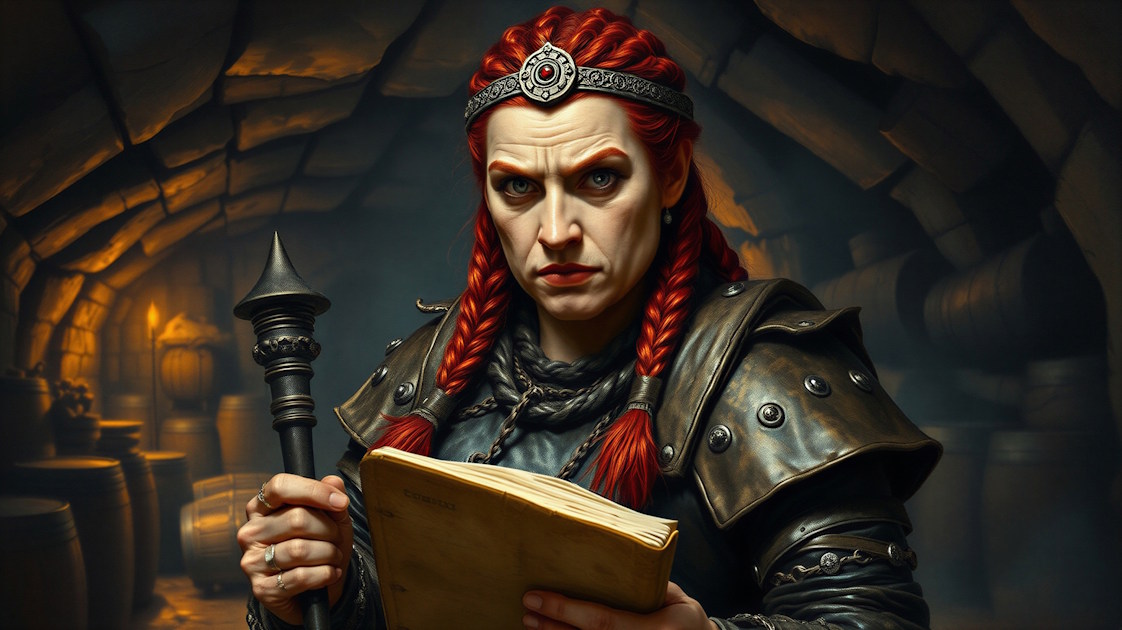
Vekara Stonecrown is the only female High King in the history of Kazad-Grimm—a distinction the dwarves themselves consider unremarkable, since the title High King describes the position’s function rather than its holder’s gender, and the dwarves who elevated Vekara to the Throne of Seven Hammers did so because she was the most qualified candidate available, not because they wished to make a statement about who could govern. The statement, to the extent one was made, was made by Vekara herself through the quality of her reign, which confronted the kingdom’s first existential crisis and emerged from it with institutions stronger and more resilient than before.
She governed during the First Great War—the initial divine conflict among the Old Gods, whose battles on the surface above sent seismic devastation through the underground realm upon which the dwarves had built their entire civilization. Earthquakes collapsed tunnels, shattered chambers, disrupted the highway network, and destroyed the mining operations that sustained the kingdom’s economy. Other leaders might have treated the crisis as a military problem or an engineering problem. Vekara treated it as a logistics problem, and in doing so, she created the Reserve System—the network of emergency stockpiles that would sustain the kingdom through the First Great War, the Second, and every subsequent crisis until the Third War destroyed everything. Her legacy is the principle she demonstrated under extraordinary pressure: that the most dangerous threat a civilization faces is not the catastrophe itself but the failure to prepare for it.
The High King
Dwarven oral tradition preserves Vekara’s path to the Throne of Seven Hammers as a story about competence recognized rather than ambition rewarded. She came to the High Council’s attention not through political maneuvering or dynastic connection but through a career in the kingdom’s logistics corps—the administrative apparatus responsible for coordinating the movement of goods, supplies, and resources through the underground highway network. It was unglamorous work, invisible when it functioned properly and blamed when it did not, and Vekara excelled at it with a thoroughness that her superiors found simultaneously impressive and slightly unsettling.
She possessed an unusual ability to think in systems rather than events—to see not the individual shipment delayed or the specific tunnel blocked but the cascading consequences that a single disruption could produce across the entire network. A collapsed passage that blocked trade between two halls was not, in Vekara’s analysis, a problem affecting two halls. It was a problem affecting every community whose supply chains depended on those two halls, every community connected to those communities, and every economic relationship sustained by goods that could no longer move. This capacity for systemic thinking, rare enough in any individual, was extraordinary in a culture that tended to approach problems with the direct, hands-on pragmatism of people who solved things by hitting them with hammers.
The High Council selected her to succeed the previous High King during a period of relative stability, and the choice reflected their assessment that the kingdom’s growing complexity required leadership capable of managing systems rather than commanding armies. The kingdom’s highway network had expanded to its greatest extent, connecting every major hall across every mountain range, and the logistical challenges of maintaining this vast infrastructure demanded the precise kind of administrative sophistication that Vekara embodied. That the choice proved prophetic in ways the Council could not have anticipated—that the very qualities they valued for peacetime governance would prove essential for crisis survival—is one of those coincidences that the dwarven oral tradition presents as the working of deeper forces, the stone itself placing the right leader on the throne at the moment the kingdom needed her most.
The First Great War
The First Great War among the Old Gods was experienced by the dwarves of Kazad-Grimm not as a war at all but as a geological catastrophe whose causes were remote and incomprehensible but whose effects were immediate, concrete, and devastating. The divine conflict that raged on the surface above sent seismic shockwaves through the deep earth, triggering earthquakes that damaged portions of the underground highway network, collapsed chambers in multiple halls, and disrupted the mining operations upon which the kingdom’s economy depended. The dwarves could not see the divine combatants or understand their motives. They could only feel the ground shake, hear the stone crack, and watch the infrastructure they had spent centuries building fracture under forces no engineering could resist.
The initial damage was severe but survivable. The kingdom’s engineering corps deployed with the speed and competence that centuries of practice had developed, shoring up damaged tunnels, rerouting traffic around collapsed sections, and stabilizing inhabited chambers whose structural integrity the seismic events had compromised. The crisis should have ended there, with the engineers solving an engineering problem and the kingdom resuming normal operations after a period of disruption. But the First Great War did not end quickly. The divine conflict persisted for months, then years, and each successive seismic event compounded the damage from those that preceded it. Repairs completed one month ago were undone the next. Tunnels cleared and reopened collapsed again. The cumulative effect was not a single catastrophe but a grinding, sustained degradation of the kingdom’s physical infrastructure that outpaced the engineering corps’s capacity to address it.
Vekara recognized the true nature of the crisis before most of her advisors did. The problem was not the damage itself, which the engineers could handle given sufficient time and resources. The problem was the disruption to the supply networks that kept every hall fed, equipped, and functioning. The highway system that connected the kingdom’s communities was not merely a transportation network, but a circulatory system, and the seismic damage was producing blockages that cut off the flow of goods to communities whose survival depended on regular resupply. Halls that produced food could not ship it to halls that consumed it. Communities sitting atop iron deposits could not supply the forges that depended on their ore. The kingdom was not being destroyed by earthquakes. It was being strangled by the slow constriction of its own logistics.
The Reserve System
Vekara’s response to the crisis was the Reserve System—a comprehensive framework requiring every hall in the kingdom to maintain emergency supplies sufficient to sustain its population for a minimum period without external trade, supplemented by central reserves maintained at strategic points throughout the highway network. The concept was straightforward. Its implementation was anything but.
The immediate political opposition was fierce. The Reserve System imposed real costs on every community in the kingdom. Supplies stockpiled against future emergencies were supplies unavailable for current consumption or productive investment. Halls whose resources were already strained by the war’s disruptions resisted the additional burden of setting aside provisions they needed for immediate survival. Communities whose geographic positions made them less vulnerable to highway disruptions questioned why they should bear costs imposed by vulnerabilities they did not share. The High Council, whose members represented these communities and their complaints, pushed back against Vekara’s proposals with an intensity that reflected genuine concern for their people’s welfare rather than mere political obstruction.
Vekara met the opposition with the same systemic clarity she brought to every problem. She presented the Council with detailed analyses of the kingdom’s supply networks, demonstrating how a disruption at any single point could cascade through the entire system and affect communities hundreds of miles from the initial damage. She mapped the specific vulnerabilities of each hall, showing communities that considered themselves secure how their security depended on connections they took for granted—connections that the ongoing seismic activity could sever at any time. She did not appeal to fear or invoke worst-case scenarios for rhetorical effect. She presented data, traced consequences, and let the mathematics speak for themselves.
The Council yielded not because Vekara outmaneuvered them politically but because her analysis was correct and they were honest enough to acknowledge it. The Reserve System took shape across the kingdom in stages, each hall contributing according to its capacity and receiving allocation based on its vulnerability. The central reserves, positioned at highway intersections where they could be deployed in any direction, represented the system’s strategic core—a network of supply caches that could sustain isolated communities through disruptions lasting months rather than weeks.
The system’s vindication came during the war’s worst phase, when a sustained series of seismic events simultaneously severed the primary highway connections to several major halls. Communities that would have faced starvation within weeks instead drew on their local reserves, while the central caches sustained them through the months it took the engineering corps to restore the damaged connections. The halls survived. Their populations endured. And the Reserve System, which had been imposed over sustained political opposition at high economic cost, proved its value in the starkest terms possible: the lives it saved were the lives of the people who had argued against its creation.
The Governance of Crisis
The Reserve System was Vekara’s most visible achievement, but her broader contribution to Kazad-Grimm’s institutional character extended beyond logistics into the fundamental principles of how a civilization governs itself under sustained pressure. The emergency governance framework she developed during the First Great War established protocols for crisis response that the kingdom formalized into its legal structure after the war’s end and applied to every subsequent emergency throughout its remaining history.
The framework’s core principle was delegation based on competence rather than rank. In normal governance, the High King’s authority flowed through established hierarchies—from the throne to the High Council, from the Council to the thane lords, from the thane lords to their local administrations. This structure worked well during peacetime, when decisions could be deliberated, debated, and refined through multiple layers of review. During a crisis, when tunnels collapsed without warning and communities faced immediate danger, the deliberative process was too slow to save lives. Vekara’s framework authorized local commanders to act on their own initiative in emergencies, exercising the authority needed to protect their communities without waiting for approval from the capital. The framework defined the conditions under which this authority could be invoked, the limits within which it operated, and the accountability mechanisms that ensured it would not be abused.
She also established the principle of compulsory mutual aid—the requirement that any hall with surplus resources provide assistance to any hall in crisis, regardless of the political relationship between them. The principle sounds obvious in retrospect, but during the First Great War, when every community was under pressure, and every resource felt scarce, the instinct to hoard was powerful. Halls whose reserves were adequate resisted sharing with neighbors whose planning had been less prudent, arguing that their foresight should not subsidize others’ negligence. Vekara overrode these objections with a directness that the traditions record with approval bordering on relish: the kingdom survived together or it died separately, and any hall that chose to let a neighbor starve while its own storerooms held surplus had no claim on the compact’s protection when its own turn came to need help.
The emergency governance framework survived Vekara’s reign to become a permanent institutional infrastructure. Every subsequent crisis the kingdom faced—including the Second Great War, which produced seismic damage exceeding the First’s—was managed through the protocols she had established, refined by her successors but recognizably descended from the principles she articulated under pressure. The framework’s survival was itself a vindication of Vekara’s approach: she built systems designed to outlast the person who created them, institutions whose effectiveness did not depend on the exceptional qualities of any single leader but on the soundness of the principles they embodied.
Legacy & Enduring Influence
Vekara Stonecrown’s legacy is the principle that foresight is not a luxury but a survival requirement—that a civilization’s most important investments are those whose value becomes apparent only when the crisis they were designed to address finally arrives. This principle, which the dwarves absorbed so thoroughly into their cultural identity that most consider it self-evident, was not self-evident before Vekara demonstrated it through the specific, costly, politically contentious act of building the Reserve System against the resistance of communities who could not see the danger she was preparing for.
Her precedent of looking ahead to crises that had not yet occurred became a foundational principle of dwarven governance throughout the kingdom’s subsequent history. Every High King who succeeded her inherited not only the Reserve System itself but the expectation that the throne’s responsibilities included anticipating threats that no one else was thinking about and investing in preparations that no one else considered necessary. The principle was tested during the Second Great War, when seismic damage exceeded that of the First in both intensity and duration, and the reserves Vekara’s successors had maintained and expanded proved sufficient to sustain the kingdom through disruptions that would have been catastrophic without them.
The bitter irony of Vekara’s legacy is the Third Great War, which destroyed everything the Reserve System was designed to protect. The divine cataclysm that killed the Old Gods and ended the Age of their influence produced geological devastation so far beyond the scale of anything the kingdom had previously experienced that no reserve system, however comprehensive, could have preserved the connections it depended upon. The highways collapsed. The central reserves, positioned at highway intersections that no longer existed, became inaccessible. The halls that survived did so not because of their reserves but because of their geographic luck—their positions in regions where the seismic damage was severe but not total, where enough infrastructure survived to sustain a population that would spend centuries rebuilding from the wreckage.
Yet even this failure does not diminish Vekara’s contribution. The Reserve System sustained the kingdom through two divine wars and centuries of smaller crises that would have fractured a less prepared civilization. The fact that the third war exceeded its capacity does not invalidate the principle behind it any more than a wall’s failure against an earthquake invalidates the principle of building walls. Vekara built the best system she could with the knowledge available to her, and it worked for centuries. If it could not withstand the death of the gods, that says more about the scale of the gods’ dying than about the quality of her engineering.
Concluding Remarks
Vekara Stonecrown governed Kazad-Grimm during the moment when the kingdom first learned that the earth it had built its civilization upon could betray it—that the stone which sheltered every hall and supported every tunnel could crack, collapse, and bury the works of centuries in rubble. She did not respond to this revelation with despair or denial. She responded with logistics—with the cold, clear-eyed assessment of vulnerabilities, the systematic preparation of reserves, and the institutional frameworks necessary to ensure that preparation translated into survival when the crisis arrived. The dwarves celebrate their warriors for standing firm and their kings for forging compacts, but they celebrate Vekara for something less dramatic and more essential: the foresight to prepare for what had not yet happened, and the political courage to impose that preparation on communities who resented its cost until they needed its benefit.
The Reserve System is gone, destroyed along with the kingdom it protected. The emergency governance framework she created survives only in fragments, preserved in the oral traditions of thanes whose crisis-response protocols echo principles first articulated by a High King they remember by name, though many have forgotten his specific contributions. Yet the deeper legacy endures: the dwarven instinct for preparation, the cultural conviction that prudent leaders plan for catastrophes they hope will never come, and the understanding that a civilization’s resilience is measured not by its strength during good times but by its capacity to endure bad ones. Every sealed storeroom in every modern thane, every emergency cache maintained against a crisis that may never arrive, every resource set aside when it could have been spent—all descend, whether the dwarves who maintain them know it or not, from the queen who understood that the mountain shakes, and that the dwarves who survive the shaking are the dwarves who stored enough to outlast it.