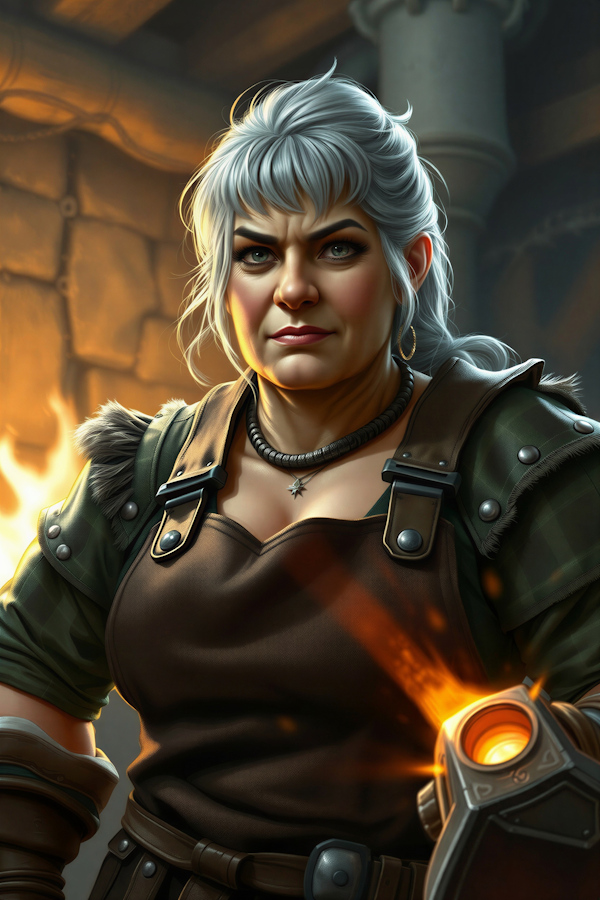
Vera Ironworks, Thane of Brokken-tor, earned her seat the way everything of value is earned inside the Engines of Innovation: through demonstrated mastery, sustained contribution, and the quiet accumulation of trust across decades of work that spoke louder than any words she might have offered in her own defense. In a fortress where merit determines status and engineering families build their reputations across generations, Vera rose from the workshops to the thane's seat without ever raising her voice above the measured tone that her subordinates, her peers, and eventually her entire hall came to recognize as the sound of authority that does not need to announce itself.
She was born into a family of metallurgists whose specialty lay in refining rare ores and crystalline formations found deep within the Ugull Mountains — the materials that make Brokken-tor's precision mechanical work possible. Her parents worked the lower forges, where raw stone was transformed into metals whose tolerances could support the gears, springs, and moving parts for which the fortress had become famous. Vera apprenticed in these forges as a girl, learning the properties of each ore the way other children learned songs, and by the time she completed her training, she understood the relationship between raw material and finished mechanism with an intimacy that few of her contemporaries could match. She did not merely know how to build things. She understood why certain things could be built and others could not, and this understanding — rooted in the physical reality of what metal and stone could and could not do — gave her judgments a weight that transcended personal opinion.
Her rise through Brokken-tor's meritocratic hierarchy was steady rather than spectacular. She served as a forge supervisor, then as a workshop coordinator in the Clockwork Halls, where the complex timing mechanisms that synchronize activity across the entire fortress require constant calibration and occasional redesign. This position suited her temperament perfectly. The Clockwork Halls demand someone who can hold the whole system in mind while attending to the particular — someone who understands that a gear out of tolerance by a fraction of a hair's width in one chamber will cascade into misalignment across a hundred interconnected mechanisms. Vera possessed this systems-level thinking naturally, and over the years of practice, she refined it into an approach to leadership that she would eventually apply to the governance of the entire thane.
She married Torben Ironworks during her years in the Clockwork Halls, a union that combined two engineering lineages whose specializations complemented each other — Vera's metallurgical expertise and Torben's background in structural engineering. Their partnership, like the mechanical systems Vera oversaw, proved greater than the sum of its parts. Together they raised three sons, each of whom followed paths into different branches of Brokken-tor's engineering culture: the eldest into the Great Engine Chamber's experimental division, the second into the stone masonry guild that produces the fortress's famous fermentation casks, and the youngest into the combat engineering corps that defends Brokken-tor's approaches against goblin incursions from Greth and elsewhere in the Ugulls. Vera takes quiet pride in the breadth of her sons' pursuits, seeing in their varied careers a reflection of the fortress's own diversity of craft.
Her elevation to thane came through a selection process that involved evaluation by the heads of every major guild and engineering family in Brokken-tor. The position is not hereditary — in a culture that measures worth by what one produces rather than what one inherits, the idea of passing leadership through bloodline would undermine the very principles that make Brokken-tor what it is. Candidates are assessed on their technical competence, capacity for collaborative decision-making, understanding of the fortress's strategic position, and demonstrated ability to balance competing priorities without sacrificing quality. Vera's candidacy was distinguished not by any single brilliant achievement but by the consistency of her judgment across decades of increasingly complex responsibilities. She had never made a decision that failed under stress. She had never approved a mechanism that did not perform as promised. In a fortress that prizes reliability above all other virtues, this record constituted the most persuasive argument any candidate could offer.
As thane, Vera governs with the same methodical precision she brought to the Clockwork Halls. Her leadership style emphasizes collaboration over individual brilliance, systematic development over inspired improvisation, and rigorous testing of new concepts before they reach the production floor. Under her authority, no innovation is adopted until it has undergone an evaluation process that can take months or years, with prototypes tested under conditions designed to reveal weaknesses that normal operation might not expose for decades. Engineers who chafe at this pace — and there are always some, particularly among the younger generation — find Vera unmoved by arguments that speed matters more than certainty. She has seen what happens when a mechanism fails because its designer was more interested in novelty than durability, and she will not permit that kind of failure to carry Brokken-tor's maker's mark.
Her steel-gray hair, worn short in the practical style favored by those who spend their lives around machinery where loose strands can catch in moving parts, frames features that are handsome in the blunt, angular way common to dwarven women but distinguished by an intensity of expression that makes her seem perpetually engaged in calculation. She does not smile easily, though when she does, the effect is striking precisely because of its rarity. Her eyes, dark and steady beneath heavy brows, assess everything and everyone with the same evaluative patience she applies to a prototype on the testing floor. Subordinates who mistake her quietness for passivity learn otherwise when she delivers assessments — always precise, always substantiated, and occasionally devastating in their accuracy.
Vera's approach to surface-dweller relationships reflects a pragmatism that sets her apart from some of her more insular counterparts among the Seven Thanes. She recognizes that Brokken-tor's mechanical innovations have applications and markets that extend far beyond the dwarven halls, and she has cultivated partnerships with human engineers, Kallendoran airship developers, and Alchester's Progressive Society with a directness that surprises those who expect dwarven leaders to be suspicious of outsiders. She is not suspicious. She is careful, which is a different thing entirely. Surface partnerships are maintained and managed, their scope defined by assessment of what each side contributes and what each side gains. Knowledge flows outward in controlled quantities — enough to sustain the collaborative relationships that benefit Brokken-tor economically and strategically, but not so freely that the fortress's fundamental advantages are compromised. Engineers who work in surface cities do so with the understanding that their primary loyalty remains to Brokken-tor and that the innovations they develop abroad will eventually find their way home.
This comfort with the wider world does not, however, extend to enthusiasm for dwarven reunification. Vera approaches the question with the same caution she applies to an untested mechanism — interested in the theoretical possibilities but unwilling to commit until the practical implications have been thoroughly examined. The Seven Thanes have been independent for over five centuries, and each has developed distinct cultures, governance structures, and economic systems during that time. Reunification would require harmonizing these differences, and Vera is not convinced that the benefits outweigh the disruptions. She has seen what happens when systems that function well independently are forced into integration without adequate testing: misalignment, friction, and failures that damage all parties. When the question arises in inter-thane councils, she advocates for gradual strengthening of cooperative agreements rather than political unification, arguing that the thanes can achieve most of the benefits of unity through careful coordination without risking the upheaval that formal merger would entail.
Her position carries weight in these debates, not because Brokken-tor fields the largest armies — it does not — but because its products are indispensable. The timing mechanisms that coordinate mining operations in Dwathenmoore, the precision instruments that support Akenraen-tor's weather prediction systems, the mechanical components that maintain defensive systems across multiple thanes — all trace their origins to Brokken-tor's workshops. This practical indispensability gives Vera a quiet leverage that military power could never provide. When she speaks in council, the other thane lords listen, not out of fear but because they understand that the devices their own halls depend upon are maintained by the standards Vera sets and the culture she sustains.
Within Brokken-tor itself, Vera navigates the tension between tradition and innovation that defines the fortress's identity. The engineering families that form the backbone of the hall's culture represent centuries of accumulated knowledge, and they guard their expertise with the fierce protectiveness that all dwarves bring to their craft. But the younger generation, raised during the Age of Advancement and exposed to the rapid pace of human technological development, sometimes views the methodical pace of Brokken-tor's adoption process as an obstacle rather than a safeguard. Vera manages this generational friction with characteristic patience, neither dismissing the young engineers' ambitions nor allowing their eagerness to override the testing protocols that ensure Brokken-tor's reputation. She reminds them, when necessary, that the fortress's fame rests not on being first but on being right — that a device bearing their mark must function as promised for as long as it is properly maintained, and that this guarantee is worth more than any advantage that speed alone can provide.
The goblin threat from Greth, whose territory in the Ugulls brings raiding parties into periodic contact with Brokken-tor's outer defenses, falls within Vera's responsibilities as thane but does not dominate her attention the way warfare dominates the leadership of Berjendale. Brokken-tor compensates for its relatively small warrior population with engineering solutions that turn every corridor into a potential killing ground — automated trap networks, pressure-triggered barriers, signal mechanisms that can alert the entire fortress to an incursion within seconds. These systems reflect Vera's philosophy applied to military matters: build it right, test it thoroughly, and trust the mechanism to perform when the moment comes. The goblin lord of Greth has learned through painful experience that attacking Brokken-tor is an exercise in encountering inventive new ways to die.
Vera Ironworks does not inspire the kind of devotion that warriors feel for battle leaders or the reverence that subjects offer to monarchs who claim divine right. What she inspires is something more durable and, in Brokken-tor's reckoning, more valuable: confidence. Confidence that the thane understands the work, respects the craft, and will not permit the standards that define Brokken-tor to be compromised by haste, politics, or the passing enthusiasms of any single generation. She leads the Engines of Innovation not by commanding them but by embodying the principles they were built upon — precision, patience, and the conviction that anything worth making is worth making right.