Vexthul the Bone Keeper, Warden of the Ancestral Deep
Introduction
Vexthul the Bone Keeper is the sitheri deity of death, judgment, and the passage between the living world and the Ancestral Deep—the realm from which the sitheri emerged at the dawn of creation and to which they will return when their time in the world is complete. Vexthul collects the dead, sorts them, and determines whether they are worthy of joining the ancestors in the Deep or whether they are condemned to dissolution—the slow unmaking of identity and memory that the sitheri consider a fate worse than any death the living world can inflict. Among the four gods of the sitheri Swamp Pantheon, Vexthul is the one the sitheri think about least and fear most, because thinking about Vexthul means thinking about the end, and fearing Vexthul means fearing not death itself but the judgment that follows it.
Vexthul’s gender is unknown. The sitheri do not assign one, and the myths offer no indication that Vexthul possesses or has ever possessed any quality that would resolve the question. The Bone Keeper is neither male nor female, neither mother nor hunter, neither the one who produces nor the one who kills. Vexthul is the one who receives what the others are finished with—the final station in the chain of sitheri existence, the ledger in which every life is recorded and every life is weighed. Gender is a characteristic of the living. Vexthul operates at the boundary where living ceases to be the relevant category.
Most sitheri believe Vexthul is dormant—not dead, not departed, but withdrawn into the Ancestral Deep to wait for the moment when the conditions of the world demand a return. This belief distinguishes Vexthul from the other gods of the pantheon, whose fates range from the contested (Sythraxis), to the confirmed (Morghen), to the ambiguous (Thessara). Vexthul is none of these. Vexthul is patient. The sitheri have always understood that death does not hurry, does not force itself on schedules it has not chosen, and does not appear until the time is exactly right. If Vexthul has not returned, the sitheri reason, it is because the time is not yet right. When it is, the Bone Keeper will emerge from the Deep with the same calm, unhurried inevitability that death itself brings to every life it claims.
Appearance & Symbols
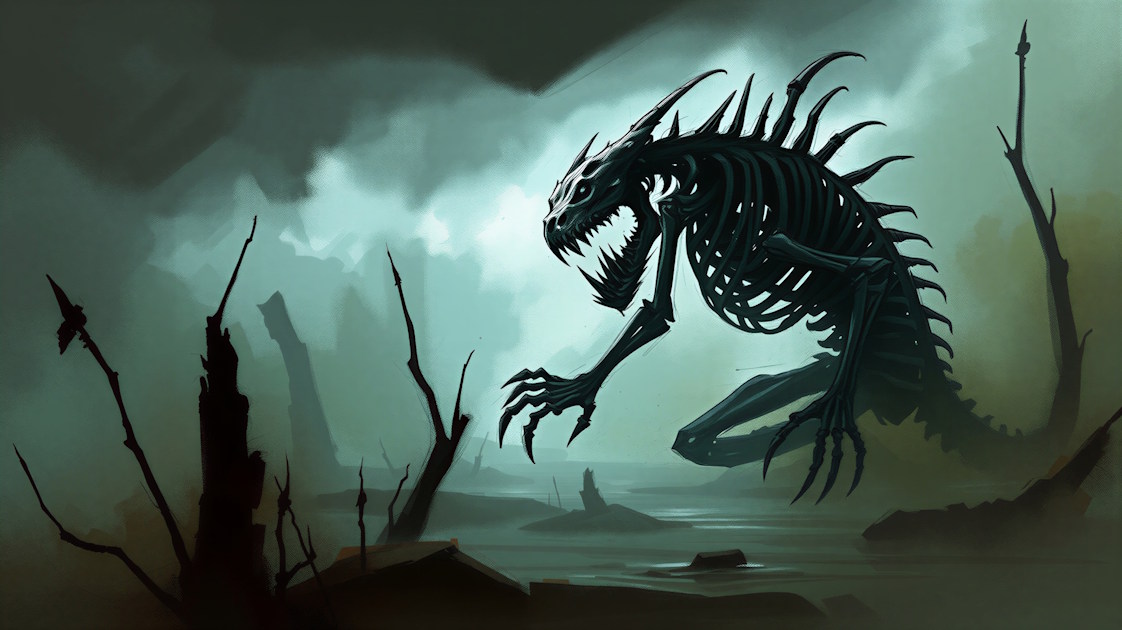
Vexthul is depicted as a skeletal sitheri—stripped of scale and muscle and every other tissue that distinguishes the living from the dead, reduced to the framework that remains when everything impermanent has been removed. The bones are rendered in the yellowed grey of remains that have lain in swamp water long enough to absorb its mineral content, stained with the particular discoloration that the Grimmere’s chemistry produces in organic material left submerged beyond the point of decay. Vexthul is not a skeleton in the human artistic tradition—grinning, theatrical, posed in the dramatic attitudes of mortality. Vexthul is bones arranged in the posture of a sitheri at rest, neither threatening nor welcoming, simply present in the way that the dead are always present in a swamp that does not release what it receives.
The skull is the focal point of every depiction—elongated, serpentine, the jaw slightly open in a posture that suggests neither speech nor silence but the specific stillness of a mouth that has nothing to say and will wait indefinitely for the moment when it does. The eye sockets are empty, rendered without the pinpoints of light or spectral glow that other races’ death imagery typically provides. Sitheri artists insist on the emptiness. Vexthul does not see with eyes. Vexthul sees with the comprehensive awareness of something that has examined every dead thing the Grimmere has ever produced and that knows the interior of every life as thoroughly as the bones know the interior of the body that carried them.
Vexthul is always depicted in stillness—not the coiled readiness of Sythraxis or the pre-strike tension of Morghen but the absolute motionlessness of something that has no reason to move because everything it needs comes to it eventually. The Bone Keeper does not hunt. The Bone Keeper does not pursue. The Bone Keeper sits at the end of every path and waits, and the path always delivers. This stillness is the most unsettling quality in sitheri sacred art, because it communicates a patience that is not chosen but inherent—the patience of something that cannot conceive of urgency because urgency implies the possibility that the outcome might not occur, and death always occurs.
Vexthul carries no weapons and wears no adornment. In some depictions, the skeletal hands cradle a single bone—never the same bone twice, never from an identifiable individual—representing the act of collection that defines the Bone Keeper’s function. In others, the hands are empty and open, palms upward, in the posture of a collector waiting to receive what is owed. The sitheri consider the empty-handed depictions more authentic. Vexthul does not need to take. Vexthul only needs to wait.
The primary symbol associated with Vexthul is the Hollow Eye—a single empty eye socket rendered as an oval void, representing both the Bone Keeper’s gaze and the emptiness that awaits the unworthy dead. This symbol appears on funerary sites, on the bones of the honored dead, and on the boundary markers that delineate the approaches to the Ancestral Deep’s surface manifestations. Secondary symbols include the Sorted Bones, two bones crossed with one placed above the other (representing the separation of the worthy from the unworthy), and the Descent Line, a single vertical stroke ending in a downward curve, representing the passage from the living world into the Deep.
Origins
The sitheri tell Vexthul’s origin as an ending story, because Vexthul is the ending of every story. In the earliest days of the Grimmere, when Sythraxis was producing her first clutches and Morghen was conducting his first hunts and Thessara’s waters were rising and falling with the indiscriminate enthusiasm of a new force learning its own capacity, things died. This was expected. This was necessary. The swamp could not sustain infinite life any more than it could sustain infinite water, and the removal of the dead was as essential to the ecosystem’s health as the production of the living. But the dead did not go anywhere. They accumulated. Bodies piled in the shallows, clogged the channels, and poisoned the water with their decay. The swamp was producing death faster than it could process the results.
Vexthul emerged from the accumulation. Not from the dead themselves but from the need to address them—the same principle of necessity that had produced Morghen from the swamp’s first killing and Thessara from the water’s first current. The world required something that would collect the dead, evaluate them, and determine their disposition. Something that would impose order on the chaos of mortality, ensuring that the dead served the living rather than burying them. Vexthul was that requirement given form—the final necessary function, the closer of accounts, the last thing any sitheri would ever see.
Vexthul’s first act was to sort. The myths describe the Bone Keeper moving through the accumulated dead of the earliest Grimmere with the methodical attention of a collector cataloging specimens, examining each body, assessing each life through evidence inscribed in bone and scale and the pattern of wounds that recorded how the creature had lived and how it had died. Those that had lived according to the principles the swamp demanded—predation, endurance, loyalty to the systems that sustained them—were gathered and carried downward, into the deep places beneath the mud, into the Ancestral Deep where their essence would be preserved. Those that had lived in violation of those principles—the weak who had survived through luck rather than merit, the parasites who had taken without contributing, the cowards who had fled when the swamp required them to stand—were left where they lay, their substance dissolving into the muck, their identities erased, their existence unmade as thoroughly as if they had never been born.
This first sorting established the template that Vexthul has followed ever since: collect, evaluate, preserve or dissolve. The sitheri absorbed the lesson immediately. Death was not the end. Death was a review. And the review was conducted by something that could not be deceived, could not be bribed, and could not be persuaded to change its assessment once the assessment was made.
Domains & Attributes
Vexthul governs death as a process rather than an event—not the moment of dying, which is frequently the domain of Morghen’s hunts or Thessara’s drownings, but everything that happens after the dying is done. The collection of the body, the assessment of the life, the determination of worthiness, and the disposition of the remains—these are Vexthul’s responsibilities, and they are executed with the dispassionate precision of a functionary whose job is too important to be contaminated by personal opinion.
Judgment forms the core of Vexthul’s second domain—the evaluation of each sitheri life against the standards that their culture establishes as the measure of a life properly lived. Worthiness in Vexthul’s assessment is not a matter of power, wealth, or even martial achievement, though these things may contribute to a favorable judgment. Worthiness is adherence—to sitheri traditions, to the brood mother’s authority, to the matriarchal order that Sythraxis established, to the hunting codes that Morghen set, to the territorial boundaries that define the broods, to the rituals and sacrifices that maintain the sitheri’s relationship with their gods and their environment. A warrior who completed the Hundred Scalps but defied his brood mother’s commands may find his judgment harsher than a lesser fighter who served the brood with perfect loyalty. Vexthul does not weigh accomplishments. Vexthul weighs fidelity.
The Ancestral Deep constitutes Vexthul’s third domain—the realm beneath the world where the worthy dead are preserved and where the sitheri believe their race originated before Sythraxis brought them into physical existence. The Deep is not an afterlife in the sense that other races understand the concept. It is not a paradise or a punishment. It is a return—a going back to the place from which the sitheri came, carrying the accumulated experience of a life lived in the world above. The worthy who enter the Deep join the ancestors, adding their knowledge and their identity to the collective reservoir from which future sitheri will eventually be drawn. The unworthy do not enter. They dissolve, their substance recycled, their identities erased, their contribution to the ancestral reservoir denied.
Vexthul’s domain does not extend to the manner of death. How a sitheri dies is Morghen’s concern if the death occurs in combat, Thessara’s if it occurs by drowning, or no god’s particular concern if it occurs through age, illness, or accident. Vexthul engages only after the dying is complete, claiming the body and the identity at the precise moment when the last vital process ceases. The myths are specific that Vexthul never arrives early and never arrives late. The Bone Keeper’s timing is absolute, calibrated to the instant of transition with a precision that no other force in sitheri mythology can match.
Nature & Temperament
Vexthul has no personality. This is not an exaggeration or a theological simplification. The sitheri myths describe the Bone Keeper with a consistency that leaves no room for the character traits that other gods possess: no anger, no satisfaction, no preference, no aversion, no curiosity, no boredom, no attachment to outcomes beyond the execution of the function that defines Vexthul’s existence. Sythraxis is cold but possesses the fierce possessiveness of a mother. Morghen is detached but carries the pride of a hunter. Thessara is indifferent but displays the caprice of an element that moves according to its own inscrutable rhythms. Vexthul displays nothing. Vexthul is the absence of display—a consciousness, if it can be called that, so completely devoted to a single function that nothing remains for any other purpose.
The sitheri find this quality more disturbing than any of the active malice or divine cruelty that characterizes the other gods. Cruelty can be anticipated, prepared for, potentially avoided through cunning or strength. Sythraxis’s consuming hunger can be placated through sacrifice. Thessara’s caprice can be mitigated through offerings and structural adaptation. Even Morghen’s predatory focus can be evaded by those fast or clever enough to escape his attention. Vexthul cannot be anticipated because there is nothing to anticipate. The Bone Keeper does not react. Does not negotiate. Does not respond to offerings, threats, flattery, or any other input that assumes a being capable of being influenced. Vexthul arrives when the dying is done, performs the assessment, and delivers the verdict. The process admits no appeal, no revision, no second opinion. It is the most final thing in a culture that values finality, and the sitheri respect it with the particular wariness reserved for forces that cannot be engaged on any terms except their own.
The calm that Vexthul embodies is not serenity. Serenity implies a choice to be at peace. Vexthul’s calm is structural—the stillness of a mechanism with no moving parts until the moment of activation, and that returns to perfect stillness the instant its function is complete. Between collections, Vexthul exists in a state that the myths describe as waiting without expectation, a condition so alien to the sitheri experience of constant vigilance and competitive tension that they find it almost impossible to imagine. A being that does not want. Does not plan. Does not scheme. Simply waits, with the certainty that what it waits for will arrive, because it always does.
The sitheri’s relationship with Vexthul is accordingly the simplest and most uncomfortable in their theology. They cannot bargain with the Bone Keeper. They cannot appease it. They cannot avoid it. The only variable within their control is the judgment they will receive, and the only way to influence that judgment is to live according to the standards that Vexthul uses to evaluate the dead. This creates a feedback loop that the brood mothers exploit with transparent efficiency: obey the traditions, serve the brood, honor the matriarchal order, complete the rituals, and Vexthul will carry you to the Ancestral Deep. Fail in any of these obligations, and dissolution awaits. The theology is simple. The incentive structure is elegant. And the enforcer is the one god in the pantheon that cannot be corrupted, distracted, or deceived.
The Swamp Pantheon
Vexthul’s position within the Swamp Pantheon is that of the conclusion—the final function in the chain of sitheri existence, the station where every other god’s work eventually arrives. Sythraxis produces. Morghen hunts. Thessara provides the medium. Vexthul collects the results. The arrangement is sequential rather than competitive, which explains why Vexthul’s relationships with the other gods are the least contentious in the pantheon. There is nothing to compete for. What the other gods are finished with, Vexthul claims. The transfer is automatic, inevitable, and requires no negotiation.
Vexthul’s relationship with Sythraxis is defined by the boundary between creation and dissolution. Sythraxis produces the living. Vexthul processes the dead. The two domains share no territory and require no interaction except at the moment of death, when what was Sythraxis’s becomes Vexthul’s. The myths describe no conflict between them because conflict requires competing interests, and the Bone Keeper has no interest in the living the way the First Mother has no interest in the dead. Their domains are perfectly complementary, two halves of a cycle that requires both to function. The sitheri observe that if there is a model for peaceful coexistence in their theology, it is the relationship between the goddess who makes and the god who unmakes—each one respecting the other’s domain because trespassing would serve no purpose.
Vexthul’s relationship with Morghen is the most frequently referenced partnership in the pantheon, defined by the simple transaction that Morghen’s myths acknowledge directly: the hunter produces the dead, the Bone Keeper collects them. Morghen had no interest in the dead once the kill was complete. Vexthul had no interest in the living until they ceased to be. The arrangement required no maintenance, no renegotiation, no adjustment over time. Morghen killed. Vexthul sorted. The dead who had fallen to a worthy hunter received the assessment their lives merited. The dead who had fallen to an unworthy one received the same assessment, because Vexthul’s judgment is based on how the dead lived, not on who killed them.
Vexthul’s relationship with Thessara follows the boundary established in Thessara’s own mythology: the drowned become Vexthul’s, the water that drowned them remains Thessara’s. This boundary is the cleanest in the pantheon, maintained without friction because both deities operate with the same fundamental indifference to outcomes beyond their specific domains. Thessara does not care what happens to the drowned after the drowning. Vexthul does not care how the drowning occurred. The transfer of the dead from water to judgment is as automatic and impersonal as the transfer of rain from cloud to ground.
The Great Deeds
Vexthul’s Great Deeds are acts of sorting—not dramatic confrontations or spectacular displays of power but the methodical, comprehensive execution of the function that defines the Bone Keeper’s existence. The sitheri tell these stories in the flat, enumerative style of a census rather than a saga, listing what was collected and what was dissolved with the same impersonal precision that Vexthul brings to the work itself.
The First Sorting is Vexthul’s foundational deed, described in the origin myth: the collection and evaluation of every dead thing that had accumulated in the Grimmere before the Bone Keeper’s emergence. The myths describe this process lasting for an unspecified period during which Vexthul moved through the swamp with methodical thoroughness, examining every corpse, every fragment of bone, every trace of organic matter that had once been alive and was now awaiting disposition. The sheer scale of the First Sorting is the element the sitheri emphasize—not the drama of individual judgments but the comprehensiveness of a process that left nothing unexamined and nothing undisposed. When Vexthul finished, the Grimmere was clean. The worthy had been carried to the Ancestral Deep. The unworthy had been dissolved. And the living understood, for the first time, that nothing they did in life would escape review after death.
The Judgment of the Broken Brood is the most frequently cited of Vexthul’s deeds and the one that brood mothers invoke when enforcing adherence to tradition. An early brood—the myths do not specify which, and the deliberate vagueness ensures that every brood can imagine it as a cautionary tale about someone else—abandoned the matriarchal order that Sythraxis had established, allowing a male to seize authority and restructure the tribe around principles of individual power rather than communal obligation. The brood thrived for a time under this arrangement, its warriors growing fat on successful raids and its territory expanding at the expense of weaker neighbors. Then the warriors began to die, as all things die, and Vexthul came to collect them.
The Bone Keeper evaluated each dead warrior against the standards of sitheri tradition and found them wanting. Not because they were poor fighters—their kills were impressive, their scalp counts high. But they had served a usurper rather than a legitimate brood mother. They had abandoned the matriarchal order. They had broken the chain of authority that traced back to Sythraxis through the line of mothers. Their lives, however successful by material measures, had been lived in violation of the traditions that Vexthul uses as the measure of worthiness. Every warrior of the Broken Brood was dissolved. Not one was carried to the Ancestral Deep. The brood mother who eventually reclaimed authority over the survivors pointed to the empty funerary sites—places where bones should have been honored but where nothing remained—as proof that Vexthul’s judgment cannot be deceived by worldly success. The sitheri took the lesson. Power without legitimacy is dissolution waiting to happen.
The Weighing of the Ten is the most mysterious of Vexthul’s deeds—a story told only by shamans and only during the most solemn funerary observances. According to this myth, Vexthul evaluated the Ten Daughters of Sythraxis themselves, not after their deaths but during their lives, assessing whether the founding mothers of sitheri civilization met the standards they would impose on their descendants. The myth does not reveal Vexthul’s verdict. It simply states that the evaluation occurred, that Vexthul observed each daughter for an unspecified period, and that the Bone Keeper’s findings were recorded in the Ancestral Deep where they remain inaccessible to the living. The myth’s power lies in its implications: if even the divine founders of the ten broods were subject to Vexthul’s judgment, then no sitheri who has ever lived or will ever live is exempt. The review is universal. The standards are absolute. And the reviewer has been watching since before any of them were born.
The Fall of the Old Gods
Vexthul’s role during the Fall of the Old Gods was, characteristically, the collection of the dead. While Sythraxis consumed the corruption that poisoned the deep waters, while Morghen fought and was killed in the Merrow Woods before the Fall, and while Thessara’s presence drained from the Grimmere’s channels, Vexthul performed the only function the Bone Keeper has ever performed: collecting, sorting, and disposing of the dead that the cataclysm produced in numbers that exceeded anything the swamp had experienced since the earliest days of its existence.
The Fall killed things. Many things. Not just gods and civilizations but the lesser creatures that populated the edges of the Grimmere—animals, plants, organisms that had thrived for millennia and that died in hours when the cosmic energies disrupted the conditions that sustained them. Sitheri died too, caught by floods, crushed by collapsing terrain, killed by the secondary effects of a cataclysm that the swamp’s isolation could reduce but not eliminate. The dead accumulated faster than at any point since the pre-Vexthul era, threatening to overwhelm the Grimmere with the same choking mass of unprocessed remains that had prompted the Bone Keeper’s original emergence.
Vexthul processed them all. The myths describe the Bone Keeper working through the accumulated dead with the same methodical thoroughness displayed during the First Sorting, examining each life, delivering each verdict, carrying the worthy to the Ancestral Deep and dissolving the unworthy into the muck. The scale of the task was unprecedented, but Vexthul’s pace did not change. The Bone Keeper did not hurry during the Fall any more than it hurries during ordinary times, because death does not operate on emergency schedules. Each dead thing received the same assessment it would have received under normal circumstances. The cataclysm did not alter the standards. The standards do not alter.
The Withdrawal of Vexthul
After the Fall’s dead had been processed—every body collected, every life assessed, every verdict delivered—Vexthul withdrew. The sitheri do not call this a death or a disappearance or a draining. They call it exactly what it appears to be: a withdrawal, a deliberate retreat into the Ancestral Deep by a being that had completed its immediate work and saw no reason to remain in the world above until more work accumulated. Vexthul did not flee. Did not fade. Did not succumb to the corruption that consumed Sythraxis or the violence that killed Morghen. The Bone Keeper simply finished the job, turned, and descended into the Deep with the same unhurried calm that characterized every other action it had ever taken.
The sitheri find this the most plausible divine departure in their theology, because it is the most consistent with Vexthul’s established character. A being that exists solely to collect and sort the dead has no reason to remain in the world of the living during periods when the living are not dying in sufficient numbers to require divine intervention. Ordinary death—the steady, manageable trickle of mortality that every population produces—can be handled by the systems Vexthul established without requiring the Bone Keeper’s personal attention. The Ancestral Deep continues to receive the worthy. Dissolution continues to claim the unworthy. The process functions. Vexthul, having ensured that it functions, withdrew to the Deep to wait for the next occasion when the scale of death exceeds the system’s capacity to process it without divine oversight.
This interpretation carries an implication that the sitheri find simultaneously reassuring and deeply unsettling: Vexthul will return when the dead accumulate faster than the system can process them. A war of sufficient magnitude. A cataclysm of sufficient scope. A dying of sufficient scale to overwhelm the mechanisms that ordinarily handle the transition from life to judgment. When that threshold is crossed, the Bone Keeper will emerge from the Ancestral Deep with the same calm, measured inevitability that characterizes every other appearance, and the sorting will resume under divine supervision. The sitheri do not know what event will trigger the return. They do not know when it will occur. They know only that it will occur, because death always produces more dead, and eventually the dead will require the Bone Keeper’s personal attention once again.
Some shamans whisper that Vexthul’s withdrawal was not merely a retreat to wait but a preparation—that the Bone Keeper descended into the Ancestral Deep to organize it, to arrange the accumulated dead of millennia into the order that will be necessary when the sitheri race itself reaches its end and the entire species returns to the Deep from which it came. In this interpretation, Vexthul is not waiting idly. Vexthul is building—constructing the final architecture of the ancestral realm, preparing the space that will receive every sitheri who has ever lived when the cycle of emergence and return reaches its conclusion. The brood mothers neither confirm nor deny this interpretation, because unlike the shamanic traditions surrounding Sythraxis and Thessara, the belief that Vexthul is preparing for the sitheri’s ultimate return does not threaten their authority. If anything, it reinforces it: live well, obey the traditions, honor the matriarchal order, and when the end comes, the place that Vexthul has prepared for you will be ready.
Legacy & Enduring Influence
Vexthul’s legacy operates as the invisible enforcement mechanism of sitheri civilization—the consequence that awaits every deviation from tradition, every betrayal of the brood, every failure to live according to the standards that the culture demands. The other gods provide positive models: be productive like Sythraxis, be lethal like Morghen, be adaptable like the water Thessara governs. Vexthul provides the negative model: fail to be these things, and dissolution awaits. Not punishment. Not torment. Simply erasure—the removal of identity, memory, and existence from the ancestral record, as though you had never been born. The sitheri fear many things, but they fear dissolution above all, because dissolution means that everything you did, everything you were, everything you fought and killed and endured to achieve will be unmade as completely as if it never happened.
The funerary traditions that Vexthul established remain the most universally observed practices in sitheri culture, followed with identical precision across all ten broods regardless of the inter-tribal conflicts that divide them in every other respect. The treatment of the dead is the one area where sitheri society achieves something approaching unanimity, because the consequences of improper funerary practice are believed to affect not just the deceased but the entire brood’s standing in Vexthul’s assessment. A brood that dishonors its dead risks collective judgment—a verdict that would condemn not individual warriors but the brood’s cultural identity to the dissolution that awaits the unworthy.
The concept of the Ancestral Deep—the realm of origin and return—shapes sitheri understanding of their place in the world in ways that distinguish them from every other race in Uhl. The sitheri do not believe they belong to this world permanently. They believe they were drawn from the Deep by Sythraxis, placed in the Grimmere to live and hunt and prove themselves, and that they will eventually return to the Deep carrying the accumulated experience of their time above. This understanding creates a people who view their existence as a temporary assignment rather than a permanent condition—a sojourn in the world of the living that will be evaluated upon its completion and that must therefore be lived according to standards that the evaluator will find acceptable.
Worship & Observances
Worship of Vexthul is conducted entirely through funerary practice. The sitheri do not pray to the Bone Keeper, do not offer sacrifices in its name, do not conduct ceremonies requesting its favor or intercession. The only interaction they seek with Vexthul is the one that every sitheri will experience exactly once: the judgment that follows death. The preparation for that judgment is the totality of Vexthul’s worship—a lifetime of adherence to tradition, service to the brood, and observance of the rituals that the culture demands, conducted not out of devotion to the Bone Keeper but out of the practical desire to receive a favorable assessment when the inevitable review occurs.
The Rite of Bone Laying is the primary funerary observance, conducted when a sitheri of standing dies and the brood prepares the remains for Vexthul’s collection. The body is stripped of flesh through exposure to the swamp’s scavenging organisms—a process the sitheri consider natural and proper, returning the soft tissue to the ecosystem while preserving the bones that carry the individual’s identity to the Bone Keeper. The cleaned bones are arranged in a specific pattern on a platform of woven reeds, positioned to face downward toward the Deep, and left for a prescribed period during which the brood mother recites the deceased’s achievements, lineage, and adherence to tradition. The recitation is not a eulogy in the human sense. It is an argument—a case made to Vexthul, wherever the Bone Keeper may be, that this individual lived worthily and deserves admission to the Ancestral Deep.
The Dissolution Warning is the counter-ceremony, conducted when a sitheri dies in disgrace—a traitor, a coward, a breaker of the matriarchal order. In this rite, the body is denied the Bone Laying. The remains are scattered in the swamp without ceremony, the flesh and bones left to dissolve in the muck without the arrangement and recitation that would present the deceased favorably to Vexthul. The brood mother publicly declares the individual unworthy, and the name is stricken from the brood’s oral records. This is not merely a punishment for the dead. It is a warning to the living: this is what dissolution looks like, and this is what awaits anyone who fails to meet the standards that the Bone Keeper enforces.
The Night of Counting, observed annually during the coldest period of the year when the sitheri’s cold-blooded bodies are at their most sluggish and mortality is at its seasonal peak, involves the communal recitation of every honored dead from the brood’s history. The recitation can take hours or days depending on the brood’s age and size, and participation is expected of every adult member of the tribe. The Night of Counting serves dual purposes: it preserves the oral record of the brood’s honored dead, and it reminds every living sitheri that their own name will either be added to this list or omitted from it, depending on how they live the remainder of their lives.
Sayings & Proverbs
Sitheri sayings associated with Vexthul are sparse and carry the specific gravity of words that reference the one force in sitheri existence that admits no negotiation.
“The Bone Keeper sees the marrow” is a warning against the belief that outward conformity to tradition is sufficient to pass Vexthul’s judgment. The saying asserts that the assessment penetrates beneath surface behavior to evaluate the interior of a life—the motivations, the loyalties, the private deviations that the living believe they have hidden from observation. A warrior who performs the rituals without conviction, a brood member who obeys outwardly while harboring disloyalty, a sitheri who meets every visible standard while violating the spirit of the traditions is warned that the Bone Keeper evaluates the marrow, not the scale.
“Worthy bones or wet mud” reduces Vexthul’s entire theology to its fundamental binary: either your remains are carried to the Ancestral Deep and preserved, or they dissolve into the swamp and are forgotten. The phrase is used when decisions of moral consequence arise, reminding the decision-maker that every choice contributes to the assessment that will determine which outcome applies. There is no middle ground. There is no partial credit. Worthy bones or wet mud. Choose accordingly.
“Vexthul waits” is spoken as both a statement of fact and a threat, applicable to any situation where the speaker wishes to remind the listener that actions have consequences that extend beyond the immediate moment. The phrase carries the weight of absolute certainty—not the conditional certainty of “you might be caught” but the unconditional certainty of “you will be assessed, and the assessment will be final.” It is the most effective deterrent in sitheri culture, more feared than the brood mother’s displeasure or the warrior’s blade, because the brood mother can be deceived and the warrior can be defeated, but Vexthul cannot be avoided.
“Add my name to the counting” is the closest thing the sitheri have to a prayer—a statement of aspiration rather than supplication, expressing the hope that the speaker’s life will be judged worthy of inclusion in the brood’s roll of honored dead. The phrase is spoken before battle, before dangerous undertakings, and sometimes in the quiet moments before sleep when a sitheri contemplates the assessment that every life eventually receives. It is not addressed to Vexthul directly. It is addressed to the life the speaker is living, a reminder to oneself that the counting will occur and that the only variable within one’s control is whether the name that is counted will be one’s own.
Sacred Sites
The Bone Fields are the primary sacred sites associated with Vexthul—designated areas within each brood’s territory where the Rite of Bone Laying is conducted and where the remains of the honored dead are placed for Vexthul’s collection. These sites are maintained with an attention to order that is unusual in sitheri culture, the bones arranged on their reed platforms in precise patterns that have not changed since the earliest days of the funerary tradition. The Bone Fields are neutral ground during inter-tribal conflicts—one of the very few designations of inviolable space in sitheri society, maintained because even the most aggressive brood mother understands that desecrating a rival’s Bone Field risks collective judgment from a deity that does not distinguish between military aggression and sacrilege.
The Descent Points are locations throughout the Grimmere where the sitheri believe the boundary between the living world and the Ancestral Deep is thinnest—places where the mud is soft enough and the water deep enough that objects placed on the surface slowly sink beyond recovery, as though the Deep itself were drawing them downward. These sites are used for offerings to the ancestors—weapons, trophies, and personal items placed on the surface and allowed to sink, carrying the sender’s respects into the realm where the honored dead reside. The sitheri do not claim that these offerings reach the Deep. They claim only that the offerings disappear, and that the disappearance is consistent with the existence of a realm beneath the world that receives what is sent to it.
The Hollow, a specific location known to every brood but belonging to none, is the site where sitheri tradition places Vexthul’s original emergence—the point where the accumulation of the first dead reached the critical mass that produced the Bone Keeper’s consciousness. The Hollow is a natural depression in the deep Grimmere, unremarkable in appearance, notable only for the complete absence of living organisms within its boundaries. Nothing grows in the Hollow. Nothing nests there. The water that fills it is still, clear, and devoid of the microbial activity that characterizes every other body of water in the swamp. The sitheri interpret this sterility as evidence of Vexthul’s lingering presence—a space so thoroughly claimed by the god of death that life itself cannot take root within it.
Concluding Remarks
Vexthul the Bone Keeper waits. This is the beginning and the end of everything the sitheri know about their god of death, the single certainty in a theology otherwise characterized by contested narratives and competing interpretations. Sythraxis may be dead or dormant. Thessara may have drained or departed. Morghen is gone, killed in a foreign swamp by a faster predator. But Vexthul waits, somewhere in the Ancestral Deep, sorting the bones that have already arrived and preparing for the bones that have not yet been delivered. The Bone Keeper’s patience is not a virtue. It is a fact of existence—as immutable as the certainty that every living thing will eventually become a dead thing, and that every dead thing will eventually be weighed.
The sitheri do not love Vexthul. They do not admire the Bone Keeper or aspire to emulate its qualities. They endure its existence the way they endure the swamp’s flooding and the seasons’ turning—as a condition of their world that cannot be changed, only adapted to. The adaptation is straightforward: live according to the traditions, serve the brood, honor the matriarchal order, complete the rituals, and when the assessment comes, the verdict will be favorable. The Ancestral Deep will receive you. Your name will be added to the counting. Your bones will be preserved among the worthy, and your identity will endure in the reservoir from which future sitheri will be drawn.
Fail in these obligations, and the alternative is dissolution—the quiet, total erasure of everything you were, performed without malice, without regret, and without the possibility of appeal by a being that has never once, in the entire span of sitheri mythology, changed its mind. Vexthul does not reconsider. Vexthul does not forgive. Vexthul sorts the bones, delivers the verdict, and returns to the stillness that is not patience but simply the natural state of something that has all the time in the world and no reason to use it until the next delivery arrives.
The Bone Keeper waits. The sitheri live with that knowledge the way they live with everything else—practically, without illusion, and with the cold awareness that the only thing standing between them and oblivion is the quality of the life they are living right now. Worthy bones or wet mud. The counting continues. And in the Ancestral Deep, in the silence that has no bottom and no end, Vexthul sits with open hands and empty eyes, ready to receive whatever the world sends down.