BERJENDALE
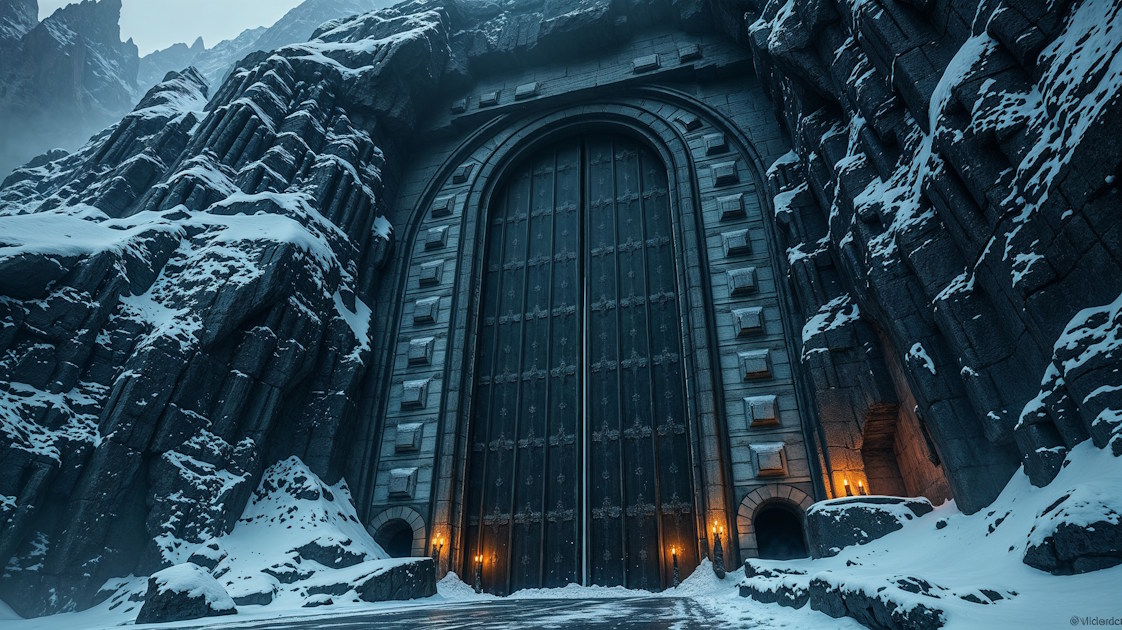
In the Alzion Mountains, where goblin strongholds infest the southern peaks and the threat of raid and siege has never known a true cessation, Berjendale stands like a clenched fist of black stone and iron against the darkness. Known throughout Uhl as the Iron Gates of the South, centuries of unrelenting warfare forged this fortress into the most militaristic of the Seven Thanes—a community where the arts of war are not simply valued but have become the organizing principle around which every aspect of life revolves. Other thanes craft and trade, brew and celebrate, and tend to the rhythms of dwarven domesticity with war as an occasional interruption. Berjendale inverts that relationship. Here, war is the constant, and everything else exists to serve it.
The fortress architecture announces its purpose before a visitor reaches its gates. Where the halls of Rillock welcome with broad approaches and human-scale doorways, and Akenraen-tor dazzles with sky-facing platforms and observation chambers, Berjendale presents a face of uncompromising severity. The outer walls are constructed from the dark stone native to this part of the Alzions, cut into massive blocks and fitted with a precision that leaves no seam wide enough to admit a knife blade. Arrow slits replace windows. Murder holes line every approach corridor. The passages leading inward are deliberately narrow, designed to force attackers into single file where defenders can bring overwhelming force to bear against each individual who rounds a corner. Every design element has been optimized for defense and tactical advantage, the aesthetic sensibility of traditional dwarven architecture subordinated entirely to the requirements of a fortress that expects attack and intends to make every attacker pay dearly for the privilege.
The gates themselves—the massive iron barriers from which Berjendale derives its epithet—are masterpieces of dwarven engineering pressed into martial service. The primary gate consists of multiple layers of protection: an outer barrier of solid iron plates, thick enough to resist battering rams and alchemical fire; a secondary gate incorporating mechanical traps that can be triggered to crush, impale, or flood the space between the two barriers; and a final inner gate reinforced with alchemical defenses whose precise nature is among the fortress’s most closely guarded secrets. These gates have never been breached. Goblin armies have broken themselves against them for centuries, and the scars of those failed assaults—gouges in the iron, scorch marks from crude alchemical weapons, the remnants of siege engines left to rust in the approaches—serve as both decoration and warning to any who contemplate testing Berjendale’s defenses.
The fortress’s position in the Alzions places it in direct proximity to some of the most concentrated goblin populations outside the Ugull Mountains. The great goblin fortress-city of Gugal lies within the same mountain range, its tunnel networks pushing outward in every direction, and smaller goblin settlements dot the surrounding peaks in numbers that no surface survey has ever fully accounted for. This proximity has defined Berjendale’s character since its founding. The dwarves who settled here during the Age of Resilience understood that they were establishing their home in contested territory, and every generation since has reinforced that original commitment with blood, iron, and an institutional memory of conflict that pervades every level of the fortress’s culture.
The military forces of Berjendale represent the most formidable fighting force assembled by any dwarven community since the era of the unified kingdom. Every able-bodied dwarf in the fortress receives combat training from youth, and the distinction between soldier and civilian that exists in other thanes is largely absent here. Smiths forge weapons between shifts on the walls. Brewers maintain their vats with one eye on the signal fires that announce goblin movement in the surrounding peaks. Children learn to handle axes before they learn their clan histories, and the stories they hear at the hearth are not the gentle ancestral tales told in Dwathenmoore or Rillock but accounts of battles fought, enemies slain, and the tactical innovations that turned the tide in engagements where the fortress’s survival hung in the balance.
The primary fighting clan—whose warriors form the core of Berjendale’s military strength—has achieved a reputation that extends well beyond the Alzions. These are not the defensive tunnel fighters of Dwathenmoore’s Deep Guard or the extreme-terrain specialists of Akenraen-tor’s Skyreach Rangers but aggressive, versatile warriors trained for both underground and surface combat, capable of conducting offensive operations deep into goblin territory as readily as they defend their own walls. Their tactics emphasize coordinated aggression—shield walls that advance rather than hold, flanking maneuvers through secondary tunnels, and pre-emptive strikes against goblin staging areas before raids can be launched. The shift from purely defensive operations to this more aggressive posture represents the most significant military development in Berjendale’s modern history, and it is inseparable from the rise of the fortress’s current leadership.
Grak Ironforge did not come to power through the traditional process of consensual selection by a council of elders. He seized the position through direct challenge and combat, defeating the previous thane lord in a trial of arms that, while not without precedent in dwarven history, violated the norms that have governed succession in most thanes for centuries. The challenge itself was conducted according to the ancient rites—no one disputes its technical legitimacy—but the manner of the ascension sent a clear signal about the values that would define the new thane’s rule. Strength, not consensus. Action, not deliberation. The martial virtues that Berjendale had always prized were elevated from cultural traits into governing principles, and the council of elders, while still nominally active, found its advisory role diminished in favor of a war council composed of the fortress’s most accomplished military commanders.
Under this leadership, Berjendale has transformed from a defensive bastion into something closer to a military state. The fortress’s economy, always oriented toward martial production, has been reorganized almost entirely around the forging of weapons and armor. Berjendale’s smiths have long been respected for the quality of their military output—heavy axes, war hammers, shields, and plate armor built to withstand the brutal close-quarters fighting that characterizes combat in mountain tunnels. But recent production has yielded equipment whose properties raise questions that other thanes have begun to ask with increasing urgency. Blades that hold edges longer than metallurgy should permit. Armor that turns strikes with a resilience that exceeds what its materials and construction can account for. Weapons that seem to respond to their wielders’ intent with a fluidity that suggests something beyond mere craftsmanship at work.
The source of these unsettling capabilities appears to lie in an alliance that the current thane has forged with forces outside the traditional boundaries of dwarven society. The precise nature of these external partners remains opaque—Berjendale’s leadership has not been forthcoming with details, and the fortress’s increasing insularity makes independent investigation difficult. What is known comes primarily from observation: warriors under the thane’s command have demonstrated enhanced strength, a resistance to injury that goes beyond the natural toughness for which dwarves are renowned, and a degree of tactical coordination in battle that suggests influences at work beyond conventional military training. These enhancements are not universal across Berjendale’s population but are concentrated among the primary fighting clan and the thane’s inner circle, creating a division within the fortress between those who have been touched by whatever power the alliance provides and those who have not.
The other thanes view Berjendale’s evolution with a mixture of concern and grudging respect. The fortress’s military effectiveness is beyond question—its aggressive campaigns against goblin positions in the Alzions have pushed the enemy further from dwarven territory than at any point in living memory, and the security this provides benefits communities far beyond Berjendale’s own walls. The Freelands settlements east of the mountains and the Seacean border communities to the west have experienced a measurable reduction in goblin raids since Berjendale’s shift to offensive operations, a fact that even the fortress’s critics must acknowledge. But the means by which these victories are achieved trouble those who value the traditions that have sustained dwarven civilization through the centuries since the Fall.
The manner of the thane’s ascension offends communities like Dwathenmoore, where consensual governance is regarded as fundamental to dwarven identity. The mysterious enhancements displayed by Berjendale’s warriors unsettle the more cautious thanes, who see in them echoes of the kind of bargains that other peoples have struck with powers beyond their understanding—bargains that have, throughout the history of Uhl, tended to extract costs that far exceed their initial benefits. And the fortress’s increasing isolation from the broader dwarven community raises questions about whether Berjendale still considers itself part of the Seven Thanes in any meaningful sense or has begun to view itself as something separate, something that has outgrown the constraints of traditional dwarven society.
Within Berjendale, these external concerns carry little weight. The fortress’s population has rallied around a leadership that delivers results—territory secured, enemies destroyed, the constant gnawing threat of goblin assault pushed further from the gates than anyone can remember. The price of this security, if price there is, remains invisible to most of the fortress’s inhabitants, who see only a thane who fights alongside his warriors, who has made Berjendale feared by its enemies, and who has restored a sense of martial pride that defensive warfare alone could never provide. The question of whether this pride rests on foundations that will prove durable or whether the alliance that powers it will eventually demand payment of a kind that dwarven strength cannot meet is one that Berjendale’s people have not yet been forced to confront.
The goblin strongholds of the Alzions, battered but far from broken, watch Berjendale’s transformation with the calculating patience that characterizes their race. The fortress-city of Gugal, with its triumvirate of rulers and its own long experience of war in these mountains, has adapted its strategies to account for a more aggressive dwarven adversary but has not been driven from the range. The conflict between Berjendale and the Alzion goblins continues as it has for centuries, its character altered but its fundamental nature unchanged—two peoples claiming the same mountains, each convinced that the stone belongs to them alone. What has changed is the intensity of the dwarven commitment to that claim and the nature of the power being brought to bear in its defense. Whether Berjendale’s current path leads to lasting security or to a reckoning whose shape cannot yet be foreseen depends on answers that lie hidden behind the Iron Gates, in the councils of a thane who took his throne by force and who draws his strength from sources that the rest of the dwarven world can neither understand nor ignore.