COLD FIRE SKELETON
Overview
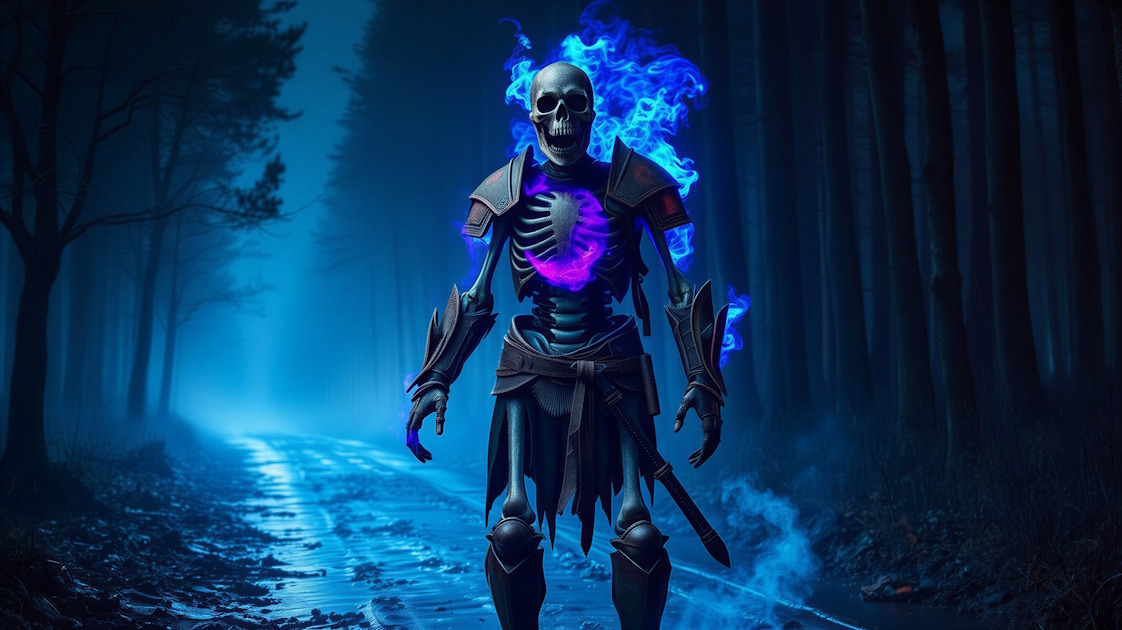
Cold fire skeletons are the long-dead, risen from old graves with nothing left but bone. A blue flame streaked with violet burns across their frames and throws off no heat at all. It pulls heat away instead. The air around them turns bitter, and any living body they lay hands on ignites in that same pale fire and burns cold until the life inside it goes out.
They walk the roads and villages far beyond Brighton, often marching in companies under a skeleton captain, and they do not tire, rest, or retreat. Their appearance traces back to the activation of the Inversion Engine and the damage it did to the elemental nexus beneath the city. Townsfolk who have faced them call them flaming bones, bags of bones, or dark spirits. Those who have fought them and lived call them by the name that stuck: cold fire.
Appearance
The bones are old and pitted, the skin and flesh long since rotted to nothing. Blue-violet energy crackles and sputters across every surface, silent despite its restless flicker. The flame burns brightest behind the ribs, pooling at the sternum, and from there it sends tendrils along the arms and legs and up the neck into the skull. Twin embers glow deep in each empty eye socket.
Their approach carries a sound before it carries a light: a dry clicking and clacking of bone on bone that some liken to stones rattling in a sack. Some jaws still work up and down with no voice behind them. Other skulls have lost the jawbone entirely. They walk with slow, measured steps until something spurs them to a charge.
Most carry what the grave left them. Armor, where any survives, amounts to bits and pieces of lusterless metal. A few wear tattered tabards whose stitched devices time has worn past reading. Their weapons range from woodsman axes and clubs to chipped stabbing swords. The unarmed reach for the living with bare finger bones, the fire dancing at their tips.
Origin & Nature
Elementalists teach that nexus points lie scattered throughout Uhl, above ground and below, each a wellspring of elemental energy. Older lore names them the Great Sources. Ley lines bind every nexus to its neighbors in a network spanning all the lands, and the steady flow of energy along those channels keeps the elemental matrix stable.
The Inversion Engine broke that balance. When it activated, it inverted the nexus beneath Brighton and laced it with necromantic energy instantly. The same event produced the inversion zone that swallowed much of the city. The instability did not stay beneath Brighton, though. It traveled outward along the ley lines toward other nexus points, and wherever it surfaced, it woke the dead in scattered, unpredictable pockets: churchyards, militia cemeteries, forgotten roadside burials. Every corpse it woke rose filled with inverted elemental energy.
That inversion explains the flame. Cold fire is fire turned inside out. It burns blue and violet where true flame burns orange, and it drinks warmth where true flame gives it. For this reason, the skeletons burn cold even in country far from the inversion zone. Inside the zone they walk in their element, but the zone is not their only source, and no place connected to the ley lines can call itself safe from them.
The flame behind the ribs serves as the seat of whatever animates them. Destroy it, and the bones fall inert, the blue and violet tongues fading until only bone lies on the ground. While it burns, the skeletons hold a single purpose: to reach the living and put them out. They show no fear and no regard for their own frames. Some cunning survives in them, though. The skeletons obey a captain's commands, spread into a line before a fight, and steer clear of any warrior who fells a skeleton with every swing.
Abilities
Chill Aura
Cold precedes them. It settles over a place like a slow-moving fog, makes breath visible, and seeps through cloaks and jerkins to sink into the bones of the living. Many mistake it at first for dread. It is real cold, and it deepens as the skeletons draw closer. When the last of them falls, the night's warmth returns.
Cold Fire Touch
The deadliest weapon a cold fire skeleton owns is its grip. It seizes a living person, often pinning the arms to the sides, and pulses its energy into the body. The victim ignites in blue-violet flame and screams that the fire is cold. The skeleton lets go, and the victim burns on until the screaming stops. Across a battlefield, the fallen flare up like small blue-and-purple bonfires.
Relentless
Cold fire skeletons never slow and never tire. They know no withdrawal, and a company of them fights until the last one falls. Defenders who outnumber them three to one still struggle, because every living fighter eventually tires and the skeletons never do.
Hard to Kill
Wounds that would drop a living soldier do little. Severing the spine splits a skeleton in two, but the upper half keeps clawing across the ground toward its foe. Splitting the skull does not end it either. As long as the fire burns behind the ribs, the thing keeps reaching.
Weaknesses
The Ribcage
Smashing the sternum and ribs puts out the fire at its source. Break the chest apart, and the flame dims and fails, and the skeleton moves no more. “Go for the ribs” has become the first lesson anyone learns about fighting them.
Water
Water does not douse cold fire. It freezes on contact. A strong enough stream, such as the jet from a fire brigade hose, sheathes a skeleton in ice so thick and heavy that the creature cannot move. One solid blow then shatters it into a hundred frozen pieces.
Weapons Do Not Carry the Flame
Cold fire leaps only to living flesh. Steel, wood, and iron carry none of it. Long tools such as hoes, pikes, and pruning saws pin a skeleton at a safe distance by tangling in its ribs, while a partner with an axe or hammer breaks it apart. This pairing turns farmers and woodsmen into effective fighters against the dead.
Blunt Force
Bone breaks, whether it burns or not. Hammers, mauls, and heavy axes serve far better than swords. A blade can do the work, but only a cut that splits the ribcage ends the fight.
Variants
Skeleton Captain
A captain leads each company of cold fire skeletons. It wears chain mail, a helmet, and gloves, and it fights with a broadsword. Its flame burns brighter and steadier than the rank-and-file flicker. The captain directs the others, signals the charge with a point of its sword, and holds back while its troops engage.
When it does fight, it fights with the skill of the soldier it once was, pressing without pause and allowing no opening. Its swordcraft belongs to another age, though. The captain stays locked into the methods it knew in life, techniques no one has taught in generations, and a skilled opponent who recognizes the pattern can predict its guard and break through. It dies the same way its troops do: sternum, then ribs, then skull for good measure.
The Cold Fire Dead
Not every body the instability raises has rotted to bone. Where it touches the recently dead, they rise with withered or even whole flesh, bloodied and dressed in the clothes they died in, and suffused with the same cerulean fire. These march alongside the skeletons and bring the same cold with them. Flesh makes them harder to break, and a sword through the gut or throat does nothing to slow them. Dismembering them works, but it's slow work.