DAEGRA
Overview
Hillman. Hammer of the company. A man working off a debt his people measure in silver and blood.
Daegra was born in the high pastures along the western flank of the Alzion Mountains, where the hill clans graze their flocks on the slopes above Wilderwood and below the goblin-haunted peaks. The clans answer to the prince in name and to their own chiefs in fact. Their law is old, short, and remembered rather than written: pay what you owe, never run from a fight you chose, and never leave one of your own on the field. Hill children learn it with their first words, alongside a saying Daegra has never been able to shake. Silver remembers how it was won.
He grew into the biggest man in his clan and the best wrestler at its summer gatherings. At one such gathering, in his twenty-third year, he threw his cousin Toren in a match both of them had wagered on. Toren struck his head on a stone and never woke. No one called it murder. Hill law does not ask whether a death was meant, only who owes for it, and the elders set the blood-price at more silver than a shepherd sees in a lifetime. Until he pays it, Daegra cannot go home.
He carried his hammer down from the hills and hired it out to whoever would pay, guarding caravans on the southern roads, where he fell in with Cassian and Marella. Every coin he does not need to stay alive goes into a purse he never spends from. The purse is heavier than it was. It is nowhere near heavy enough.
Appearance
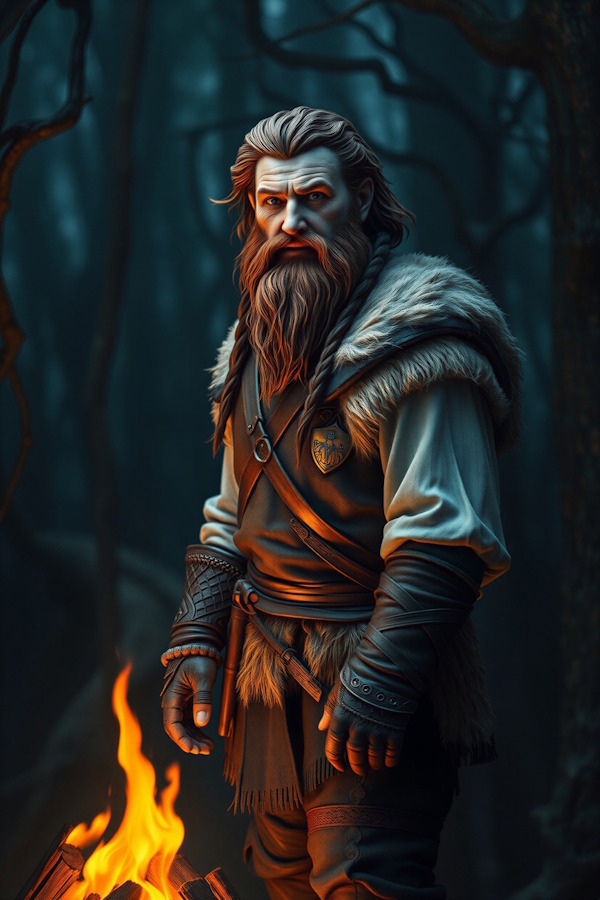
Daegra is twenty-eight and built like the hills that raised him: broad through the shoulders, thick in the neck, with forearms roped from years of hauling ewes out of snowdrifts. His hair and beard are a rough red-brown, the beard worn in the twin braids of a grown hill man. Knotwork inked along both forearms records his clan, his father’s line, and every goblin he has killed. The count has grown crowded.
Around his left wrist he wears a cord of red wool, knotted there by the clan elders on the day they named his debt. Custom forbids him to cut it. It comes off the day he pays the blood-price. He has worn it five years.
He dresses like what he is, a herdsman gone to war: a sheepskin jerkin with the fleece turned inward, a shirt of riveted mail bought from a dead man’s widow, heavy wool breeches, and boots laced to the knee. His warhammer is long-hafted and plain, its head a squared block of Berjendale steel with a spike on the reverse. The dwarves of Berjendale have fought the same goblins as the hill clans for centuries, and they sell good steel to anyone who means to use it on them. Daegra paid for his hammerhead with his first season’s fleece. He cut the haft himself from mountain ash, and he has replaced it three times.
Abilities & Expertise
Daegra fights the way hill men fight goblins: close, heavy, and without flourish. His hammer cracks shields, helms, and bones alike, and he swings it with a patience that looks like slowness until someone steps inside his reach. Years of wrestling gave him balance and leverage, and he is nearly as dangerous without the hammer as with it.
Off the battlefield, his skills are a shepherd’s skills. He reads weather, ground, and goblin signs. He can track, butcher, splint a broken leg, and cover thirty miles on hard bread and a mouthful of hill spirit. He cannot read, and he trusts what someone says to his face over anything written down.
Personality & Demeanor
Daegra grumbles. He grumbles about the weather, the food, the pay, the road, and whatever job Cassian has talked the company into this time. The grumbling is how he tells the others he is still with them. The day he stops complaining is the day to worry.
He is not fearless, and he has never pretended to be. Fear shows on him plainly—in breath gone short and fast, in a hammer that trembles in his grip. What his people call courage is whatever comes after. He sets his jaw, plants his feet, and stays.
He carries hill law everywhere he goes, and it weighs on him more than the hammer. He believes in debts. He believes a man is what he does when the choice is hard, and he believes with a shepherd’s plain certainty that silver remembers how it was won. Every coin in his purse has come to him clean. He means to keep it that way.
Notable Relationships
Cassian and Daegra hold the front of every fight together and have spent more nights trading insults than trading watches. Daegra thinks Cassian is a spoiled lowland boy with a good sword and a mouth that will get him killed. He also thinks Cassian is the bravest fool he has ever met. He has said the first to his face a hundred times and the second never.
Marella keeps the company’s accounts, and she is the one person Daegra trusts with the tally of his purse. He trusts her judgment over Cassian’s as well, and says so, which never helps.
Lista reads whatever the company needs read, and for Daegra that includes the letters his mother has a hill priest write out each spring. Lista reads them aloud in the back corners of taverns, softly, and has never once let him feel it was a favor. In return, he has taught her every hill song he knows, and he has stood between her and trouble more times than she has noticed.
Daegra knew Almeric’s name before the company ever hired him. Every child in the high pastures hears of the patroller who led five into Wilderwood and walked out alone, and the clans call that a debt no silver pays. Daegra argued for hiring him anyway. Whatever else the old man was, he came out.
His father has not spoken Daegra’s name since the gathering. His mother sends word with the drovers every spring. Toren’s mother, her own sister, sends nothing.
Role & Affiliations
Daegra serves as the company’s heavy hand, the man who holds a doorway, carries the wounded, and hauls the loot. Between contracts, he keeps a seat at the Stabbing Sword beside the others, closest to the fire. Under hill law, he remains a member of his clan, living in exile and bound to its elders by the red cord on his wrist. He takes jobs for the silver and stays for the people he fights beside, though he would sooner eat his hammer than admit it.