DURGAN OAKTHORN
Overview
Durgan Oakthorn is a master weaponsmith of Berjendale, one of the seven great dwarven thane-cities. His craft is his life’s work and has been since he first stood at an anvil as a boy, learning to read the color of heated steel the way other children learn to read letters. Over a long career, he has earned a reputation that extends well beyond the halls of his home—merchants, warriors, and even goblin loremasters in distant Gugal know the name Durgan Oakthorn and the quality of the blades it represents.
The loss of his wife, Madilyn, cast a shadow over the years that followed. Durgan channeled his grief into his work with a stubbornness that surprised no one who knew him, and the forge became both refuge and purpose. It was during this time, on a bitter winter morning, that the smiths of Berjendale discovered an infant wrapped in a threadbare blanket outside the city gates. Where others debated what to do with a human child found at a dwarven threshold, Durgan claimed the girl as his own without hesitation. He named her Madilyn, after the wife he had lost, and raised her among the sounds of hammer striking anvil and the warmth of the forge.
Raising a human daughter in a dwarven city was not without its difficulties. The child outgrew him before she was twelve, towered over the weapon masters who trained her, and could never quite fit into the narrow passages and low-ceilinged chambers designed for dwarven proportions. Durgan met each challenge with the same practical resolve he brought to a stubborn piece of steel. He taught her the secrets of the forge, believing that understanding how weapons were made would make her a better warrior. Her human height proved advantageous at the anvil, allowing her to work larger pieces that dwarven smiths found awkward to handle—a fact Durgan noted with quiet pride, though he would sooner swallow hot iron than say so aloud.
When Madilyn announced her intention to leave Berjendale and seek her fortune in the wider world, Durgan did not argue. He understood restlessness. Instead, he presented her with the masterwork they had forged together: a sword of steel folded a thousand times and imbued with dwarven runes of protection. It was the finest blade he had ever helped shape, and he gave it away without ceremony, because ceremony would have required words, and words would have required admitting that the halls were going to feel very empty without her.
Appearance
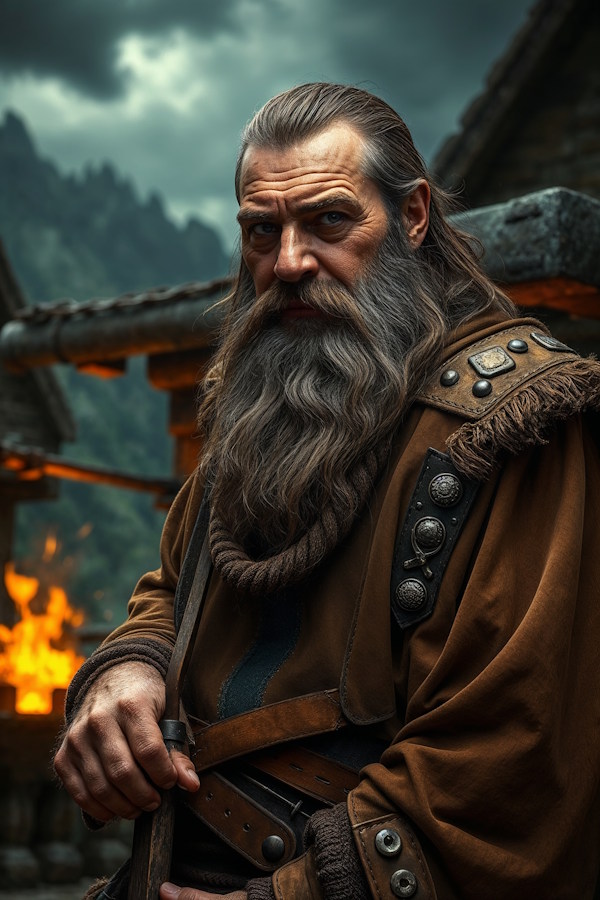
Durgan is built like every dwarf who has spent a lifetime at the forge—short, stocky, and broad across the shoulders and chest, standing roughly four and a half feet tall. His hair and beard are a deep, iron-flecked brown, the beard worn long and loose in the traditional fashion, its length a point of quiet pride. His cheeks carry the permanent ruddy flush of a man who has spent more hours before an open furnace than away from one, and his hands are thick, scarred, and strong, the knuckles swollen from decades of gripping hammer and tongs. His rounded ears and five blunt fingers mark the standard dwarven frame, and his clothing tends toward the practical and drab—a leather apron over simple woolens, the fabric darkened by soot and spark-burns that no amount of washing has ever fully removed.
Personality & Demeanor
Durgan is gruff in the way old anvils are hard—not out of malice but because the world has been hitting him for a very long time and he is still here. He speaks plainly when he speaks at all, prefers work to conversation, and has little patience for flattery, politics, or anyone who treats a good blade as a decoration rather than a tool. His kindness, which is genuine and runs deep, expresses itself through action rather than words: a meal set out without being asked for, a flaw corrected in a young smith’s technique with a grunt and a demonstration rather than a lecture, a human infant claimed and raised as his own when no one else stepped forward.
He is fiercely proud of his daughter, though he would express this pride by pointing out a flaw in her sword grip before he would ever say it plainly. Their correspondence—letters that travel regularly between Berjendale and wherever the Mavens happen to be camped—is the one concession to sentiment he permits himself, and even those, one suspects, are heavy on forge talk and light on feelings.
Notable Relationships
The central relationship in Durgan’s life is with his adopted daughter, Madilyn Oakthorn, captain of the Mavens. He found her as an infant, raised her as his own, and forged her—both literally and figuratively—into the woman she became. Letters still pass between them, and Madilyn returns to Berjendale when she can to work the forge alongside him, a ritual that means more to both of them than either would willingly admit.
His late wife, also named Madilyn, remains a presence in his life long after her death. Naming his adopted daughter after her was not an attempt to replace what he had lost but to ensure something of the name endured—carried forward by someone strong enough to bear it.
Role & Affiliations
Durgan serves as a master weaponsmith in Berjendale, one of the seven dwarven thane-cities. His reputation for exceptional bladework has spread far beyond dwarven lands, reaching as far as the goblin warrens of Gugal, where loremasters remember his name and the quality of his craft. Within Berjendale, he is a respected figure whose standing rests entirely on the work of his hands and the decades he has spent perfecting it. He holds no political office and seeks none—the forge is his domain, and he has never needed another.