GAWNY JONES
Overview
Gawny Jones came up in Saltwick, a working port on the Barrens coast where the yards run right down to the tideline and the whole town smells of pitch and sawn oak. It is not a grand place. The great galleons are built inland and floated down to Fairgate; Saltwick builds the smaller hulls and mends everything else, taking in whatever limps out of the Barrens with its planking stove and its crew grateful. His people were yard men before him, and he was set to the trade young—first sweeping shavings, then holding stock for men who did not explain themselves, and eventually cutting and fitting frames of his own. By the time he was grown, he had learned the two things that matter most in the trade: that wood tells you what it intends to do if you know how to read it, and that a ship is never finished, only launched.
A repair yard is a better teacher than a building yard, and Gawny knew it even then. In Saltwick nothing arrived whole. Every hull that came up the slip brought its own particular disaster—grounded, holed, worked loose in a gale, gnawed through by rot nobody had caught in time—and a boy who spent his apprenticeship on damage learned to see a ship the way a surgeon sees a body. He never lost the habit. He still looks at sound timber and sees where it will fail.
He took the Duke’s coin like most of his generation and served his years in the Seacean Navy, where a yard-trained carpenter is worth more than his weight in almost anything. Warships take damage, and somebody has to put them back together while they are still taking it. He served through actions against Anolgan raiders and Steel Island pirates, patched hulls at sea with the enemy still in view, and learned the particular discipline of a man whose work happens during the fight rather than after it. He came out of the service with his rate, his tools, and a settled understanding of his own competence.
What he did not come out with was much appetite for the deck of another naval vessel. The Griffin offered something the Navy could not—a ship unlike any he had worked on, built to a design no shipwright of his father’s generation would have credited, and a berth aboard her as master carpenter and cooper with the whole of her timber his own responsibility. He signed on and has not looked for anything since.
An airship, he discovered, is a harder problem than a galleon. Weight matters in a way it never did on water. Every timber he replaces must be no heavier than the one it relieves, because the balloon can only lift what it can lift, and a carpenter who overbuilds a repair on an airship has not fixed the ship at all—he has simply moved the problem. Gawny worked that out early and has built light and true ever since.
Appearance
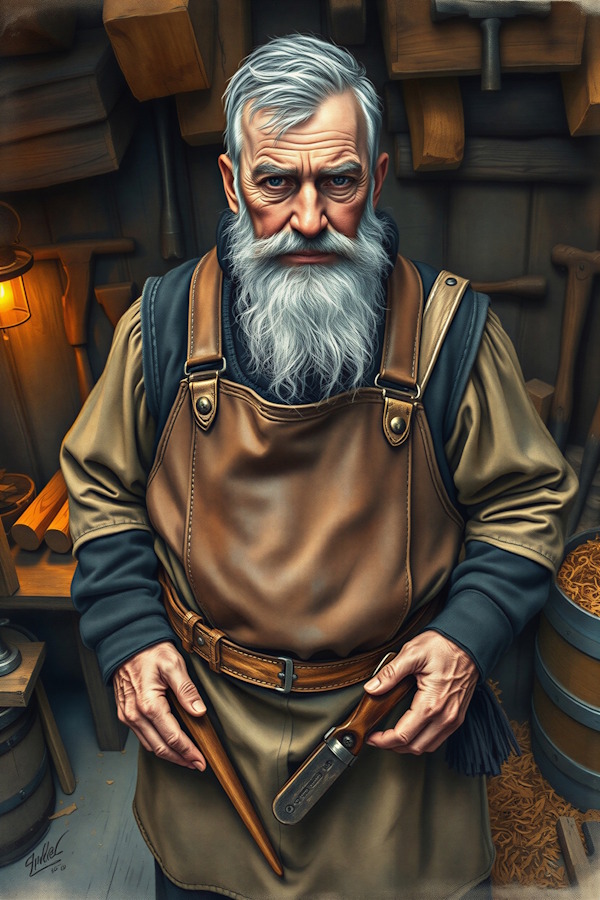
Gawny is a broad, thick-set man past his middle years, built through the shoulders and chest by decades of sawing, adzing, and hauling stock. He is not tall. He gives the impression of being difficult to move, which is roughly accurate.
Age has worked on him without softening him. His hair has gone gray and thin on top, and he keeps what remains cropped short; a gray beard, trimmed close, covers a jaw that has been broken at some point and set slightly out of true. His hands are the hands of a lifelong woodworker—wide, scarred, missing most of the nail on one thumb, and permanently rough enough that he can run a palm along a joint and feel a flaw his eye would miss.
He wears a leather apron over homespun and dark wool, its pockets and loops worn to the shape of the tools that live in them. Sawdust gets everywhere, and he no longer bothers about it. He carries a folding rule and a marking awl at all times, and he has a habit of tucking a lead point behind his ear, then hunting for it.
Abilities & Expertise
Gawny is the Griffin’s master carpenter and cooper, and the ship’s entire structure is his charge—hull, frames, decking, gunwales, hatches, ladders, spars, and every barrel and cask in the hold. He keeps a carpenter’s shop belowdecks, fitted out to his own arrangement, and it is understood aboard that the shop is his and entering it is a courtesy rather than a right.
His most valuable function in a crisis is assessment. After an action, he walks the ship and returns a judgment the command deck can act on—what is structural and what is cosmetic, what will hold and what will not, how long the work will take. Those assessments go to the first officer and from her to the captain, and they are trusted without argument because they have never yet been wrong in a way that cost anyone.
He makes repairs while under way as readily as on the ground and says so plainly when asked. Setting down makes his work more comfortable; it does not make it possible. He will get it done either way, and he sees no reason to pretend otherwise in order to give the captain an easier decision.
His cooperage is the quieter half of the job and the half nobody notices until it fails. Water, salt pork, hard biscuit, and lift gas all arrive aboard in containers, and containers on a ship that pitches and climbs and takes cannon fire do not last forever. Gawny makes and mends them, and the crew eats and drinks because of it.
Personality & Demeanor
Gawny is a man of few words and fewer wasted motions. He answers questions with the shortest true answer available and does not embellish, which some officers find restful, and others find maddening. He does not volunteer opinions on matters outside his trade, and within it he does not soften them.
He is unflappable in a way that has to be seen to be understood. Under fire, with the deck splintering around him, his manner does not change from the manner he shows when planing a board in his shop. He looks at the damage, he decides what to do about it, and he starts. The crew has learned to take a certain comfort from this.
Where he does have strong feelings, he shows it by looking at a man rather than speaking to him. A long, level, unhurried look from Gawny Jones is the whole of his objection, and it is generally sufficient. He is loyal to those who have earned it, slow to transfer that loyalty, and entirely unmoved by arguments about money.
Notable Relationships
Captain Jacob Madison has Gawny’s loyalty, and it is the settled kind rather than the enthusiastic kind. The two men share a naval background and a preference for saying what is so, and Gawny has never given his captain reason to check his work or doubt his word.
Commander Alice Briggs is the officer he reports through, and the relationship suits them both. She calls for him by name when the ship is coming apart and relays his assessments upward without diluting them, and he gives her his findings straight.
Among the working crew he is a fixed point—older than most, senior in his trade, and generally left to it. He shares the ship’s upkeep with Neomar and Rebecca Stratum, the three of them holding between them the timber, the envelope, and the engines, and while none of them much interferes with the others, each is privately certain his or her own domain is the one keeping the Griffin in the sky.
Role & Affiliations
Gawny Jones serves as master carpenter and cooper aboard the airship Griffin under Captain Jacob Madison, a private vessel crewed by contracted airmen. He holds no commission and gives no orders beyond his own work, but his rate is a senior one, and his word on the ship’s condition carries weight that no rank confers.
Before the Griffin, he served in the Seacean Navy and, before that, apprenticed in the yards at Saltwick on the Barrens coast. He keeps no visible ties to either. What he has instead is a shop below decks, a ship that needs him, and the unhurried satisfaction of a man doing work he is unambiguously good at.