GRIMOIRE OF THE DEAD
Overview
The Grimoire of the Dead is the spellbook of the eslar necromancers Ill Sigith and Jux Jeorn—a manual of dark origins and darker purpose, containing not only their spells but instruction in necromancy’s deepest secrets. It is the companion artifact to the Scepter of the Dead. Where the scepter provides the power, the grimoire provides the method, and together they carried out the conversion of Miradath into the Dead Lands.
Every eslar learns its name, whether or not they ever learn anything else about their people’s worst century. It is also called the Book of the Dead.
Origin & History
Ill Sigith and Jux Jeorn wrote it. They were once trusted sorcerers, respected among their people, who turned to necromancy and the eternal life it promised. They made two artifacts—the scepter to harvest and channel the life force of tortured souls, and the grimoire to apply that energy on a scale beyond any single sorcerer—and used them, together with the monoliths known as the Pillars of the Dead, to subvert all life within Miradath. The land became the Dead Lands, and the city of Penrose Ive became Navarre, the City of the Dead, from which the two necromancers intended to rule.
When the eslar armies broke them, they tore down the monoliths and smashed them to rubble. The grimoire did not turn up among the spoils. No chronicle records its destruction, and none records its recovery, which has left scholars to assume the necromancers hid it themselves—a book of that kind not being the sort of thing one misplaces.
Physical Description
The book conceals itself. What a casual observer sees is not the real cover, and no amount of ordinary handling will reveal otherwise.
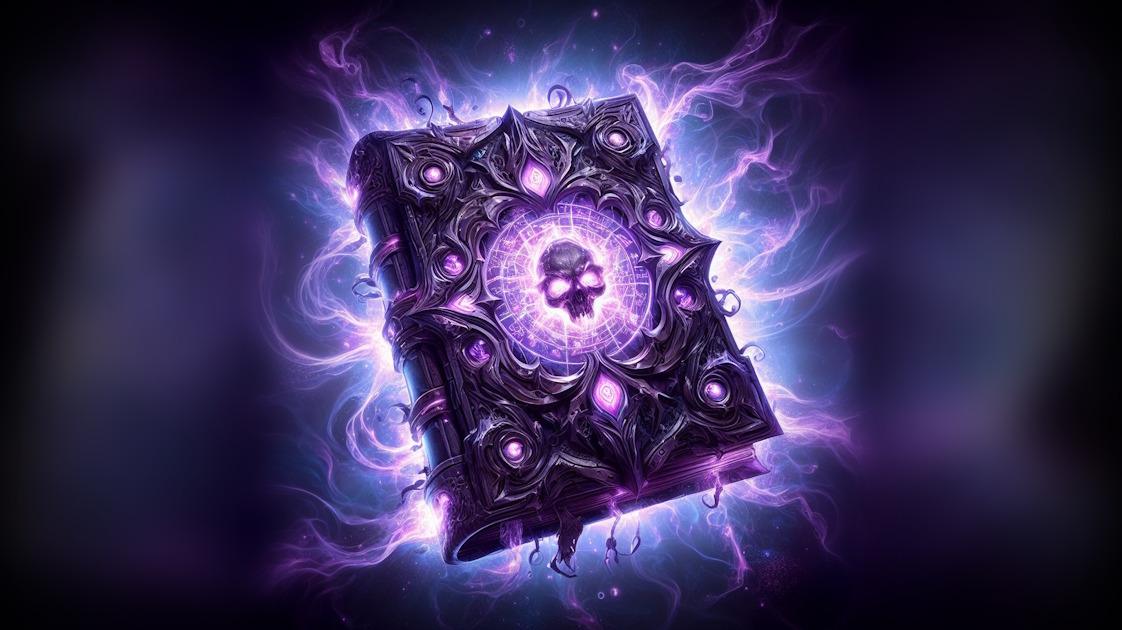
Under the correct working, a violet glow spreads from the edges across the binding, creeping around and around before settling at the exact center—and where it settles, a different tome stands revealed. A coarse black hide jacket. Ornate runes beginning at the center and spreading to every corner. A metal clasp holding the whole thing shut. The runes on that true cover carry the title and the names of its authors, because names hold great power and are not so easily hidden.
It is heavy for its size, heavy enough to require both hands and some effort to lift and turn. Once disturbed, a soft violet light surrounds it, and neither fades nor grows.
Wards & Defenses
The grimoire is warded twice over.
A locking spell holds the cover shut against any conventional attempt to open it, and against most unconventional ones. It is a powerful enchantment, laid by someone who knew exactly what they were doing, and it carries a final discourtesy for the careless: reverse it by any route but the correct one, and the book explodes. Beneath that lies a second working, a befuddlement dweomer, which renders the text illegible to anyone who does get inside. Both have been undone, at least once, by a sorcerer with nerve enough to try—and even with the scrawl made legible, a reader without the necessary training will make little of what is written there.
The book is also detectable. Most sorcerers can sense magic being worked, and the grimoire announces itself to anyone attuned to it long before they are close enough to see it. Hiding a thing its owners can feel has proven a waste of effort.
One soothsayer who examined the book gave a verdict blunter than any scholarly assessment: “This is more than a book. It is a thing alive, and you must destroy it.”
Contents
What has been read of it so far accounts for only a fraction of the whole:
- The charging of the Scepter. An account of the ritual of imbuement, performed at the peak of the Necromancer’s Hour with a thousand thousand tortured souls, and a note that the charged scepter stood ready for a further step the text never specifies.
- The process of everlasting life—undeath, in plainer language, and the closest thing the book offers to a statement of its authors’ ambition.
- A reversal process, described at length and never named.
- The monoliths, and what the necromancers meant to do with them.
The monoliths channel raw necromancy, broadcasting it well beyond the ability of any necromancer or artifact. Still, by themselves, the monoliths’ range remains limited. But if we enhance the stream at the monoliths’ precise center, the monoliths will broadcast such energy exponentially. When the necromantic power is then coupled with the spells of this book, the monoliths will ensure all positive dispositions for a thousand leagues are reversed.
That passage is the closest surviving description of how a country was unmade, set down by one of the two men who unmade it.
Significance
The scepter is the more frightening object. The grimoire is the more dangerous one. Power without method is a limited weapon in the hands of whoever happens to be holding it; method turns that same power into the end of a nation.
It is also the harder of the two to be rid of. The scepter, at least, has a principle working against it. Nobody has found the equivalent for the book. Every proposal for its destruction so far has amounted to putting it somewhere deep and hoping, which is not a plan so much as a postponement—and the last people to postpone the question left it buried for centuries, and it did not stay buried.