JUX JEORN
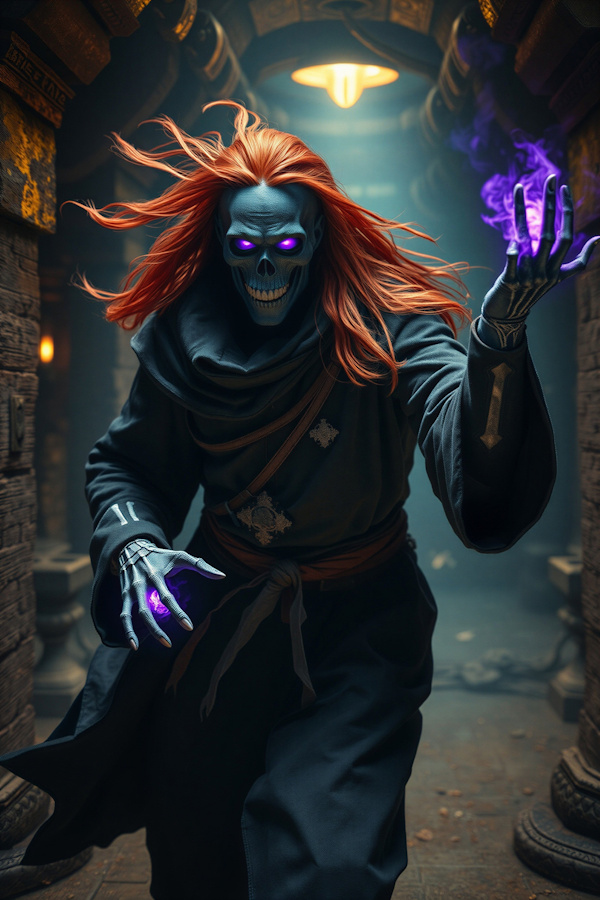
Jux Jeorn was born to a family of minor scholars in Isia, Panthora's magnificent capital, where crystalline spires reached toward the heavens and the pursuit of knowledge was considered the highest calling an eslar could answer. His parents were competent but unremarkable researchers in natural philosophy, content with the steady accumulation of incremental insights that characterized most academic careers. Their son was not content. From his earliest years, Jux displayed a restless intelligence that chafed against the careful, methodical approach his parents embodied. He did not want to add another brick to the edifice of eslar knowledge. He wanted to tear it down and rebuild it on foundations no one had yet imagined.
This restlessness showed in an approach to scholarship his instructors found both brilliant and alarming. While his peers worked through problems systematically, testing hypotheses against evidence and proceeding only when each step was confirmed, Jux leaped ahead. He made intuitive connections between seemingly unrelated fields, saw patterns in data others dismissed as noise, and reached conclusions that seemed reckless until his reasoning—always delivered after the fact, often with an air of impatience—revealed the logic that had guided him. His theories were often wrong, but when they were right, they were breathtakingly so, and this intellectual daring earned him a reputation that preceded him through the academies.
It also earned him Ill Sigith.
They met during their advanced studies, drawn together by a mutual recognition that each possessed what the other lacked. Ill Sigith was the practitioner — cold, precise, capable of translating any theory into functional reality through disciplined experimentation. Jux was the theorist — the one who saw the shape of the answer before anyone else saw the question. Their collaboration began with a shared fascination with mortality and the tantalizing possibility that death wasn't a fixed boundary but a problem awaiting a sufficiently bold solution. What began as an academic partnership deepened into a romantic bond that would endure through decades of increasingly dark research, through the transformation of their own bodies, and ultimately through death itself.
Jux was the greater risk-taker of the pair, the one who pushed their work into territories that even Ill Sigith — who had few moral qualms about anything — approached with caution. Jux first argued that conventional approaches to longevity were insufficient, that slowing the body's decline or extending its vitality through alchemical means addressed the symptom rather than the disease. The disease was mortality itself, and the cure, he argued, lay in understanding the fundamental relationship between the soul and the body it inhabited. If that relationship could be restructured — if the soul could be made to persist in a body that no longer required the fragile biological processes that eventually failed — then death could be rendered irrelevant.
This line of reasoning led inevitably to necromancy. Other eslar scholars had studied the theoretical foundations of death magic and recoiled from what they found. Jux did not recoil. He saw necromancy not as a perversion of natural law but as an unexplored frontier, a vast territory of magical and scientific possibility that cowardice and convention had placed off limits. The ethical objections that constrained his colleagues struck him as failures of imagination — the protests of small minds confronted with ideas too large for them to hold. He was as cold in his convictions as Ill Sigith was in her methods, but where her coldness manifested as disciplined detachment, his expressed itself as a philosopher's certainty that the ends justified whatever means were necessary to reach them.
When they relocated from Isia to Penrose Ive to escape the Council of Minds' scrutiny, Jux framed the move as liberation rather than exile. In Isia, surrounded by committees, oversight bodies, and the stifling caution of lesser intellects, their work could never reach its full potential. Penrose Ive, far from the capital and its watchful academies, offered the freedom to pursue their research without restraint. Here, in laboratories hidden beneath the city's outskirts, Jux could finally follow his ideas wherever they led, no matter how far into the darkness that path descended.
And descend it did. The theoretical framework Jux developed during this period was revolutionary in scope and horrifying in its implications. He mapped the mechanics of the soul's departure from the body at the moment of death, identifying the precise interval during which the connection could be severed, rerouted, or reversed. He theorized that the energy released by death — particularly violent, agonizing death — could be captured, concentrated, and repurposed as a fuel source for magical processes that would otherwise require power beyond any single sorcerer's capacity. He called this energy "tortured soul essence" and spent years working out the theoretical parameters for its extraction and storage.
Ill Sigith turned these theories into practice, but the practice would not have existed without Jux's framework. Together, they compiled their findings into a grimoire that became the most comprehensive treatise on necromancy ever produced—not merely a collection of spells, but a complete intellectual architecture for understanding and manipulating the boundary between life and death. The grimoire bore both their names and reflected both their temperaments: Ill Sigith's precise, methodical notation alongside Jux Jeorn's sweeping theoretical passages, the practitioner and the theorist working in tandem to create something greater—and more dangerous—than either could have produced alone.
Creating the Scepter of the Dead was Jux's conceptual triumph. He recognized that a focus capable of channeling the concentrated energy of thousands of tortured souls would need to operate on principles that went beyond conventional magical engineering. The Scepter could pierce what he called the Veil—the barrier between the living world and the realm where the dead resided—allowing a sufficiently skilled necromancer to summon spirits back across that boundary and bind them to bodies prepared to receive them. Ill Sigith built the Scepter to his specifications, but the underlying theory — the understanding of how the Veil could be weakened, how spirits could be called, how the energy exchange between realms could be managed — was entirely his.
The monoliths were also his conception. Where the Scepter operated through direct, focused application, the monoliths worked through broadcast—channeling raw necromantic energy across distances no individual practitioner could cover. Jux understood that their ambitions extended far beyond what they could accomplish one corpse, one ritual, one city at a time. To transform an entire region into a realm of undeath, they needed infrastructure. The monoliths, massive stone pillars inscribed with formulae that Jux had derived from first principles, served as that infrastructure. Positioned correctly and powered by the Scepter's concentrated soul energy, they could ensure that, as the grimoire recorded, "all positive dispositions for a thousand leagues are reversed, and, at long last, our dream of a land infused with nothing but the purity of unlife will become a reality."
These were Jux Jeorn's words. The grimoire's most ambitious passages — the ones that articulated the vision of a world remade, of mortality conquered not for individuals but for civilizations — bore his philosophical stamp. Where Ill Sigith wrote of processes and procedures, Jux wrote of destiny. He believed, with the unshakable conviction of a man who had spent decades constructing the logical foundations for his beliefs, that what they were doing was not merely permissible but necessary. Eslar civilization produced brilliance that death extinguished. Knowledge accumulated over centuries was lost when the minds that held it ceased to function. The solution was not to mourn this waste but to end it — to create a society where death no longer interrupted progress, where every mind that had ever contributed to eslar achievement could continue contributing in perpetuity.
That this society would be composed of the undead — that achieving it required the harvesting of tortured souls on a scale that dwarfed any atrocity in recorded history — did not trouble Jux Jeorn. He had moved past moral categories long before the first monolith was raised. He saw the world in terms of problems and solutions, and the problem of death was too important to be constrained by the emotional discomfort of those too limited to understand the solution.
When the Necromancer Wars began in Year 285 and the city of Penrose Ive — now Navarre — fell under their complete control, Jux assumed the role he had always occupied in their partnership: the strategist, the visionary, the one who saw the larger pattern while Ill Sigith executed the details. He directed the campaign against Panthora not as a military commander but as an architect of inevitability, designing a long-term strategy that leveraged their greatest advantage — the fact that every enemy who fell became a soldier in their ranks. He calculated attrition rates, projected conversion timelines, and mapped the optimal sequence of engagements to bring their forces to the gates of Isia with minimal resource expenditure.
His willingness to take risks manifested on the battlefield as it had in the laboratory. Where Ill Sigith favored methodical advances, consolidating gains before moving forward, Jux advocated bold strikes deep into Panthoran territory—raids designed not to hold ground but to sow terror and harvest fresh corpses for their army. He understood that the psychological dimension of their campaign was as important as the military one. Every village that fell, every patrol that vanished, every family that watched their dead rise and march against the living eroded the will of those who opposed them. Fear was a weapon, and Jux wielded it with the same intellectual precision he applied to everything else.
In the years before the Great Cleansing ended their reign, both necromancers had undergone transformations that rendered them something other than the eslar they had once been. The sustained practice of necromancy at such intensity exacted a physical toll that no living body could withstand indefinitely. Rather than resist this deterioration, they embraced it, using their own bodies as subjects for the same processes they had perfected on others. They became lich-like creatures — their blue-black skin drawn tight over sharpened bones, their features hollowed and desiccated, their eyes no longer the stark white of the eslar but burning with the cold violet radiance of concentrated necromantic energy. They no longer ate, no longer slept, no longer aged. They had become, in the most literal sense, proof that their theories worked. Death had not conquered them. They had conquered death.
Or so they believed. The Great Cleansing, powered by Keth'mor's sacrifice, the Cleansing Fire—a man who had once called them both colleagues and friends—destroyed everything they had built. The undead armies crumbled. The monoliths shattered. The land they had transformed into their kingdom became the Dead Lands, a permanent scar on the face of Panthora where necromantic energies still fester in poisoned soil. And the physical forms of Ill Sigith and Jux Jeorn, lich-like though they were, proved insufficient to survive a magical working powered by the willing sacrifice of a life freely given — the one form of energy their necromantic defenses had never been designed to counter.
But Jux Jeorn had always planned for contingencies. The same theoretical framework that let him map the mechanics of the soul's departure from the body also gave him insight into what lay beyond the Veil, and he had prepared for the possibility that their physical forms might be destroyed before their work was complete. The spirits of both necromancers endure in the afterlife—not as passive shades awaiting whatever fate the dead are consigned to, but as conscious, calculating intelligences who carry every scrap of knowledge they accumulated in life. They wait in the realm beyond the Veil, patient and purposeful, for someone to call them back.
Their grimoire survived the Great Cleansing. So did the Scepter of the Dead. Centuries later, these artifacts have resurfaced in a world that has largely forgotten the necromancers who created them — a world where eslar students find their names filed under "Mythology" in Isian libraries and most citizens of Panthora know of the Necromantic Wars but cannot be bothered with the details. This forgetfulness is, perhaps, the most dangerous legacy of all. The knowledge encoded in the grimoire remains as potent as the day it was written. The Scepter still holds the power to pierce the Veil. And somewhere in the afterlife, Jux Jeorn — theorist, visionary, architect of a dead kingdom — waits with the same restless intelligence that defined him in life, certain that the future he envisioned has merely been delayed, not defeated.