SCEPTER OF THE DEAD
Overview
The Scepter of the Dead is a necromantic relic created by the eslar necromancers Ill Sigith and Jux Jeorn. It harvests the life force of tortured souls and channels that energy across great distances. It can pierce the Veil between the living and the dead, summon the spirits of those sent to the realm beyond, and bind them to physical forms, restoring them to a natural state of undeath.
It is one of the two artifacts by which the land of Miradath became the Dead Lands. Any eslar of learning knows it by reputation, and by every account it should have stayed buried.
Origin & History
Ill Sigith and Jux Jeorn were eslar sorcerers of considerable standing before they turned to necromancy in pursuit of eternal life. Accounts differ on what drove them—ambition, madness, grief—but agree on what they made with the knowledge they gained: a scepter to harvest and channel the life force of the dead, and a grimoire of spells designed to apply that energy on a scale no single sorcerer could achieve.
The scepter’s charging is recorded in the necromancers’ own hand:
Tonight we harvested a thousand thousand tortured souls, thralls taken from the spoils of war and some others from outlying homesteads vulnerable to our death walkers. We performed the ritual of imbuement at the peak of the Necromancer’s Hour when the moon was new and the night darkest, charging the Scepter with the life force of these souls.
The same passage notes that the scepter already held the power to pierce the Veil before that night, and that once charged with so many dark souls, it stood ready for a further step the text never describes.
With the scepter, the grimoire, and the monoliths known as the Pillars of the Dead, the necromancers subverted all life within Miradath. The land became the Dead Lands, and the city of Penrose Ive became Navarre, the City of the Dead. When the eslar armies broke them at last, the monoliths were torn down and smashed to rubble, and the scepter passed out of every surviving record. It was assumed lost, or hidden away against some later use—an assumption that ceased to matter the day it surfaced again.
Physical Description
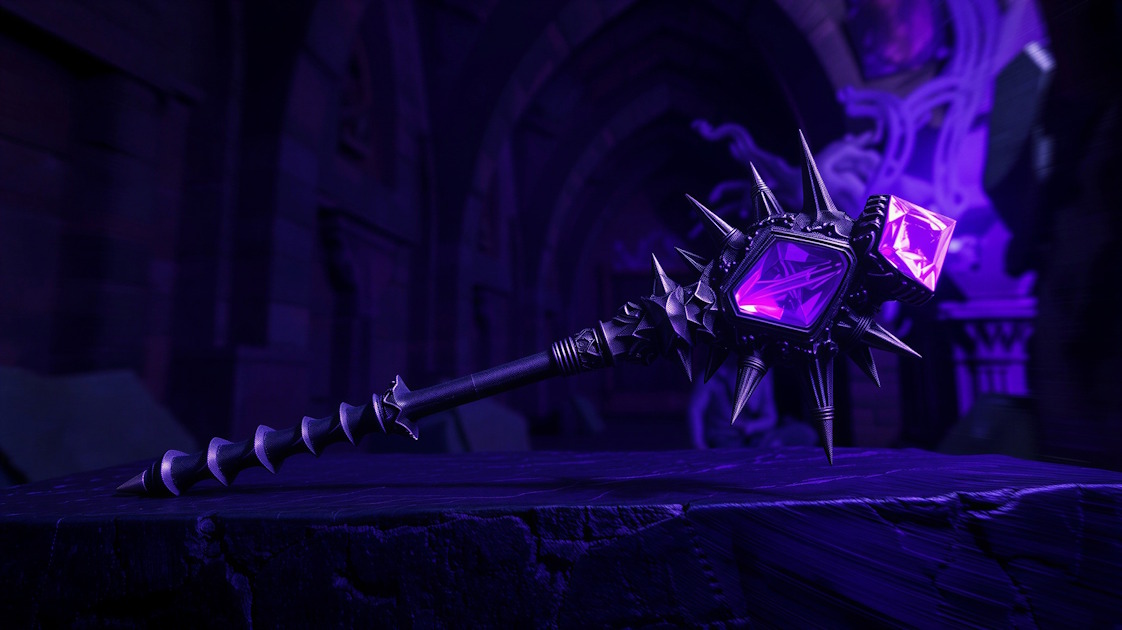
A haft of dark iron, shorter than a proper staff, its surface bristling with spiked protrusions that jut from the metal at irregular intervals. At the tip sits a violet gemstone cradled in an iron setting. The gem does not reflect light so much as contain it, like a vessel holding water, and it pulses with concentrated necromantic energy even when dormant.
In a wielder’s hands, it burns with violet fire bright enough to see across a town square. Parted from that wielder, it falls quiet, and the light does not return of its own accord.
The few scholarly renderings that exist show the scepter in cross-section, its interior drawn as concentric circles radiating outward from a central point, ringed by geometric patterns in a dense angular script. What that structure is, or does, no surviving commentary explains.
Powers & Functions
The scepter performs three related tasks.
It harvests. The souls it draws upon are not the peaceful dead but tortured ones, twisted and darkened by suffering, and the darker the torment, the greater the yield. What must be done to a person to produce such a soul has sickened even practitioners of dark magic who considered the question.
It pierces the Veil. It summons spirits from the realm beyond and binds them to physical forms, restoring the dead to undeath—a working performed over a corpse, at close quarters, by a wielder who knows the words.
It channels. The harvested energy can be projected outward to raise the dead in numbers. Its reach, however, has a limit. A scepter of unbounded range would need no allies, no monoliths, and no machinery, and the history of the Dead Lands would have been a far shorter and far worse story.
In the conversion of Miradath, the scepter supplied the raw power, the grimoire supplied the method, and the monoliths broadcast the result. Remove any one of the three and the working fails.
Source of Power
The scepter does not create necromantic power. It perverts what was living into something else. The ritual of imbuement subverts life force, twists it, darkens it, and channels the corrupted product into the artifact. That inversion is the entire source of its strength.
It is also, by the reckoning of those few who have studied the thing closely, the artifact’s one vulnerability. A power built out of the perversion of life cannot abide life in its pure form, any more than shadow can abide a flame held against it. What such a confrontation would demand of whoever attempted it—and whether they would survive the attempt—no account agrees upon, and none of the accounts are encouraging.
Significance
Most relics are measured by the skill of the hand that holds them. The Scepter of the Dead is measured by how much suffering has been fed into it, which makes it unlike any other artifact in the histories and explains why the eslar have never spoken of it as a weapon so much as an atrocity with a handle.
This object once killed a country. Everything written about it since has circled the same two questions: whether a thing built out of agony can ever be destroyed, and what it would cost to try.