THE NULLIFICATION ENGINE
Overview
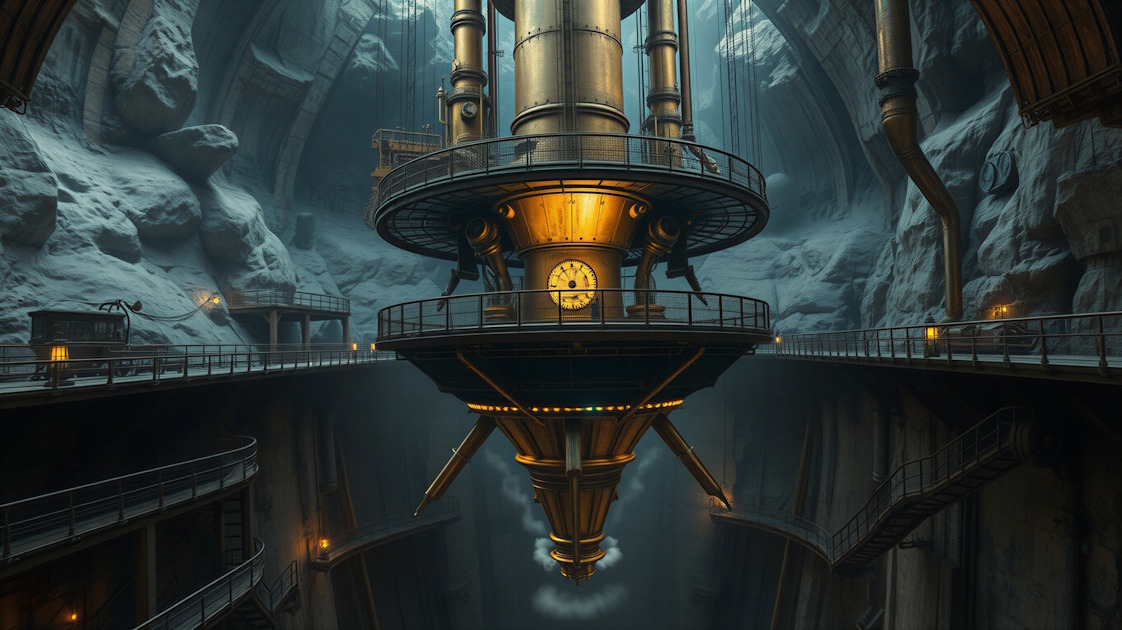
The Nullification Engine is an ancient machine buried in a vast shaft beneath Brighton, designed and built by the elementalist Cyrus Melkor. Its purpose was to nullify elemental energy within its sphere of influence—not as a weapon in the conventional sense, but to create a region where the druids held no power and therefore no influence. Melkor never activated it. During early experimentation with prototypes, he discovered the machine drained more than elemental energy: it drained all energy, from every living thing within reach. By then, construction had gone too far to stop, and Melkor concluded that if he did not oversee the work, another elementalist would.
The engine has since been activated, modified, renamed, and turned to purposes its architect never intended.
Design & Construction
Melkor built the engine in secret, in a cavern beneath the city, and guarded that secrecy from the druids, from his fellow elementalists, and from the people of Brighton alike. He encrypted his research with several ciphers, some far harder to break than others, and kept a hidden workshop whose library held his journals, schematics, and many books on subjects unrelated to machinery. Some of the engine’s components came from an alchemist’s forge, the elementalist apparatus that fused the mechanics of science with the magic of sorcery.
Melkor also built in a failsafe: an aversion sequence that would let the machine run to completion without producing any nullification effect. The other elementalists would have concluded the device simply did not work, never knowing he had sabotaged it himself. The sequence was entered at an input assembly on the control deck.
The elementalists built at least one other engine, found centuries later in a valley in the Underland. It differed in shape, size, and configuration, and no means of collecting ambient energy has ever been identified on it—most likely an internal power source—but it shared the same output relays, conduit configuration, platforms, and controls. That machine ran to completion and to full effect, killing every living being in the valley instantly, and burned itself out doing so.
Two others altered the Brighton engine, and neither of them was an elementalist. The first installed a triggering mechanism; without it, the machine would never have activated at all. The second studied it in secret for years and made several modifications no one else knew about, including disabling the input assembly so Melkor’s aversion sequence would not take—the pin-plate and several other parts went over the side and into the chasm, and have not been recovered. A third alteration came later still: a brass cylindrical chamber inlined between the collecting arms and the core to serve as a harmonic field generator.
Physical Description
Six stories of brass and iron hang suspended at the center of a shaft hundreds of feet across, descending into a darkness whose depth was never measured. Platforms and catwalks reach from the chamber walls to the engine’s superstructure like the spokes of a wheel. The machine itself carries three platforms, each built of metal grating and separated from the others by a fair distance. A single metal ladder inside a cage-protected chute spans all three.
The Collection Deck
The lowermost platform, and the first step in the reaction. It has no railing. Directly below it, four collecting arms—properly, elemental collecting rods—sweep in a rotation dizzying to watch from close range, gathering energy from the environment as they spin. The arms attach to a hub of brass gears and mechanical workings capping the bottom of the core. Inside that hub sits a series of energy enhancers and modulators, feeding the primary concordium regulator; behind a further panel at the regulator’s output side runs a series of tubules and flow valves.
The Middle Platform
Set between the other two. During the eslar occupation, engineers cantilevered an auxiliary deck off the engine’s middle section, supported by cables anchored to the central shaft.
The Upper Platform
The controls: an instrument panel covered in dials, knobs, levers, and gauges, the activation mechanism added long after Melkor’s death, and, beside it, the catalytic chamber. Inside the chamber, a crystal housing carries a slot cut to precise dimensions. Eight panels cap the chamber’s top; during final activation, they shoot out vertically and fold open, and the machine’s energy flows out through them.
The Core
Exhaust pipes line the central shaft and billow steam when the engine runs hard. The core itself is a cylinder whose shell is not glass, crystal, or any material at all, but energy sheathing—a concordium containment field. The energy within is predominantly golden, shot through with coruscating deposits of white, green, blue, and red that flicker to life, swirl, and dissipate. The collecting arms glow in the colors of the four elements as they spin: red, blue, green, and white.
Functions
The arms collect ambient elemental energy. The collection hub converts it. The core accumulates it. As accumulation rises, the frequency of the engine’s radiation oscillates through an ever-narrowing range, converging on a value of 1.618. At that value, the machine has taken in all the energy it needs and enters the state Melkor named full nullitivity, at which point it fully activates and drains the life force from every living thing for miles.
The catalytic chamber governs what the activation actually does. Without a reactant of the correct composition seated in the crystal housing, the engine is nothing more than a very large explosive. With one, the reactant focuses and concentrates the output, enhancing the intended effect.
What that effect is, however, is not fixed. This is the part of Melkor’s design his fellow elementalists appear never to have grasped, and the part that has proved most useful to everyone who came after him: the chamber does not merely determine how much the engine releases, but what the release does. A sufficiently informed hand, working from the right composition, can turn the machine to an outcome its architect never contemplated—and has.
Power Source
The engine draws entirely on ambient elemental energy collected from its surroundings; it has no internal supply, which is what distinguishes it from its sister machine in the Underland.
The reactant is a separate matter, and a far harder problem. It took years of failed work by a chemist of considerable gifts to produce one at all. The metal finally smelted is mostly iridium, with a hint of copper, silver, and other materials never disclosed. The filament measures 3.24 inches long and 1.28 wide at each end, belled at both ends and narrower through the middle. Inserted into the slot, it fuses to the crystal housing and is consumed by the process, leaving only slivers behind.
The reactant is best understood as an enhancer: it increases control and multiplies energy output. Handling the raw metal is said to affect a person as well, and not slightly, though the accounts are few and none of them careful.
Significance
Cyrus Melkor built a machine capable of emptying a country of life, and then spent the rest of his career making certain no one could switch it on. Everything that has happened around the engine since has been the work of someone undoing a dead man’s caution.
It has never once done what it was designed to do. Each hand that has touched it has left it able to do something its architect did not intend or sanction, and the engine has accepted every alteration without objection, because a machine cannot refuse. Whether that makes it an instrument or a participant is a question those who study it have not settled, and the ones best placed to answer have not survived the asking.
What we can say with confidence is that the engine is not finished. It was built for one purpose and turned to another, and it remains capable of a third that no one has yet set down in full.