THE STABBING SWORD
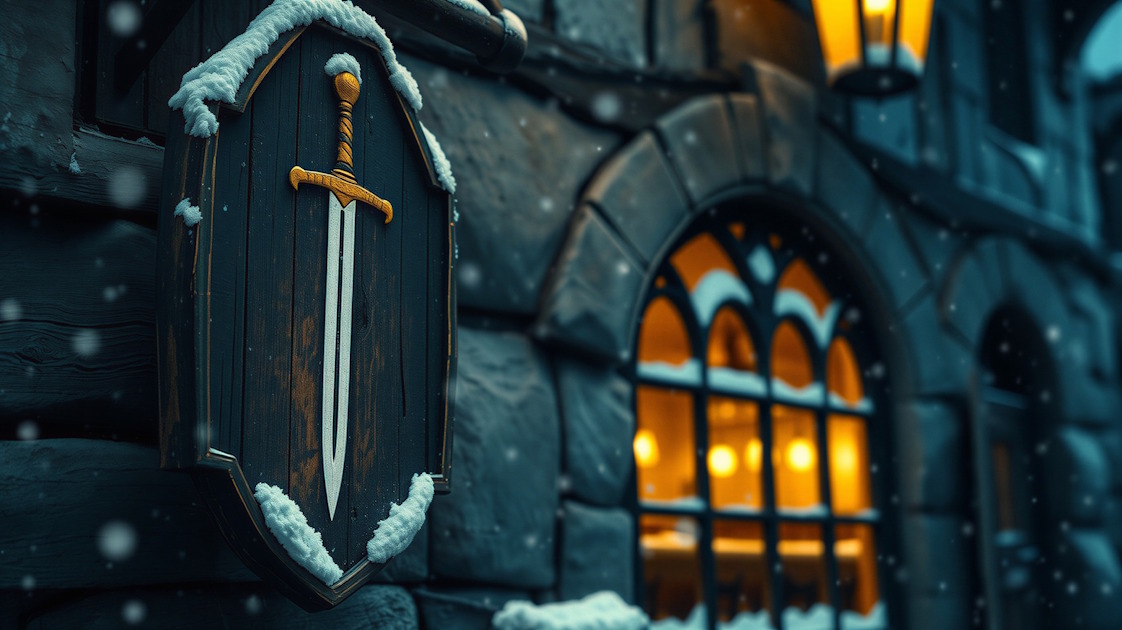
The Stabbing Sword stands at the eastern end of Greyford, the last market town on the road to Wilderwood, and the last roofed house a traveler passes before the wardens’ line. Its lower story is old grey stone, thick-walled and small-windowed, and everything above it is timber and thatch that has burned twice and been raised again. Stables flank the yard. A painted board swings over the door, weathered to little more than a shape: a sword driven point-down. No lettering. If it had words, most of the trade couldn't read it, anyway.
The house began as a wayhouse for wardens. When Lord Caelmir sealed the forest and set watchers along its edge, the crown raised shelters at intervals down the line, and this one stood where the road met the track north to the coast. Wardens slept here between patrols, ate at the crown’s expense, and carried news back and forth. The kingdom that paid for it did not outlast two generations. The wardens stayed, the wages stopped, and a woman whose name nobody recorded started charging them for their beds. Greyford grew up around the yard afterward.
The sword the house is named for stands driven through the great beam that runs the length of the taproom, a plain arming blade, point down, hilt worn smooth by three hundred years of hands reaching up to touch it for luck. Every landlord tells a different story about how it got there. A warden drove it in the night the forest took his whole patrol. A man was killed under it, and the killer left it where it stuck. The first landlady put it there to end an argument about who would pay. The Hesks, who have held the house for four generations, tell all three and charge for none of them. Nobody has ever pulled it out, and the current landlord will explain at length why nobody ever should.
The wardens still drink here, but they no longer make up most of the custom. Caravan crews stop on the coast run. Woodcutters from the foothill villages spend their season’s coin over two nights and walk home poorer. And the treasure hunters gather, as they have gathered every year for three centuries, because Greyford is the last place to hire a guide, sell a horse, or buy rope before the road stops mattering. A board beside the door carries the work: contracts, notices, offers of hire, and the occasional appeal for word of a company overdue. The appeals stay up longer than anything else.
The talk runs to gold. Every table in the room holds someone who knows a man who saw the vault, owns a map drawn by someone who did, or can name the exact stretch of boundary where the fog thins. Guides drink free until they take a contract, a custom the Hesks keep because a guide with an audience sells the whole room a dream by midnight. Almeric, the only man in the principality who will take coin to walk a company into Wilderwood, has told the forest’s history at that hearth more times than he can count, and has watched more companies than he can count decide the history was exaggerated.
The house keeps two rules and bends neither. It takes no coin stamped with a leaf where the crest belongs, the pieces the border markets call Hollow coin, and any traveler who offers one finds his drink already paid for and the road outside recommended to him. And it settles up nightly. Nobody runs a tab at the Stabbing Sword, whatever the size of the fortune they mean to bring back, because too many tabs have gone uncollected. Along the underside of the great beam, near the blade, the Hesks have cut a short mark for every company that walked east out of Greyford and did not walk back. The marks run most of the beam’s length. The family stopped explaining them to customers two generations ago, and they do not point them out to anyone who has already signed a contract.
For all of that, the Stabbing Sword is a warm house. The hearth is broad and kept high, the cups are honest, and on a winter night with the shutters closed and a storm working at them, the room holds heat and noise and the smell of a fire against everything waiting east of the town. Nowhere in the principality sits closer to Wilderwood, and nowhere feels further from it. That is the whole trick of the place. Under that roof, with the fire up and a guide holding the room, the tales sound like nothing but tales.