Grimmere Swamp
Introduction
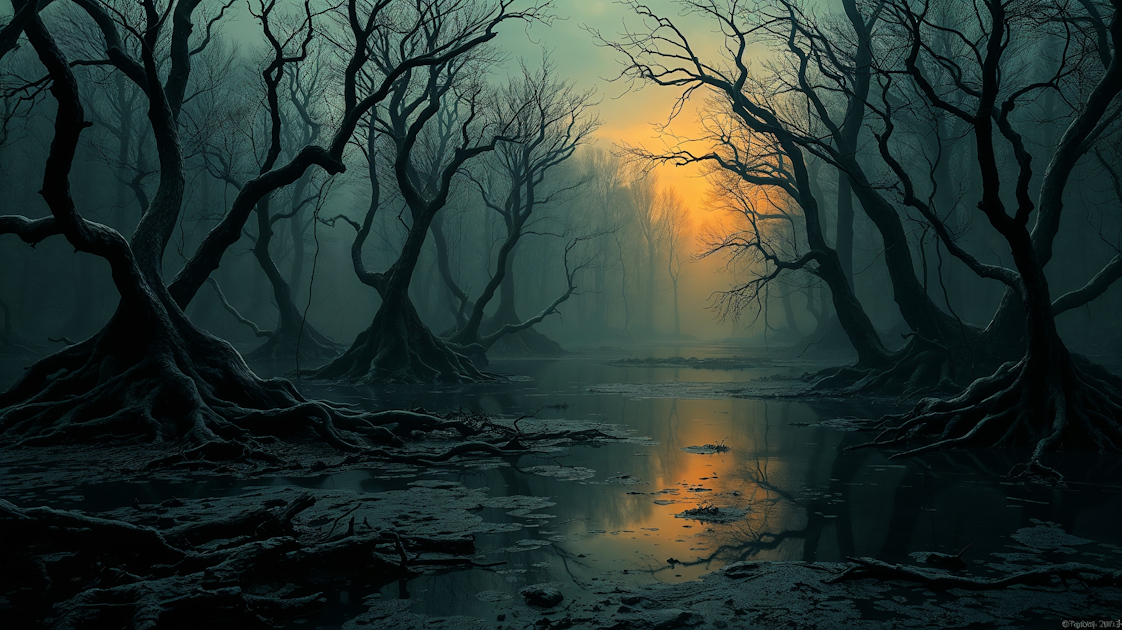
The Grimmere, known to outsiders as Death's Head Swamp, is a vast and treacherous wetland stretching across the lowlands between the eslar kingdom of Panthora and the Shadow Downs to the north, the Freelands to the west, the Hollow Hills to the south, and the Alderden Mountains to the east. Comparable in size to the Blackwood Forest, the Grimmere dominates its corner of the continent as an impenetrable morass of stagnant waterways, quickbogs, and dense thickets of gray swamp trees whose tangled canopies trap heat and moisture in an atmosphere so oppressively humid that even seasoned travelers find themselves gasping for breath within minutes of entering its borders.
Its name among the peoples of the Freelands and the Four Fiefdoms — Death's Head Swamp — speaks to the near certainty of death that awaits those who enter unprepared, and even the prepared rarely fare much better. Venomous serpents, disease-carrying insects, and predators both natural and unnatural thrive here in conditions that remain deadly to most other living things. The swamp's grim reputation is well earned, and no fiefdom, kingdom, or expedition has ever succeeded in imposing its will on the interior for longer than the swamp allowed.
That is because the Grimmere already has masters. The sitheri, the fierce serpentine race that has claimed the swamp as its homeland for millennia, are organized into ten territorial broods, each led by a brood mother who commands absolute authority over her tribe and each holding a distinct region of the wetlands. Beneath the murk lie older claims still: the ruins of Il'kell, an empyrean city drowned by the slow transformation of the land, whose vine-choked stone the sitheri regard as sacred ground. The Grimmere is at once sanctuary and fortress to those born to it, and to everyone else it is a wall of water, heat, and teeth.
Geography and Terrain
The Grimmere occupies a broad basin of lowland terrain hemmed in on every side by higher or harder country. The Shadow Downs and the eslar kingdom of Panthora define its northern limits, the Freelands press against it from the west, the Hollow Hills rise to the south, and the eastern margin runs up against the stone roots of the Alderden Mountains. Within those boundaries the swamp sprawls to a scale that rivals the Blackwood Forest, and the distances involved are a defense in themselves — no traveler crosses the Grimmere quickly, and few cross it at all.
Two rivers feed the swamp's sprawling interior. The Rotwater descends from the Shadow Downs through a series of silted channels before losing itself entirely in the wetlands, its current dissipating into a thousand shallow branches that no map has ever fixed with confidence. The Mireborn winds northward out of the Hollow Hills carrying mineral-rich runoff, and it is this water that gives portions of the swamp their characteristic brackish, iron-tinged quality. Together the two tributaries sustain an ecosystem as hostile as it is vast, replenishing the standing water that makes the Grimmere what it is while depositing the mineral loads that account for much of its stranger character.
The swamp is not uniform. Water that runs ink-black beneath the northern springs runs rust-red at the swamp's heart, green along its western drainage, and lightless in the flooded caverns below. The canopy that closes over the northern reaches into perpetual half-light gives way in the east to broken stone rising above the waterline, and in the south to bone-littered channels where the mud preserves what should long since have rotted away. Beneath all of it, ancient underground waterways connect flooded cave systems to subterranean lakes and rivers that surface miles from any visible part of the swamp. The Grimmere is better understood as ten distinct countries sharing a single hostile climate than as one continuous wetland.
Weather does the rest of the work. Storms that build over open water arrive already forceful and worsen as they interact with the swamp's humid air and irregular terrain, and lightning strikes the tallest trees with enough regularity that the oldest have been split and re-split into jagged silhouettes. Water levels shift with seasonal patterns, drowning landmarks and opening channels that did not exist a month earlier. Quickbogs form and reform without announcement. Ground that held weight in the morning may not hold it by evening, and this is not a hazard the Grimmere reserves for outsiders — it is simply how the swamp behaves.
The Ruins of Il'kell
Beneath the murk and mist lie the ruins of Il'kell, an ancient empyrean city that flourished thousands of years before the Age of the Old Gods, when the land was fertile and the climate hospitable. The slow transformation of the region into swampland claimed both the city and the civilization that built it, leaving behind miles of vine-choked stone, crumbling columns, and sealed laboratories that still hold secrets and dangers in equal measure. Whatever the empyreans were working toward when the water came for them, a portion of it is still down there, still sealed, and still waiting.
The ruins are considered sacred ground by the sitheri, and the protection they extend to Il'kell is not ceremonial. Trespassers who venture too close to the city's remains rarely live long enough to report what they find there, and the handful of accounts that have reached the Freelands and the Four Fiefdoms are fragmentary, contradictory, and impossible to verify. What is certain is that the Grimmere's most dangerous inhabitants regard the drowned city as worth dying over, which tells any prospective treasure-hunter most of what they need to know.
Read more about Il'kell.
The Sitheri Broods
The sitheri are the undisputed masters of the Grimmere. Cold-blooded predators uniquely adapted to the swamp's punishing conditions, they thrive in an environment that serves them as both sanctuary and fortress against the outside world, and their society is built around the absolute authority of the brood mother — spiritual leader, sole reproductive female, and unchallenged sovereign of her tribe. Ten broods share the swamp between them, each holding a distinct territory, each maintaining its own traditions, specializations, and claims.
Those claims are never settled for long. The broods have warred with one another across the whole of recorded sitheri history, and the borders between their territories shift with every campaign season. This perpetual internal conflict has prevented any single brood from achieving lasting dominance over the others, which has in turn prevented the sitheri from ever presenting a unified front to the world beyond the swamp. It has also kept every brood in a permanent state of military readiness. The outside world benefits from sitheri disunity far more than it realizes, and would find the alternative considerably less comfortable.
Each brood's character is inseparable from the ground it holds. The poison gardens of the Blackwater Reaches produced the Apis-aba as surely as the Apis-aba cultivated them; the stone of the Granite Reaches shaped the Cutho-ka; the storms of the Tempest Reaches and the Sish-pon who call them are, by the brood mothers' own accounting, not usefully distinguishable. The ten territories below are therefore as much a description of the sitheri themselves as of the swamp they inhabit.
Read more about the sitheri broods.
The Ten Reaches
The Grimmere is divided into ten territories, each held by a single brood and each defined by some feature of geology, water chemistry, weather, or history that sets it apart from everything around it. The boundaries between them are disputed constantly, but the character of each territory has proven far more durable than the lines drawn around it.
Abyssal Reaches
Held by the Okzimba-ma, the Deep Dwellers
Beneath the surface of the deepest-sinking terrain in the Grimmere, beyond the flooded root systems and the murky shallows that characterize most of Death's Head Swamp, the Abyssal Reaches descend into something that functions less like wetland and more like a gateway. Sinkholes open without warning into flooded cave systems of enormous extent. Springs rise from depths that instruments have never plumbed. The surface of the Reaches is deceptive in the way all the Grimmere is deceptive — still-looking water concealing constant movement, apparent ground proving anything but — but what sets this territory apart is what lies below. The Okzimba-ma brood has mapped cave networks here that extend for miles in multiple directions, connecting to underground seas and subterranean rivers that emerge in places far distant from any visible part of the swamp.
The Okzimba-ma have adapted to this three-dimensional territory over generations, developing physiological and cultural traits suited to extended underwater habitation in absolute darkness. Their surface presence is minimal and deliberately understated — the true extent of their territory, measured through the cave systems below, dwarfs what any visitor to the Abyssal Reaches could observe from above. The brood guards knowledge of the deeper network with extraordinary care, and for good reason: those tunnels represent not only their greatest defensive advantage but their primary trade routes and expansion corridors. What reaches the surface world from the depths of the Abyssal Reaches does so on Okzimba-ma terms, through Okzimba-ma channels, and only when the brood judges it advantageous to allow it.
Blackwater Reaches
Held by the Apis-aba, the Poison Speakers
The Blackwater Reaches occupy the northern stretches of the Grimmere, where mineral-laden springs push up through the swamp floor and taint the water a deep, opaque black. Toxic plants flourish in unusual abundance here — pitcher plants large enough to drown small animals, flowering vines whose pollen induces paralysis, root systems that leach lethal compounds into the soil — and the creatures that call these waters home have adapted accordingly, their bites and stings carrying venoms that resist common antidotes. The Apis-aba brood has claimed this territory for as long as the sitheri have held records, and the match between race and landscape is no coincidence. Generations of brood mothers have cultivated these resources deliberately, expanding poison gardens along the waterways and maintaining breeding populations of venomous creatures that serve as both weapon and raw material.
The Reaches take their name not from any single body of water but from the cumulative effect of dozens of mineral springs working across a wide basin — the black seeping outward from each source until it dominates the entire territory. Outsiders who have glimpsed the region from a distance describe the water as more like ink than swamp, still and lightless even in full sun. The Apis-aba exploit this quality without apology, using the darkness and the natural toxicity of their domain to conceal movement and discourage intrusion. Few who venture uninvited into the Blackwater Reaches understand what killed them. That is, by Apis-aba standards, exactly as it should be.
Conquest Reaches
Held by the Zaros-goz, the War Serpents
Where the Grimmere finally yields to solid ground along its western and southern margins, the swamp does not end so much as it negotiates — channels giving way to sodden earth, sodden earth to contested scrubland, scrubland to the borderlands where sitheri territory and the outside world have pressed against each other for centuries. The Conquest Reaches are defined by this friction. Unlike the deep interior regions of Death's Head Swamp, which discourage intrusion through environmental hostility alone, the Reaches sit at a threshold where traffic is inevitable and conflict is constant. Raiding parties push outward from the swamp's edge. Settlements beyond it build walls and train soldiers. The Zaros-goz brood has occupied this borderland since the earliest recorded ages of sitheri history, and their culture reflects every year of it.
The Zaros-goz philosophy holds that continuous warfare is not merely practical but sacred — a divine mandate received from Morghen the Hunter, expressed through the unbroken cycle of raid, conquest, and expansion that has defined their history. The Conquest Reaches serve this mandate well, providing an endless supply of enemies close enough to strike and terrain variable enough to demand tactical sophistication. The brood controls more territory than any other in the Grimmere, nearly a fifth of the swamp's total expanse, and their military forces are regarded as the premier fighting strength among all the sitheri tribes. That reputation was not inherited. It was built engagement by engagement across centuries of warfare in terrain where the only constant is that someone, somewhere nearby, is looking for a fight.
Crimson Marshes
Held by the Lusa-na, the Blood Dancers
At the heart of the Grimmere, where iron-rich water bleeds up through ancient geological formations and stains the pools a deep, unsettling red, the Crimson Marshes stretch across one of the most contested and predator-dense territories in all of Death's Head Swamp. The color is striking even by the swamp's grim standards — channels running rust-red between banks of dark sedge, the water thick with minerals that tint the mud and the hides of creatures who spend their lives wading through it. The constant struggle this environment demands has shaped the Lusa-na brood into the most purely combat-focused of all the sitheri tribes. In a territory where everything capable of motion is either hunting or being hunted, elegance in violence is not an aspiration but a prerequisite for survival.
The Lusa-na call their martial tradition the Blood Dance, and in the Crimson Marshes the name feels less metaphorical than it does elsewhere. The iron-red water that colors their home runs freely after every raid and every rite, the marshes absorbing the evidence of centuries of conflict without apparent limit. Warriors who earn their full status here bear the marks of that proving ground — scars layered over scales, movements shaped by years of fighting in terrain that punishes hesitation and rewards precision. Other sitheri broods respect the Lusa-na's reputation and treat their borders accordingly. The Crimson Marshes do not need walls.
Deepwater Reaches
Held by the Kel-kala, the Tide Hunters
Where other parts of the Grimmere reveal their depths through murky shallows and exposed root networks, the Deepwater Reaches plunge downward into something altogether more serious. Complex networks of channels cross the southeastern swamp at the surface, but beneath them, ancient underground waterways connect to river systems that flow for miles before emerging in subterranean lakes far beneath the Alderden Mountains. The Kel-kala brood has spent generations mapping these hidden corridors, developing techniques for extended underwater travel and deep navigation that no other race has come close to replicating. Their territory is, in a meaningful sense, larger than it appears — the surface channels are merely the entryway to an underwater domain that extends far beyond the visible swamp.
The Deepwater Reaches defy conventional territorial understanding. Water levels shift with seasonal patterns, obscuring landmarks that would otherwise anchor navigation, and the channels themselves branch and reconnect in configurations that appear chaotic until the underlying logic of current and gradient reveals itself. Kel-kala guides know the system as intimately as a smith knows a forge, reading flow patterns and pressure differentials to navigate without landmarks, emerging from hidden surfaces at distances that seem impossible to anyone without their knowledge. The brood has used this advantage well — both to expand their reach through the underground networks and to ensure that no enemy force can follow them home.
Granite Reaches
Held by the Cutho-ka, the Stone Serpents
Along the eastern margin of the Grimmere, where the swamp's endless water finally encounters the stone roots of older terrain, ancient geological upheavals left behind a broken landscape of rock outcroppings, hidden caves, and elevated ridgelines that rise above the bog in a series of natural platforms and escarpments. The Granite Reaches are the only part of Death's Head Swamp where solid ground and standing water exist in sustained tension, the stone forcing channels into convoluted paths while the water works perpetually at cracks and foundations. The Cutho-ka brood arrived here long ago and recognized the opportunity immediately: in a swamp that offered no high ground to anyone else, they had found it.
The Cutho-ka have spent centuries transforming those natural advantages into an integrated network of stone fortresses, carved tunnels, and concealed defensive positions that no other sitheri brood has succeeded in breaking. Their technique of "stone singing" — a practice combining engineering knowledge with ritualized attunement to the rock itself — allows them to identify weaknesses in natural formations and shore them up or exploit them as circumstances demand. The great fortress of Echoing Stones, carved directly into a massive granite outcropping above the waterline, has withstood multiple siege attempts without once yielding its gates. For any army hoping to move through the eastern reaches of the Grimmere, the Cutho-ka and their stone are the first problem — and often the last.
Ossuary Reaches
Held by the Saamnak-hut, the Bone Collectors
In the southwestern swamp, geology and history have conspired to create a landscape unlike anything else in the Grimmere. Ancient water chemistry and unusual mineral deposits preserve organic remains that would dissolve or sink elsewhere, and the region has served as a battlefield, a dumping ground, and a cemetery for so many centuries that the accumulated dead have become a geological feature in their own right. Bones jut from the mud at low water. Skulls surface after heavy rains. In the deeper channels, long stretches of the bottom are layered with skeletal remains from creatures and peoples whose names no living thing remembers. The Saamnak-hut brood calls this territory the Ossuary Reaches, and they have built their entire civilization on the understanding that the dead here are not gone — they are waiting.
The Saamnak-hut's practice of "death speaking" — communication with the spirits of the dead through ritual preparation and ceremonial use of their remains — finds its most fertile ground in the Ossuary Reaches, where the sheer density of preserved material means that the spiritual residue of centuries of conflict still echoes through the waterlogged soil. Their bone gardens are spread throughout the territory, some tended for the materials they yield and others maintained as sites of ongoing spiritual consultation. To outsiders, the Ossuary Reaches are a place of considerable dread; stories about what moves there after dark circulate through every settlement within three days' travel. To the Saamnak-hut, those stories are not warnings. They are the truth, stated plainly.
Tempest Reaches
Held by the Sish-pon, the Storm Callers
The geography of the Grimmere channels prevailing winds across its open stretches and funnels them through the dense canopy corridors of its interior, and nowhere does this produce more dramatic results than in the Tempest Reaches. Storms that build over open water arrive here already forceful and grow worse as they interact with the swamp's humid air and irregular terrain. Lightning strikes the tallest trees with enough regularity that many of the oldest have been split and re-split over centuries, their crowns opening into jagged silhouettes that have become landmarks in their own right. Waterspouts form over the wider channels during the most violent seasons. The Sish-pon brood has inhabited this territory throughout recorded sitheri history, and the question of whether their culture produced their storm-calling abilities or whether those abilities simply emerged from generations of living inside perpetual meteorological violence is one the brood mothers do not find particularly interesting. The storms are theirs. That is enough.
The Sish-pon's relationship with weather is not passive observation but active communion — a ritualized attunement to atmospheric forces that allows skilled practitioners to predict storm behavior with precision, influence intensity and direction within limits, and harness lightning and wind as weapons in both open combat and siege operations. The Storm Conquest of the early Age of Resilience, in which Sish-pon forces drove rivals from vast swamp territories through controlled weather deployment, established their military reputation in terms that have never required updating. Other broods negotiate access to the Tempest Reaches carefully and treat their agreements with the Sish-pon accordingly. A brood that can call a storm does not need to ask twice for respect.
Twilight Reaches
Held by the Shi-ono, the Shadow Weavers
In the northern stretches of the Grimmere, where the canopy grows dense enough to collapse the distinction between day and night, the Twilight Reaches exist in a state of perpetual grey half-light broken only by the slow drift of mist between the trunks. Ancient trees press together overhead in a canopy so complete that seasons register below only as gradations of darkness — lighter grey in summer, heavier grey in winter, the sun's position irrelevant beneath so many layers of leaf and limb. The Shi-ono brood has inhabited this territory long enough that the distinction between the sitheri and their environment has blurred into something difficult to articulate. They do not simply hide in the mist. They have learned to become it.
The Twilight Reaches reward patience and punish overconfidence with the same indifference. Trails that appear to lead toward solid ground loop back into open water. Stable-looking footing subsides without warning. Sounds carry strangely in the thick air, arriving from directions that don't match their source. The Shi-ono exploit every one of these qualities, using their intimate knowledge of the Reaches to move unseen through terrain that disorients anyone unfamiliar with it. Their intelligence networks extend well beyond the swamp's borders — Shi-ono operatives have been documented as far as the Four Fiefdoms — but the Twilight Reaches remain their anchor: a territory so thoroughly understood by its inhabitants that any intruder, however skilled, enters on borrowed time.
Verdant Reaches
Held by the Tul-anon, the Flesh Shapers
Along the western stretches of the Grimmere, where nutrient-rich water drains slowly through dense organic sediment and the swamp floor supports an almost extravagant density of life, the Verdant Reaches present a face unlike the rest of Death's Head Swamp. The water runs green here rather than black or red, thick with algae and suspended organic matter that feed cascading chains of life from the smallest invertebrates up through the largest predators. Plants grow in profusion and in variety — mosses, ferns, floating mats of vegetation, trees whose root systems descend through meters of saturated soil before finding purchase. The abundance is real, not illusory, and the Tul-anon brood has spent generations learning to exploit it in ways that would not occur to anyone without their particular obsessions.
The Tul-anon's mastery of biological manipulation — healing, physical enhancement, and the creation of new life forms through techniques they trace to visions received from Sythraxis the First Mother — finds its richest raw material in the Verdant Reaches. Creature cultivation programs run throughout the territory, some producing warriors, some producing laborers, some producing things with purposes known only to the brood mothers who commissioned them. The healing knowledge the Tul-anon have developed here is extensive enough that other broods seek their services even at the cost of negotiating with rivals, and their enhancement procedures have made their own warriors difficult to kill by any ordinary standard. The Verdant Reaches look, at first glance, like the gentlest part of the Grimmere. They are not. They are simply the part where the danger has been most thoroughly domesticated.
Dangers of the Grimmere
The Grimmere kills the unprepared with such reliability that the peoples of the Freelands and the Four Fiefdoms long ago stopped bothering with its proper name. Death's Head Swamp is not a poetic exaggeration but a practical warning, and the hazards behind it begin working on a traveler well before anything with teeth takes an interest. The heat and the trapped humidity beneath the canopy exhaust newcomers within minutes. Disease-carrying insects breed in every stagnant pool. Water that looks like standing shallows conceals quickbogs that take a body down without leaving a mark on the surface, and the mineral loads carried in from the Rotwater and the Mireborn render whole stretches of the swamp undrinkable to anything not born to them.
What follows the environment is worse. Venomous serpents and predators both natural and unnatural thrive in the Grimmere, and in the Blackwater Reaches, generations of deliberate Apis-aba cultivation have produced creatures whose venoms defeat common antidotes outright. Elsewhere the danger is stranger still — the Tul-anon's cultivated life forms in the west, whatever moves through the Ossuary Reaches after dark, and the sealed laboratories of Il'kell holding hazards no living scholar has catalogued. Above all of it, the swamp's weather can turn an ordinary crossing into a rout without warning, and in the Tempest Reaches that weather may not be acting on its own.
Then there are the sitheri themselves, who miss very little of what enters their territory. Even the prepared rarely fare much better than the reckless: preparation implies knowledge, and the knowledge required to survive the Grimmere is held almost exclusively by broods with no interest in sharing it. The practical result is that the swamp has never been mapped by outsiders, never been settled by them, and never been crossed by an organized force without severe cost. It stands as one of the most dangerous and inaccessible regions in all of Uhl, and it has stood that way for as long as anyone has been keeping records.
Conclusion
The Grimmere is a place that has swallowed a civilization and shaped another. Il'kell rose here when the land was fertile and the climate kind, and the swamp took the city and its builders with the patience of rising water. The sitheri arrived to a world already drowned and made it a homeland, adapting so completely to its poisons, its darkness, its storms, and its dead that the ten broods can no longer be understood apart from the ten territories that produced them.
What holds the Grimmere in balance is the same thing that makes it so dangerous: nothing in it rests. The broods war endlessly over borders that will move again next season. The channels rearrange themselves. The water rises and falls, exposing bone in one reach and drowning trails in another. No brood has ever achieved lasting dominance, and no outside power has ever come close enough to try.
To the peoples beyond its borders, Death's Head Swamp remains a blank space on the map with a warning written across it — a barrier that has held longer than most kingdoms have existed. To the sitheri, it is simply home: sanctuary and fortress both, hostile to everything that was not born to it, and theirs by every measure that has ever mattered to them.