THE GODS & HEROES OF UHL
Forces & Spirits of the Dryads
The Great Oak
The Great Oak is the supreme figure in dryad reverence—the first tree, the oldest living thing in Uhl, and the foundation upon which all else rests. It predates the Old Gods, the Green Mother, and Sylvana the Eternal, existing not as a deity that commands or communicates but as a vast, ancient consciousness whose awareness operates on a scale so immense that a single thought may take centuries to form. Dryads do not worship the Great Oak through ritual or prayer in the mortal sense; to them, it is less a god to be believed in than an axiom to be understood—as fundamental and unquestionable as the ground itself.
The Great Oak is believed to thread its consciousness through every tree in every forest across Uhl by way of a vast root network, absorbing the world’s unfolding history at a tempo no shorter-lived being can meaningfully comprehend. No dryad has ever claimed to have found it, and none has ever set out to search for it—for the search itself would miss the point. The Great Oak does not need to be found. It simply is, and in being, it sustains the deep pulse of life from which all fey existence ultimately flows.
Learn more about The Great Oak.
The Green Mother
The Green Mother is the second of the three great presences revered by the dryads, standing beneath the Great Oak and above Sylvana the Eternal in their ancient hierarchy. She is the origin and source of Earth Power—the fundamental energy that flows through soil, stone, and root, binding the living world to the ground from which it springs. Without her, there would be no fey magic, no dryads, and no life in the deep places where sunlight never reaches. Like the Great Oak, she predates the Old Gods by an immeasurable span, existing outside mortal theology entirely as something so elemental that comparison to the gods loses all meaning.
Earth Power radiates from the Green Mother the way light radiates from flame—not by conscious effort but as a natural consequence of her existence, pooling in some places more than others depending on the age and depth of the forest above. Dryads draw on this power constantly to sustain their magic, heal, and communicate through the root networks connecting their trees. The Green Mother herself is vaster and more remote than Sylvana—an elemental force that achieved consciousness, or perhaps a consciousness so ancient it has become indistinguishable from the element it inhabits. She has a will and personality, but these qualities exist at such magnitude that mortal minds can perceive only the nearest edge of them.
Learn more about The Green Mother.
Sylvana the Eternal
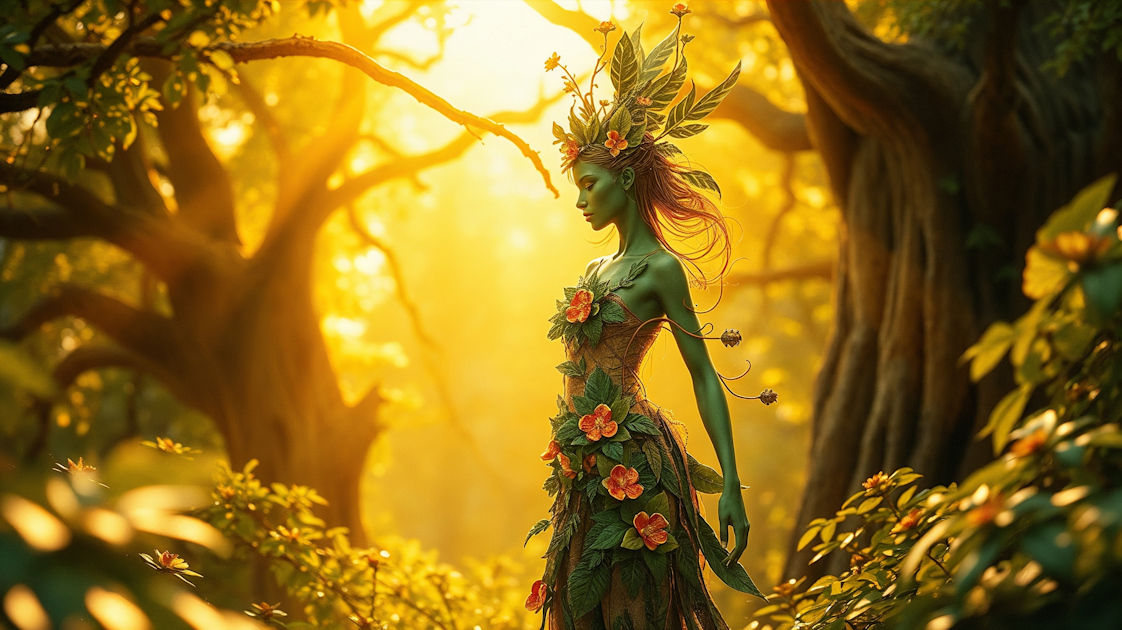
Sylvana the Eternal is the third and most immediately present of the three great spiritual figures of dryad reverence, standing beneath the Great Oak and the Green Mother in the ancient hierarchy of forces that govern fey existence. Unlike the Old Gods, whose dominion arose during a specific age and whose fall reshaped the mortal world, Sylvana predates that entire divine order. She is real—not a metaphor woven from oral tradition but a living, immortal being with a will, a personality, and a presence that can be felt by those fortunate enough to encounter her. Where the Green Mother gives life and the Great Oak provides the foundational consciousness of all forests, Sylvana serves as steward of what that creative power produces, walking the path of the cycle to ensure that all living things grow, flourish, decline, die, and return to nourish the world anew.
When Sylvana chooses to reveal herself, she appears as a radiant dryad—surrounded by a warm golden glow that emanates from within her, her features sharpened to a clarity that makes ordinary dryads seem muted by comparison. Her hair shifts between shades of green and gold with the turning of the seasons, and leaves and blossoms seem to grow from her very form, blooming and withering in a slow rhythm that mirrors the cycle she embodies. She appears when she is needed, offering guidance or simply a calming presence, and she is perhaps the only one of the three figures that dryads can ever truly hope to encounter face to face.
Learn more about Sylvana the Eternal.
Gods & Heroes of the Dwarves
Morden Fireforge
Morden Fireforge, known to the dwarven people as the Keeper of Flames, is the god of fire, the forge, and the transformative act of creation. Son of Grommara the Mother of Stone and brother of Rurik the Guardian of the Realm, Morden embodies the creative fire that turned raw stone and ore into the foundations of dwarven civilization. He is remembered not as a distant or inscrutable deity but as the most dwarven of gods—loud, boisterous, and perpetually blackened by soot and singed by sparks, a god who worked alongside his children rather than above them. The myths portray him drinking from cups of molten gold and throwing himself into every endeavor with the reckless confidence of one who believed that courage and skill could overcome any obstacle.
Born in an eruption that split a mountain in two and illuminated the underground world for the first time, Morden spent his divine existence crafting wonders and teaching his people the secrets of the forge. His death—a willing sacrifice to seal a catastrophic threat rising from the depths beneath the world—is considered the defining moment in dwarven mythology, a story that shapes how the dwarven people understand courage, selflessness, and the true meaning of craftsmanship. Every forge fire burning in the seven thanes is said to carry a faint ember of his essence, a claim that dwarves neither fully believe nor fully dismiss.
Learn more about Morden Fireforge.
Rurik
Rurik Shieldbearer, known to the dwarven people as the Guardian of the Realm, is the god of protection, vigilance, and the unyielding defense of home and kin. Where his brother Morden embodied the creative fire that gave the dwarves the power to build, Rurik embodied the patient, immovable strength that ensured what they built would endure. Shaped from the hardest granite of the world’s deepest foundations, he entered the world not with a spectacular eruption but in perfect silence—stepping from the stone fully formed, already scanning the horizon for threats that did not yet exist. His first instinct was to place himself between Grommara and whatever might come from beyond, and that protective resolve defined him from that moment forward.
Of the three dwarven gods, Rurik is perhaps the most quietly revered—lacking Morden’s boisterous charisma and the primordial mystique of Grommara, yet so deeply woven into the foundations of dwarven life that he is like the stone underfoot: unnoticed until the moment he is needed most. His death came during the cataclysm of the Fall of the Old Gods, when he stood at the threshold of the dwarven realm and held the line against cosmic destruction long enough for his people to seal their great doors against it. He did not survive. But the dwarves did, and to their way of thinking, that is exactly the outcome Rurik would have chosen.
Learn more about Rurik.
Gods & Heroes of the Krill
Nimala
Nimala the Swift, known as the Blade of the Canopy, is the krill goddess of speed, the hunt, and the killing stroke—the shadow that crosses the branch before the eye can follow, the silence between heartbeats where death lives. Among the gods of the krill Forest Pantheon, equals in standing and each governing a different facet of existence, Nimala holds a singular place in the hearts of her people. She is not the most comforting of their gods, nor the wisest, nor the most protective. She is the one they fear, and love, and strive to become. The krill do not worship her through supplication; they honor her by moving faster, striking harder, and refusing to show weakness before anything the forest can throw at them.
The krill tell Nimala’s origin not as a creation story but as a hunt story—because the krill understand everything through the lens of the hunt. She did not emerge from the Great Tree or descend from the sky; the oldest tellings hold simply that the world required a predator, and so a predator appeared, called into existence by the fundamental need of a living world for something that hunts and is never hunted. Unlike the dwarven gods, whose deaths are recorded in myths of spectacular sacrifice, Nimala’s fate remains unknown. When the Old Gods tore themselves apart in the cataclysm that ended their age, she simply vanished—no body, no final act, no last words. The krill take this as evidence of her survival, reasoning with characteristic bluntness that a goddess of speed would not be caught by anything so clumsy as an apocalypse.
Learn more about Nimala.