THE CALENDAR OF UHL
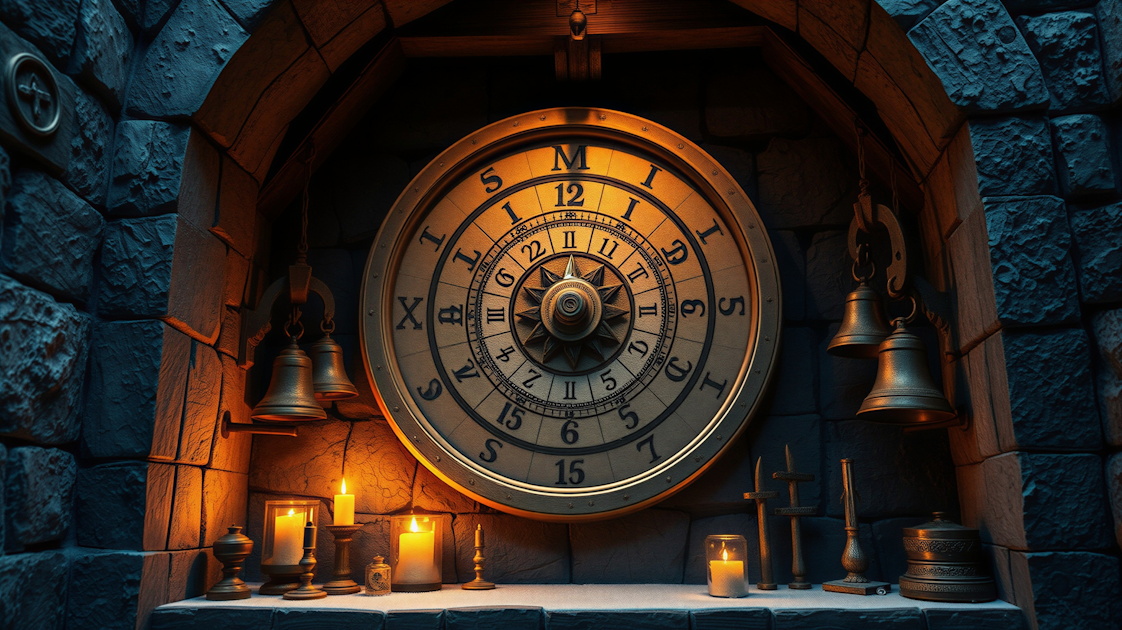
The peoples of the Four Fiefdoms share a single calendar: twelve months of thirty days, a seven-day week, and five Hollow Days at midwinter that belong to no month at all. Bells mark the hours, the moon marks the months, and every year is counted from the day the Old Gods destroyed themselves.
The dwarves, eslar, krill, sitheri, and Freelanders all know this calendar, and most of them trade by it. Among their own, though, each keeps time in its own way.
The Reckoning of Years
The Fall of the Old Gods was so devastating that it reset the world’s calendar. The year of the Fall is Year 0, and every year since is counted from it. The present day is Year 539.
Scholars divide that span into ages. A new age names a stretch of years without restarting the count. A formal date gives both, as in Year 539, Age of Advancement. Scholars and clerks shorten this to 539 AF, for After the Fall, and count backward from the Fall for older events, marking them BF.
- The Age of the Old Gods (before Year 0): Darshavon, the One Kingdom, under its high king.
- The Age of Resilience (Years 0–100): survival and rebuilding after the Fall.
- The Age of Change (Years 101–450): the Rise of the Four Fiefdoms and the long reshaping of Uhl.
- The Age of Advancement (Year 451 to the present): airships, alchemy, and the great cities.
For the full history, see The Ages of Uhl.
Months & Seasons
The month names come from the farmers’ almanacs of Vranna, the agricultural heartland. Kallendor’s printers carried them to every corner of the Four Fiefdoms. Each month runs thirty days, close to one cycle of the moon, and people often say “a moon” when they mean a month. The year turns at midwinter.
| # |
Month |
Season |
Character |
| — |
The Hollow Days |
Winter |
Five days that belong to no month; the Day of Remembrance falls on the third |
| 1 |
Rime |
Winter |
Hard frost and the new year’s first moon |
| 2 |
Thaw |
Winter |
Mud and swollen rivers; the dwarves keep the Day of the Mother |
| 3 |
Sowing |
Spring |
Planting begins, and Seacea’s sailing season opens |
| 4 |
Greentide |
Spring |
The Great Ride thunders across Kallendor’s plains |
| 5 |
Bloom |
Spring |
Orchards in flower; the favored month for weddings |
| 6 |
Highsun |
Summer |
Ends on Midsummer, the longest day of the year |
| 7 |
Ripening |
Summer |
Heat, fever season in the cities, and Anolga’s Trials of Strength |
| 8 |
Reaping |
Summer |
Harvest, ending with Reaping Home |
| 9 |
Gleaning |
Autumn |
The leavings gathered and the year’s accounts settled |
| 10 |
Emberfall |
Autumn |
Leaves turn, and masks come out for Nammarom’s Veil |
| 11 |
Frostfall |
Autumn |
First frosts; the mountain passes and the sailing season close |
| 12 |
Longnight |
Winter |
The dark month before the Hollow Days |
The calendar keeps true to the sun thanks to eslar astronomers, whose instruments transformed calendar-making across the known world.
Days of the Week
The seven days take their names from the temple calendar of Darshavon, when each day was sacred to a human god. The gods are gone, but the names stuck, worn smooth by five centuries of use. Few in Alchester could say who “Kal” was.
| Day |
Named For |
Custom & Superstition |
| Veshday |
Veesha, Goddess of the Sun and Stars |
The first working day. Shops open early, and debts and rents fall due. |
| Namsday |
Nammarom, god of the moon |
Night markets stay open late. Witches call it a fair night for their work. |
| Arksday |
Arkon, the Mad God of Inventors |
Guild day. Workshops show off new pieces, and Alchester’s patent clerks keep long hours. |
| Kingsday |
The High King of Darshavon |
Court and market day. The High King once heard petitions on Kingsday; now lords and magistrates do. |
| Kalday |
Kalthar, the God Between Shadows |
“Kalday’s debts are paid in the dark,” the old saying goes. Honest folk don’t walk alone after Last Bell. |
| Graveday |
Sarrengrave, God of Disease and Lord of Rot |
An unlucky day. No one marries, launches a ship, or opens a business on Graveday. Funerals and physicians’ rounds. |
| Stillday |
No god |
The day of rest. No god ever claimed it, and the old priests said even the gods rested. |
Kingsday is the only day named for a mortal. It kept its name after the last high king died at the Fall, because the lords of the Four Fiefdoms found the title useful. The weeks run straight through the months and pause for the Hollow Days, so the new year opens on a different weekday each year.
The Hollow Days
Between Longnight and Rime fall five days that belong to no month and no week. They have no names, only numbers: First Hollow through Fifth Hollow. Tradition holds that the Third Great War ended over five days, and these are the days the gods lost.
The bells of Alchester fall silent from First Hollow until dawn on Rime 1. With no towers ringing the hours, people tell time by candle, clock, or guesswork, and someone “lost in the Hollow” has no idea what day or hour it is. Courts don’t sit, and most work stops. Any contract signed during the Hollow Days is void, which makes these days popular with swindlers.
The third Hollow Day is Midwinter, the longest night of the year and the anniversary of the Fall. All four Fiefdoms keep it as the Day of Remembrance, lighting memorial fires and reciting genealogies. In every dwarven thane, the same night brings the Vigil of the Guardian, held in near silence for Rurik Shieldbearer, who died holding the line at the Fall.
Some years bring the Midwinter Rift as well, a night when the barriers between worlds grow thin. Its timing is irregular, and only the most gifted soothsayers can predict it. Common folk believe it most likely to strike during the Hollow Days, though it has come weeks before or after them.
At dawn on Rime 1, every bell tower rings twelve together. Firstlight is the loudest morning of the year in Alchester, and the new year begins with it.
Telling the Time
A bell is an hour. Every tower in a city rings the count each hour, one through twelve, twice a day, so an appointment is made for “four bells,” and a short wait lasts “half a bell.” Smaller spans are quarter bells and minutes.
Whether four bells falls in the afternoon or the dark of night is usually plain from context. When it isn’t, people say “four bells of the afternoon” or “two bells past midnight.” The hours after midnight are called the small bells. Three bells carry names of their own:
- First Bell rings at six in the morning, when the city gates open and work begins.
- High Bell rings at noon.
- Last Bell rings at ten at night, when the gates close and the watch changes. Nothing good happens after Last Bell.
In the Age of Advancement, clockwork timepieces are common aboard airships, in guild halls, and in wealthy homes. Their owners still read them in bells: the clock shows “a quarter past four bells.”
Festivals of the Four Fiefdoms
Each of the Four Fiefdoms keeps its own festivals, shaped by its land and history, and a few are shared by all.
| Festival |
Kept By |
When |
Custom |
| Day of Remembrance |
All four Fiefdoms |
Third Hollow |
The anniversary of the Fall and the death of the last king, marked with memorial fires and the recitation of genealogies |
| Firstlight |
All four Fiefdoms |
Rime 1 |
Every bell tower rings twelve together at dawn to open the new year |
| Blessing of the Tides |
Seacea |
Sowing 1 and Frostfall 1 |
Opens and closes the sailing season |
| Festival of Flowing Waters |
Vranna |
Sowing |
Boat processions and water ceremonies while the thaw rivers run high |
| The Great Ride |
Kallendor |
Greentide |
Horse races and cavalry displays that can last for weeks |
| Festival of First Flight |
Kallendor |
Bloom |
Honors Sir Aldric’s maiden voyage in the Steppe Walker, Kallendor’s first airship |
| Midsummer |
All four Fiefdoms |
Highsun 30 |
Hilltop bonfires on the longest day; country folk still call it Veesha’s Crown |
| Trials of Strength |
Anolga |
Ripening |
Contests of strength, heavy drinking, and storytelling |
| Reaping Home |
Vranna and Kallendor |
Reaping 30 |
The last sheaf is carried through town and burned at midnight |
| Nammarom’s Veil |
The cities, Alchester above all |
First full moon of Emberfall |
Masks, lanterns, and a night market; witches count it a night of power |
Other Reckonings
The Dwarven Thanes
The dwarves count their years from the Sealing, the three days Rurik Shieldbearer held the threshold while the great doors of the thanes ground shut. The Sealing fell in the same year as the Fall, so 539 is also the 539th year of the Sealing. Their seven-day week is called a hammer, and each day carries the name of a thane. With no sun underground, the forge bells start the working day and divide it into three eight-hour shifts: Forge, Anvil, and Ash.
The year’s great observances are the Day of the Mother for Grommara at the start of spring, when meltwater seeps into the deep wells; the Festival of Flames for Morden Fireforge; the Vigil of the Guardian on the longest night; and the Festival of the Deep Earth in autumn, in thanks for the year’s bounty. See The Dwarven Thanes.
Panthora
The eslar keep the common count of years with an observatory’s precision, and they divide each hour into hundredths. They number their days rather than name them, because they regard god-named days as superstition. Panthora’s week-long Festival of Knowledge falls on the anniversary of the Great Cleansing. See Panthora.
The Krill
The krill keep no count of years. Their year follows the forest, opening with the Spring Awakening and passing through Summer Canopy, Autumn Preparation, and Winter Reflection. They remember a year by what happened in it, and speak of time in moons. The Unali tribe keeps the krill’s astronomical calendars.
Three nights stand above the rest: the Gathering of Leaves for Velania at the height of the growing season, the Night of Swift Shadows for Nimala on the darkest new moon of autumn, and Sentinel’s Night for Thyrkos at the onset of winter. See Tribes of the Krill.
The Sitheri Broods
In the Grimmere Swamp, the year turns on the wet season and the dry season. Long stretches of time are counted in floods, and eras take the names of the brood mothers who ruled them. The Night of the First Hunt opens the wet season in Morghen’s name, the Dark Tide marks the lowest water of the dry season for Sythraxis, and the Night of Counting honors the dead in Vexthul’s name during the coldest stretch of the year. See The Sitheri Broods.
The Freelands
Freelanders refuse to name their days for gods or kings, so they number them, Firstday through Seventhday. They count their years from the Oath of Independence, sworn at High Holt in Year 23, which makes 539 the 516th year of the Oath. Each year on Oath Day, representatives from across the Freelands gather at High Holt to renew the Oath in Gareth Ironhand’s own words. See The Freelands.
The Skeva and the Raspel
The skeva count their years from the Scattering, when Ulusaba’s subjects fled and built a civilization of their own. The raspel mark their history by their own eras, the Time of Integration and the Modern Era. See Skeva and Raspel.